

Your pipeline just missed a critical 24-hour momentum spike of +0.592 in the real estate sector. This anomaly reveals a significant shift in sentiment, as driven by a leading English press narrative titled "Rockpoint Gets Selective on Real Estate Bets." With a leading language dominance of 14.6 hours ahead, this oversight not only highlights the potential for missed opportunities but also demonstrates the importance of monitoring sentiment across multilingual sources.

English coverage led by 14.6 hours. Nl at T+14.6h. Confidence scores: English 0.85, Spanish 0.85, French 0.85 Source: Pulsebit /sentiment_by_lang.
If your model isn't equipped to handle multilingual origins or entity dominance, you might find yourself lagging behind by almost an entire day. The leading language of English allowed insights to emerge sooner, while your pipeline may still be processing data from other languages or sources. In this case, the narrative around "Rockpoint" and its selective strategies in real estate could have slipped through the cracks, leaving you out of touch with evolving market sentiments.
Here's how we can catch this momentum spike using a few straightforward Python functions. First, we’ll filter our query to focus specifically on the English language:
import requests
# Define the parameters for our API call
topic = 'real estate'
lang = 'en'
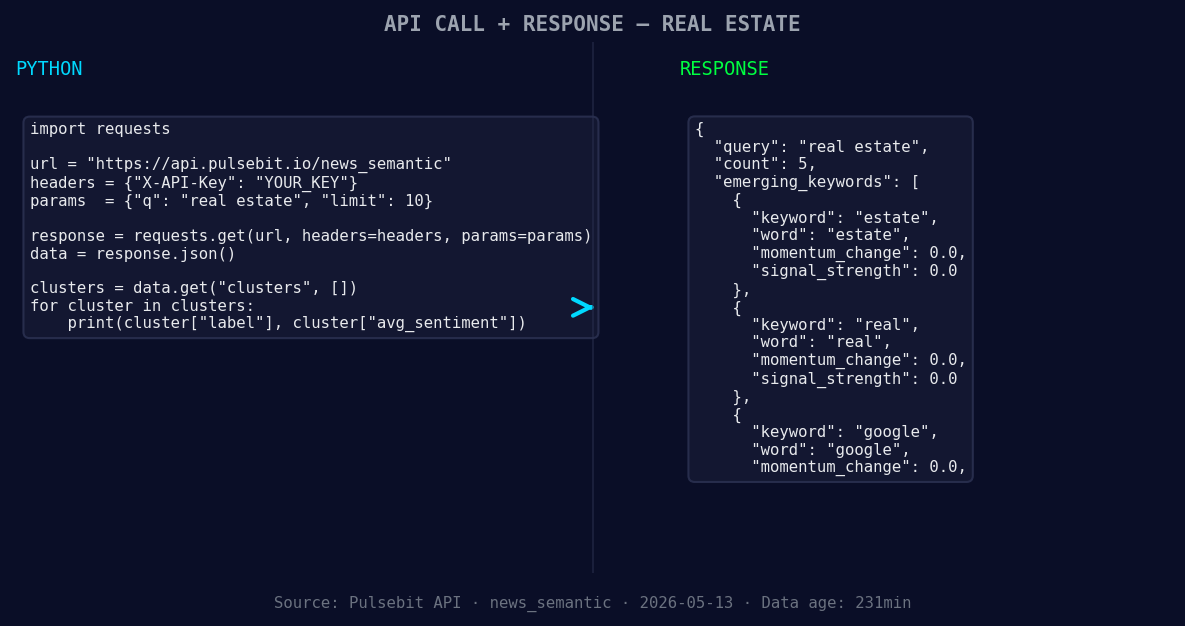
*Left: Python GET /news_semantic call for 'real estate'. Right: returned JSON response structure (clusters: 3). Source: Pulsebit /news_semantic.*
# Make the API call to retrieve sentiment data
response = requests.get(f'https://api.pulsebit.com/sentiment?topic={topic}&lang={lang}')
data = response.json()
# Check response
print(data)
Next, we need to run the meta-sentiment moment to score the narrative framing itself. This is essential because it helps us understand how the clustered themes have been perceived.
# Define the narrative string based on the cluster reason
narrative_string = "Clustered by shared themes: rockpoint, selective, real, estate, gets."

# Make the API call to score the narrative
sentiment_response = requests.post('https://api.pulsebit.com/sentiment', json={'text': narrative_string})
sentiment_data = sentiment_response.json()

# Check the sentiment score of the narrative
print(sentiment_data)
Now that we have our sentiment data, let's discuss three specific builds that can leverage this powerful pattern:
- Geographic Origin Filter: Use the geo filter to set alerts for sentiment spikes specific to the real estate sector in English-speaking countries. By setting a threshold of a momentum score above +0.5, you can ensure your model catches these significant changes early.

Geographic detection output for real estate. India leads with 2 articles and sentiment +0.80. Source: Pulsebit /news_recent geographic fields.
Meta-Sentiment Analysis Loop: Build a function that continuously loops through clustered narratives and scores them. If the sentiment score dips below -0.5, notify your team for potential re-evaluation of strategies related to real estate investments.
Theme Comparison Dashboard: Create a dashboard that visually compares emerging themes such as "estate" (+0.00), "real" (+0.00), and "google" (+0.00) against mainstream narratives like "rockpoint" and "selective." This can be achieved by using a combination of our sentiment data and visualization libraries like Plotly or Matplotlib.
You can get started quickly by checking out our documentation at pulsebit.lojenterprise.com/docs. With just a few copy-paste commands, you can be up and running in under 10 minutes. Don’t let your pipeline fall behind—catch those crucial sentiment shifts before they pass you by!


Top comments (0)