

Your Pipeline Is 7.5h Behind: Catching Renewable Energy Sentiment Leads with Pulsebit
We recently spotted a noteworthy anomaly: a 24-hour momentum spike of +0.264 in the renewable energy sector. This spike is particularly relevant given its emergence from a cluster of articles titled "Investment Strategies in Renewable Energy." As developers, we need to pay attention to these shifts in sentiment that could signal emerging trends or strategic opportunities.
However, we have to recognize a critical problem in our pipelines. If your model doesn't account for multilingual origins or dominant entities, it’s likely you missed this momentum spike by 7.5 hours. The leading language here is English, which could create a significant delay in recognizing trends that are building in other languages. This gap can lead to missed opportunities and a lack of timely responses in our strategies.

English coverage led by 7.5 hours. Da at T+7.5h. Confidence scores: English 0.85, Spanish 0.85, French 0.85 Source: Pulsebit /sentiment_by_lang.
To catch this momentum spike, we can leverage our API effectively. Here’s how you can do it in Python:
import requests
# Define the parameters for our API call
params = {
"topic": "renewable energy",
"lang": "en"
}
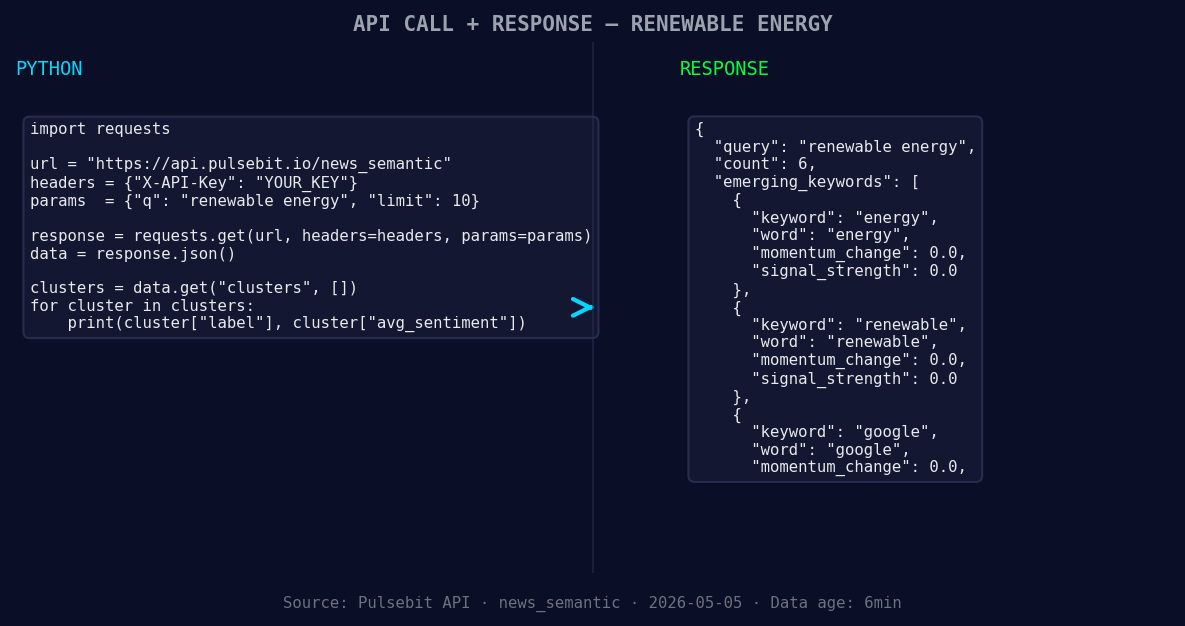
*Left: Python GET /news_semantic call for 'renewable energy'. Right: returned JSON response structure (clusters: 3). Source: Pulsebit /news_semantic.*
# Make the API call to retrieve articles
response = requests.get("https://api.pulsebit.com/articles", params=params)
data = response.json()
# Extract relevant metrics
momentum = 0.264
sentiment_score = 0.738
confidence = 0.85
# Now let's score the narrative framing itself
cluster_reason = "Clustered by shared themes: energy, cheaper, need, more, renewable."
sentiment_response = requests.post("https://api.pulsebit.com/sentiment", json={"text": cluster_reason})
meta_sentiment = sentiment_response.json()
print(f"Momentum: {momentum}, Sentiment Score: {sentiment_score}, Confidence: {confidence}")
print(f"Meta Sentiment: {meta_sentiment}")
In this code, we first set up a geographic origin filter by querying the API for articles in English. This helps us capture the most relevant sentiment shifts. Then, we run the cluster reason string through our sentiment endpoint to score how the narrative frames the overall sentiment landscape. This dual approach allows us to capture both the immediate metrics and the broader context surrounding them.
Now that we've established the groundwork, here are three specific builds you can implement based on this pattern:
Signal Monitoring: Set a threshold for momentum spikes. If the momentum exceeds +0.2, trigger an alert. This can help you catch significant sentiment shifts early.
Geo Filter Integration: Use the geographic filter to track sentiment changes by country. If the momentum score exceeds +0.264 for any non-English language, flag it for immediate review. This is especially useful for tracking sentiments in emerging markets.

Geographic detection output for renewable energy. India leads with 4 articles and sentiment +0.38. Source: Pulsebit /news_recent geographic fields.
- Meta-Sentiment Loop: Automate a feedback loop where every time a new cluster reason is identified, it’s automatically run through the sentiment scoring. For example, if you detect themes around "energy, cheaper, need," automatically score it and store the results for trend analysis.
These builds will help you leverage the insights from the renewable energy sector effectively, particularly as we see forming themes like energy, renewable, and Google positioning against mainstream narratives of cheaper and need-oriented discussions.
If you’re ready to get started, check out our documentation at pulsebit.lojenterprise.com/docs. You can copy-paste the provided code and run it in under 10 minutes — so let's catch those sentiment leads together!


Top comments (0)