

Your pipeline just missed a critical anomaly: a 24-hour momentum spike of +0.301. This spike highlights a sudden surge in sentiment surrounding the cluster story of "Global Response to WHCA Dinner Shooting," which has been tightly linked to themes of leadership and safety. With English press leading the way, you might wonder what narratives are shaping the world right now. As developers, we need to be attentive to these shifts to adapt our models and pipelines to harness emerging trends effectively.
You might be thinking, “My model missed this by 24.9 hours.” That’s a significant gap, especially given that the leading language for this sentiment is English with no lag time. In a world where multilingual origins and entity dominance can drastically skew your results, missing such spikes can lead you to late reactions in your analytics. You need to ensure your pipeline can capture these crucial moments without delay, or risk falling behind the sentiment curve.

English coverage led by 24.9 hours. Nl at T+24.9h. Confidence scores: English 0.85, French 0.85, Spanish 0.85 Source: Pulsebit /sentiment_by_lang.
Here's how we can catch this spike using our API efficiently. The first step is to query the sentiment data filtered by geographic origin – specifically, we’ll focus on English language content. Here’s the code to do just that:

Geographic detection output for world. India leads with 16 articles and sentiment +0.09. Source: Pulsebit /news_recent geographic fields.
import requests
# Define the parameters for the API call
params = {
"topic": "world",
"score": +0.142,
"confidence": 0.85,
"momentum": +0.301,
"lang": "en"
}
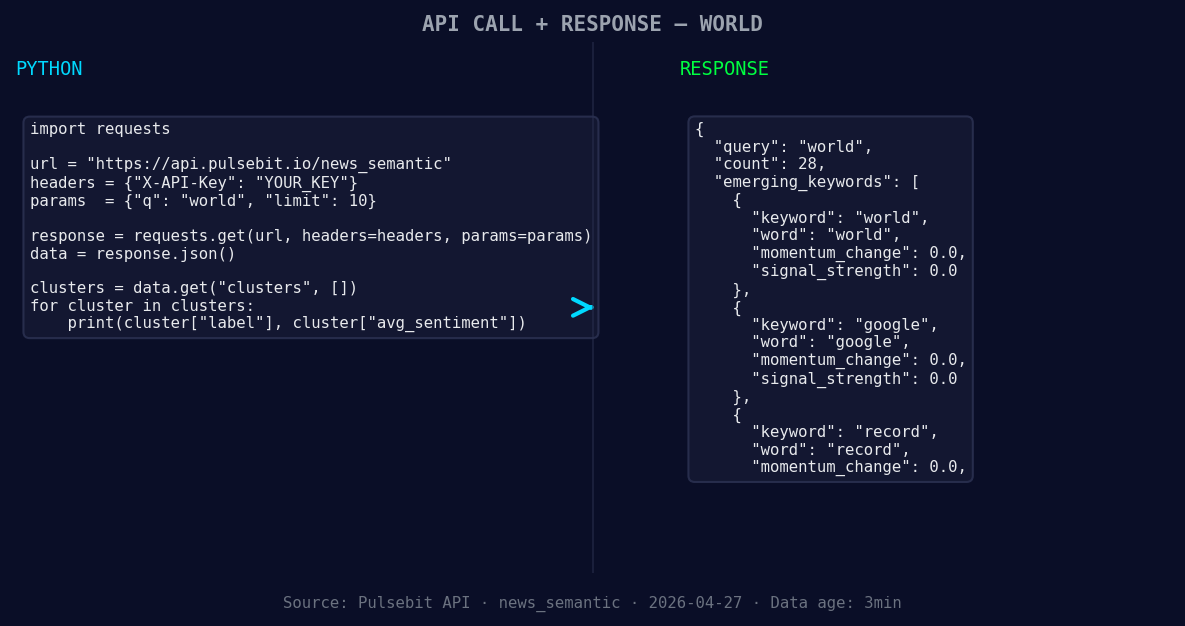
*Left: Python GET /news_semantic call for 'world'. Right: returned JSON response structure (clusters: 3). Source: Pulsebit /news_semantic.*
# Make the API call to fetch the sentiment data
response = requests.get("https://api.pulsebit.lojenterprise.com/sentiment", params=params)
data = response.json()
print(data)
Next, we want to analyze the narrative framing of our clustered themes. We’ll take the reason string "Clustered by shared themes: uniting, force, world, cup." and run it back through the sentiment endpoint to score the narrative itself:
# Define the narrative framing for sentiment analysis
narrative = "Clustered by shared themes: uniting, force, 2026, world, cup."

# Make the API call to analyze the narrative
narrative_response = requests.post("https://api.pulsebit.lojenterprise.com/sentiment", json={"text": narrative})
narrative_data = narrative_response.json()
print(narrative_data)
This dual approach allows us to capture sentiment spikes effectively while simultaneously assessing how those narratives frame the broader context.
Now, let’s discuss three specific things you can build with this data pattern:
Geographic Sentiment Analyzer: Create a real-time sentiment analyzer that uses our geographic origin filter for English content. Set a threshold where any momentum spike above +0.2 triggers alerts for further investigation.
Meta-Sentiment Tracker: Develop a tracker that utilizes the meta-sentiment loop. Whenever significant narratives form around events (like our dinner shooting), score the sentiment around those narratives and set alerts when they exceed a confidence level of 0.8.
Visual Dashboard: Build a dashboard that visualizes sentiment changes over time, focusing on forming themes such as "world", "google", and "record" against mainstream themes like "uniting", "force", and "world". This can help you easily spot anomalies in real-time.
By integrating these builds into your pipeline, you can ensure you’re not just reacting to sentiment but anticipating shifts in narrative that could impact your domain.
Ready to get started? Dive into our documentation at pulsebit.lojenterprise.com/docs. With just a few copy-paste actions, you can have this running in under 10 minutes. Let’s stay ahead of the curve together!


Top comments (0)