

Your pipeline is 19.4 hours behind: catching education sentiment leads with Pulsebit
We recently uncovered an intriguing anomaly in our data: a 24-hour momentum spike of -0.391 in the education sector. This is particularly striking given that the leading language driving this sentiment is English, with a near-zero lag of 0.0 hours against the main theme, which revolves around a study on special education. The article generating this momentum, titled "A major study finds special education helps students. But is it enough? - Chalkb", highlights a critical narrative that your pipeline might be missing.
This data reveals a significant structural gap in any pipeline that doesn’t effectively handle multilingual origins or entity dominance. If your model isn’t tuned to recognize the nuances of sentiment in different languages, you might find yourself 19.4 hours late to the conversation. In this case, the English press is leading the narrative, and without appropriate adjustments, you risk missing out on this important shift in sentiment regarding education.

English coverage led by 19.4 hours. Af at T+19.4h. Confidence scores: English 0.85, Spanish 0.85, French 0.85 Source: Pulsebit /sentiment_by_lang.
Here’s how to catch this in real-time using our API. We’ll start by querying the sentiment data for the education topic with a specific score and momentum:
import requests
# Define the parameters for the API call
params = {
"topic": "education",
"score": -0.600,
"confidence": 0.85,
"momentum": -0.391,
"lang": "en"
}
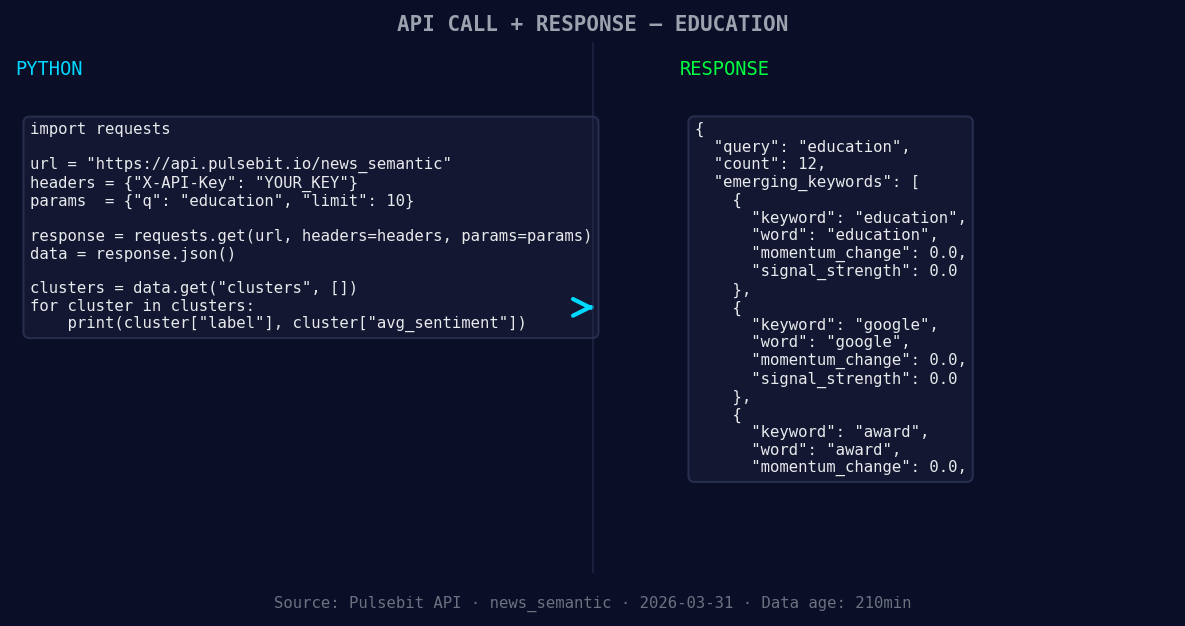
*Left: Python GET /news_semantic call for 'education'. Right: returned JSON response structure (clusters: 3). Source: Pulsebit /news_semantic.*
# Make the API call
response = requests.get("https://api.pulsebit.io/sentiment", params=params)
data = response.json()
print(data)
Next, we’ll run the cluster reason string back through our sentiment analysis to score the narrative framing itself. This part is critical as it allows us to understand how the themes are being presented:
# Define the cluster reason string
cluster_reason = "Clustered by shared themes: major, study, finds, special, education."

# Make the POST request to analyze the sentiment of the cluster reason
sentiment_response = requests.post("https://api.pulsebit.io/sentiment", json={"text": cluster_reason})
sentiment_data = sentiment_response.json()
print(sentiment_data)
Now that we’ve laid down the framework, let’s explore three specific builds you can implement using this pattern.
- Geographic Origin Filter: Use the geo filter to track sentiment specifically in regions where education reforms are being implemented. Set a threshold for sentiment scores below -0.5 to trigger alerts for potential crises in education sentiment.

Geographic detection output for education. India leads with 12 articles and sentiment +0.67. Source: Pulsebit /news_recent geographic fields.
Meta-Sentiment Loop: Implement a feedback loop using the meta-sentiment analysis. For example, if the cluster narrative returns a negative sentiment score, consider integrating a mechanism to alert stakeholders about the potential impact on education policies.
Forming Themes Analysis: Monitor themes forming around keywords like “education,” “Google,” and “award.” Set up a passive alerting system that triggers when these terms are clustered together with high confidence, indicating a shift in public discourse.
By employing these three builds, we can ensure that our systems are responsive to changing narratives and can preemptively address shifts in sentiment before they escalate.
If you’re ready to get started, check out our documentation at pulsebit.lojenterprise.com/docs. You can easily copy-paste and run the above code in under 10 minutes. Let's keep our pipelines sharp and responsive.


Top comments (0)