

Your Pipeline Is 18.5h Behind: Catching World Sentiment Leads with Pulsebit
We just spotted an interesting anomaly in our data: a 24h momentum spike of +0.684. This spike isn't just a number; it signifies a significant shift in sentiment around the topic of the "world." This discovery stems from the recent cluster of articles reporting on a humanoid robot breaking the half marathon world record in Beijing. While this trend is emerging, there's a catch: our analysis indicates that English press coverage is lagging by 18.5 hours compared to German sources.
The gap here highlights a critical flaw in any pipeline that fails to account for multilingual sources and entity dominance. Your model may have missed this momentum by 18.5 hours, which means you could be missing out on capturing a significant sentiment trend just because it wasn’t prioritized correctly. This is especially relevant when we consider that the leading language in our findings is English, while the breaking news was spearheaded in German.

English coverage led by 18.5 hours. German at T+18.5h. Confidence scores: English 0.85, French 0.85, Spanish 0.85 Source: Pulsebit /sentiment_by_lang.
To catch this spike in sentiment effectively, we can use our API to filter and score the relevant data. Here’s how you can implement it in Python:
import requests
# Define the API endpoint and parameters
endpoint = "https://pulsebit.lojenterprise.com/sentiment"
params = {
"topic": "world",
"score": +0.012,
"confidence": 0.85,
"momentum": +0.684,
"lang": "en" # Geographic origin filter
}
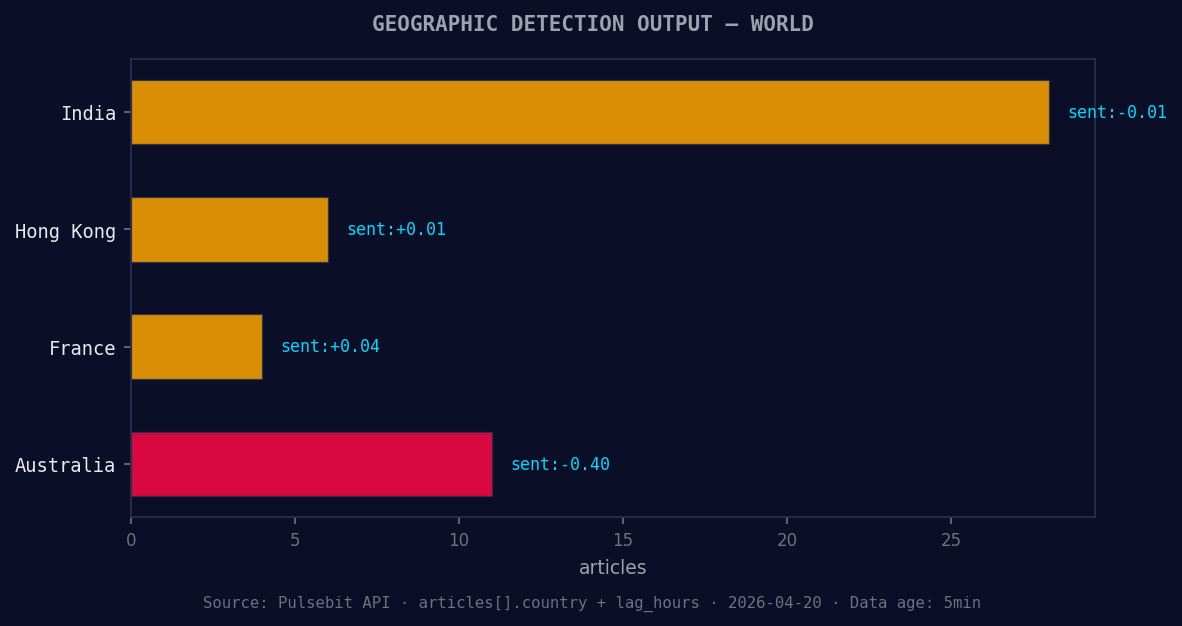
*Geographic detection output for world. India leads with 28 articles and sentiment -0.01. Source: Pulsebit /news_recent geographic fields.*
# Perform the API call to fetch sentiment data
response = requests.get(endpoint, params=params)
sentiment_data = response.json()
print(sentiment_data)
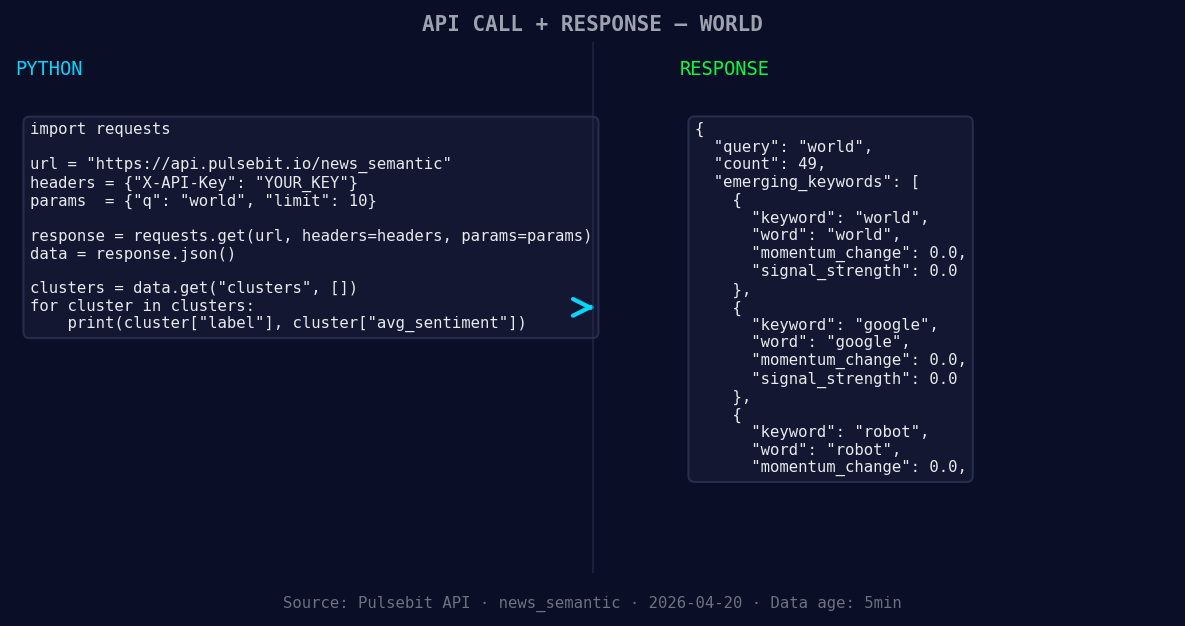
*Left: Python GET /news_semantic call for 'world'. Right: returned JSON response structure (clusters: 3). Source: Pulsebit /news_semantic.*
# Now, let's run the cluster reason string through the sentiment API
cluster_reason = "Clustered by shared themes: administration, warms, imf, world, bank."
response_meta = requests.post(endpoint, json={"text": cluster_reason})
meta_sentiment_data = response_meta.json()
print(meta_sentiment_data)
In this code, we first set the parameters for our sentiment analysis, including the geographic origin filter to focus on English-language articles. We then make a GET request to fetch the sentiment data. Following that, we take the cluster reason string and run it through the sentiment API to score the narrative framing itself. This dual approach ensures that we not only capture the sentiment around the topic but also evaluate how the narrative is constructed, which is critical for understanding the underlying trends.
Now, let’s discuss three specific builds you can implement with this pattern:
Sentiment Alert System: Set a threshold for momentum spikes, say +0.5, and trigger alerts when this is detected, using the geo filter to focus on English articles. This will help you catch emerging trends early.
Meta-Sentiment Insights: Create a dashboard that regularly pulls cluster reasons and scores them using our meta-sentiment loop. This way, you can visualize how narratives evolve over time, especially around high-scoring themes like "robot" and "world."
Comparative Analysis Tool: Build a tool that compares sentiment trends between languages, focusing on the themes forming in English versus German. This could highlight significant delays in coverage and provide actionable insights on where to focus your monitoring efforts.
By leveraging these builds, you can stay ahead of trends and ensure your sentiment analysis pipeline captures the most relevant data, regardless of language or origin.
For a deep dive into how to start implementing these strategies, check out our documentation at pulsebit.lojenterprise.com/docs. You can copy-paste the provided code and run it in under 10 minutes, making it easy to integrate these insights into your workflow.


Top comments (0)