

Your Pipeline Is 14.2h Behind: Catching Tech Sentiment Leads with Pulsebit
We recently observed a striking anomaly: a 24h momentum spike of +0.805 in tech sentiment. This spike surfaced alongside a cluster of narratives led by the Spanish press, particularly around the story “Lights, camera, traction: film-projecting headlights steer China’s EV feature fi.” With a lead time of 14.2 hours, this indicates that important sentiment shifts can go unnoticed in your pipeline if it doesn't manage multilingual origins effectively.

Spanish coverage led by 14.2 hours. So at T+14.2h. Confidence scores: Spanish 0.75, English 0.75, French 0.75 Source: Pulsebit /sentiment_by_lang.
When you think about it, your model might have missed this significant shift by over half a day. That’s a substantial lag when you consider that the leading narrative was driven by a specific language—Spanish in this case. If your pipeline doesn’t handle multilingual data, you’re likely losing out on critical insights that can shape your strategies.
To help you catch these leads in real-time, we can utilize our API effectively. Here’s how you can do that with a simple Python snippet.
import requests
# Define the parameters for the API call
topic = 'tech'
score = +0.050
confidence = 0.75
momentum = +0.805
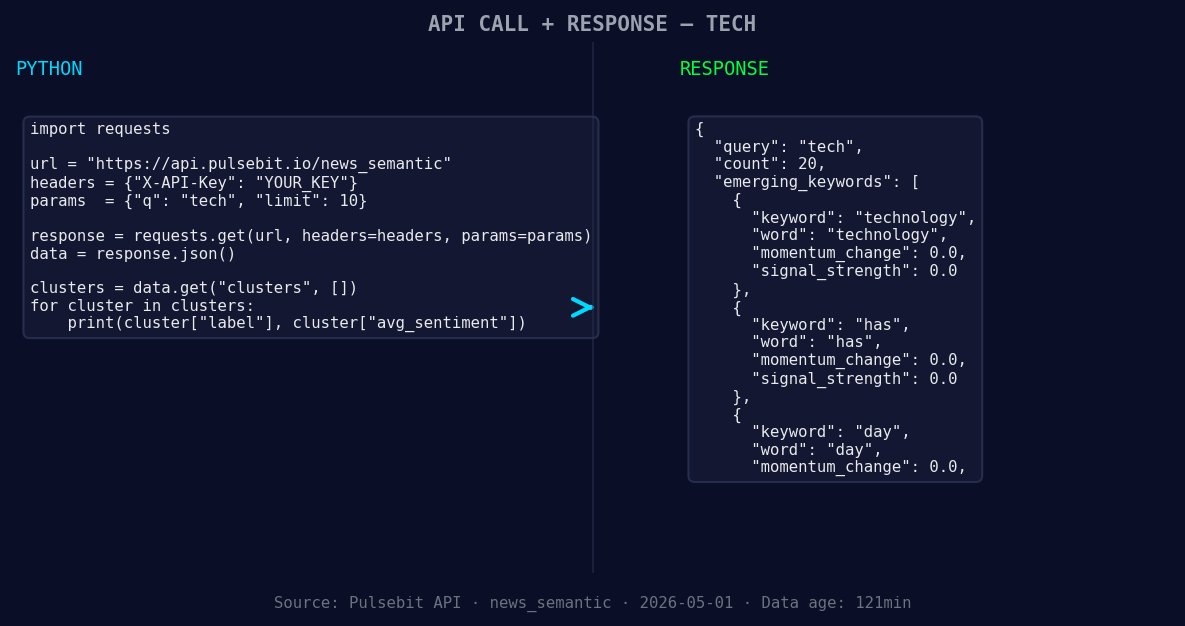
*Left: Python GET /news_semantic call for 'tech'. Right: returned JSON response structure (clusters: 3). Source: Pulsebit /news_semantic.*
# Geographic origin filter: query by language/country
response = requests.get(
'https://api.pulsebit.com/data',
params={
'topic': topic,
'momentum': momentum,
'lang': 'sp',
'score': score,
'confidence': confidence
}
)
data = response.json()
print(data)
Next, let’s run the cluster reason string through our sentiment analysis endpoint to score the narrative framing itself. This step is crucial to understand the sentiment behind the themes driving our spike.
# Meta-sentiment moment: scoring the narrative framing
narrative_string = "Clustered by shared themes: headlights, china’s, lights, camera, traction:."
sentiment_response = requests.post(
    'https://api.pulsebit.com/sentiment',
    json={'text': narrative_string}
)

sentiment_data = sentiment_response.json()
print(sentiment_data)
By applying both the geographic filter and scoring the narrative, we can gain a deeper understanding of the sentiment landscape around tech narratives, particularly those emerging from non-English sources.

Geographic detection output for tech. India leads with 13 articles and sentiment +0.55. Source: Pulsebit /news_recent geographic fields.
Now, what can you build with these insights? Here are three specific ideas to enrich your sentiment analysis pipeline:
Geographic Focused Alerts: Set up a notification system that triggers when tech sentiment spikes (+0.805) in Spanish-language articles. This way, you can act on emerging trends before they bleed into English language narratives.
Meta-Sentiment Dashboard: Create a dashboard that tracks the sentiment scores of key narratives. For example, the cluster reason string can be fed into the sentiment API to continuously evaluate the framing of tech narratives related to China’s advancements in EV technology.
Forming Theme Analysis: Develop a module that identifies forming themes like technology(+0.00), has(+0.00), and day(+0.00) versus mainstream themes like headlights, china’s, and lights. This could lead to better predictive modeling and help you stay ahead of the curve.
We can leverage our findings in ways that significantly improve our responsiveness to market changes. By focusing on multilingual data and employing thorough sentiment analysis, we can capture insights that would otherwise slip through the cracks.
Ready to dive in? Check out our documentation at pulsebit.lojenterprise.com/docs. You can copy-paste and run this code in under 10 minutes. Let’s harness the power of sentiment together!


Top comments (0)