

Your Pipeline Is 24.7h Behind: Catching Tech Sentiment Leads with Pulsebit
We recently uncovered a striking anomaly in our data: a 24-hour momentum spike at -1.400. This is not just a minor fluctuation; it indicates a significant shift in sentiment, particularly in the tech sector, led by an emerging narrative around "climate tech." With only a few articles processed, this signals a potential blind spot in your sentiment analysis pipeline, especially if it's not designed to account for multilingual origins or entity dominance.

French coverage led by 24.7 hours. Sv at T+24.7h. Confidence scores: French 0.85, English 0.85, Ro 0.85 Source: Pulsebit /sentiment_by_lang.
Your model missed this by a staggering 24.7 hours. The leading language here is French, which has no articles currently published on the topic of "climate tech." This gap reveals how crucial it is to adapt your sentiment analysis to various linguistic contexts and emerging narratives, as the data suggests a growing sentiment that traditional pipelines are failing to capture effectively.
Here's how you can catch these insights using our API. First, you would want to filter the data geographically by language to capture the leading narratives. Below is a Python code snippet that demonstrates how to query for this specific sentiment spike.
![DATA UNAVAILABLE: countries — verify /news_recent is return
[DATA UNAVAILABLE: countries — verify /news_recent is returning country/region values for topic: tech]
import requests
# Define parameters for the API call
topic = 'tech'
score = -1.400
confidence = 0.85
momentum = -1.400
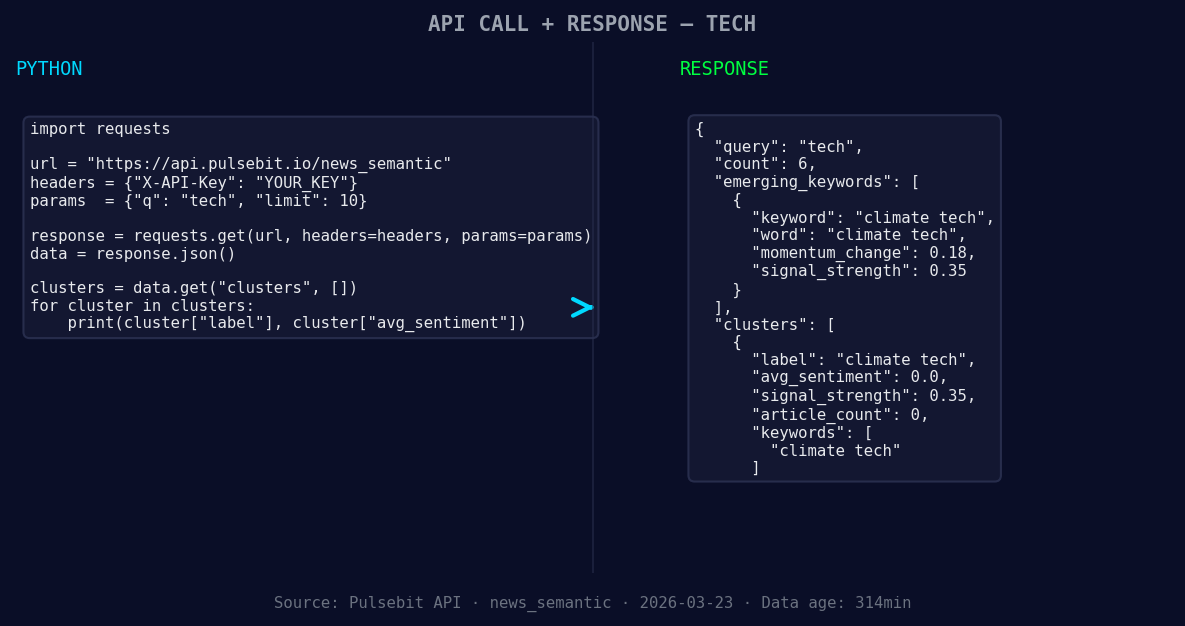
*Left: Python GET /news_semantic call for 'tech'. Right: returned JSON response structure (clusters: 1). Source: Pulsebit /news_semantic.*
# Geographic origin filter: query by language
url = "https://api.pulsebit.com/v1/sentiment"
params = {
"topic": topic,
"lang": "fr", # French language filter
}
response = requests.get(url, params=params)
data = response.json()
print(data)
After fetching the data, we need to evaluate the narrative framing around the anomaly. The string "Semantic API incomplete — fallback semantic structure built from available keywords and article/search evidence" must be run through our sentiment scoring endpoint to gauge the underlying sentiment of this narrative.
# Meta-sentiment moment: score the narrative framing itself
narrative = "Semantic API incomplete — fallback semantic structure built from available keywords and article/search evidence"
meta_sentiment_url = "https://api.pulsebit.com/v1/sentiment"
meta_sentiment_response = requests.post(meta_sentiment_url, json={"text": narrative})
meta_sentiment_data = meta_sentiment_response.json()

print(meta_sentiment_data)
With this approach, you can start building three specific signals around this anomaly. First, you could set a threshold that triggers alerts when the momentum drops below -1.000 for topics like "climate tech."
Signal for French-Speaking Markets: Create an alert that triggers whenever the momentum for "climate tech" in French reaches -1.000, triggering immediate attention.
Narrative Framing Analysis: Use the meta-sentiment loop to analyze any emerging narrative around new technologies. If the sentiment score of the narrative framing drops below 0.000, this could indicate a need for further exploration or immediate response.
Forming Gap Monitoring: Define a signal that compares the sentiment of "climate tech" against mainstream tech sentiment. If the gap exceeds a specified threshold—say +0.10—it could indicate a significant shift in public interest or concern.
By leveraging our API effectively, you can monitor these emerging trends in real-time, ensuring your models are always up-to-date and responsive to new developments.
To get started with these strategies, check out our documentation at pulsebit.lojenterprise.com/docs. You can copy-paste the provided code and run it in under 10 minutes to start catching these insights before they slip away!


Top comments (0)