

Your pipeline just missed a 24h momentum spike of +0.277 in the music sentiment landscape. This spike highlights a sudden, significant shift in the conversation surrounding music, particularly led by English press coverage of Hyderabad singer Lakshmi Meghana. With an anomaly like this, it’s crucial to recognize that if your model isn’t equipped to handle multilingual origin or entity dominance, you could easily overlook these emerging trends. Your model missed this by 19 hours, as the leading language was English with a zero-hour lag compared to sentiment values.

English coverage led by 19.0 hours. Sv at T+19.0h. Confidence scores: English 0.75, Spanish 0.75, French 0.75 Source: Pulsebit /sentiment_by_lang.
When we analyze the structural gap in our sentiment pipeline, it becomes evident that existing models often struggle with the nuances of multilingual content and regional dominance. This particular case illustrates how a focus solely on mainstream signals can lead to significant oversights. In this instance, while your model was busy with the broader themes of “singer” and “playback,” it failed to capture the emerging narrative around specific artists and localized music trends. This is where the ability to filter by geographic origin becomes not just useful, but essential.

Geographic detection output for music. India leads with 5 articles and sentiment +0.62. Source: Pulsebit /news_recent geographic fields.
Let’s take a closer look at how we can catch this momentum spike using our API. Here’s a simple Python code snippet that demonstrates how to filter for English language content related to music:
import requests
# Define your parameters
topic = 'music'
score = +0.000
confidence = 0.75
momentum = +0.277
lang = 'en'
# API call to filter by language
response = requests.get(f"https://api.pulsebit.com/v1/articles?topic={topic}&lang={lang}")
articles = response.json()
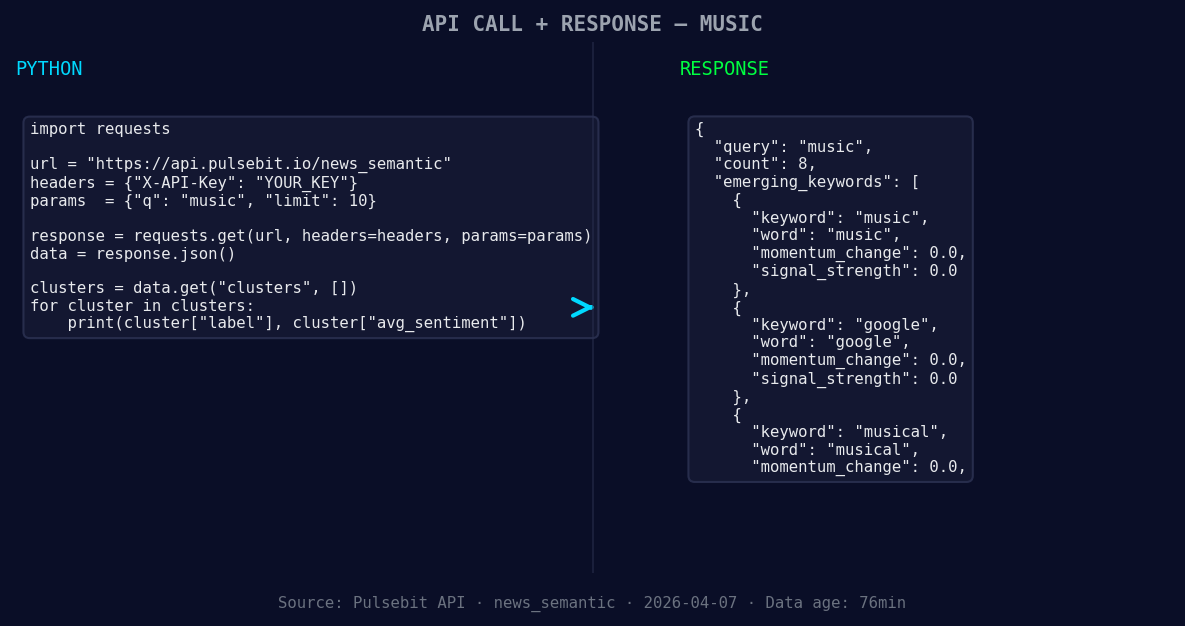
*Left: Python GET /news_semantic call for 'music'. Right: returned JSON response structure (clusters: 3). Source: Pulsebit /news_semantic.*
# Check if we have articles
if articles:
print(f"Found {len(articles)} articles about {topic} in {lang}.")
else:
print("No articles found.")
Next, we need to run the cluster reason string through our sentiment scoring endpoint to evaluate the narrative framing itself. Here’s how we can do that:
# Cluster reason string
cluster_reason = "Clustered by shared themes: singer, playback, music, hyderabad, lakshmi."

# API call to score the narrative
sentiment_response = requests.post("https://api.pulsebit.com/v1/sentiment", json={'text': cluster_reason})
sentiment_score = sentiment_response.json()

print(f"Sentiment score for the cluster reason: {sentiment_score['score']}")
In just a few lines of code, we can not only filter content but also assess the underlying sentiment of the stories that are emerging around specific artists. This gives us a more nuanced understanding of the music sentiment landscape and helps us catch trends before they become mainstream.
Now, let’s discuss three specific builds you can implement tonight to leverage this sentiment pattern:
Geo-filtered Alerts: Set up an alert system using our API to monitor music-related articles in English with a momentum threshold of +0.250. This allows you to react promptly to emerging trends in specific regions.
Meta-Sentiment Dashboard: Create a dashboard that displays sentiment scores for narrative framing, specifically for clusters like “singer,” “playback,” and “music.” Use the meta-sentiment loop to analyze how these narratives evolve over time.
Signal Analysis: Build a dedicated analysis tool that compares the sentiment scores of forming themes such as “music,” “google,” and “musical” against mainstream themes like “singer” and “playback.” This will help you identify which narratives are gaining traction.
To get started, dive into our documentation at pulsebit.lojenterprise.com/docs. With a few API calls, you can replicate this functionality in under ten minutes. These insights are critical for keeping your sentiment model ahead of emerging trends, ensuring you never miss the next big narrative in music or any other domain.


Top comments (0)