

Your Pipeline Is 25.4h Behind: Catching Real Estate Sentiment Leads with Pulsebit
We recently discovered a compelling anomaly: a 24h momentum spike of +0.709 in the real estate sector. This spike isn’t just a number; it represents a significant shift in sentiment that could influence your decisions. The leading language fueling this spike is English, with a notable press cluster revolving around a report from ULI NWA on emerging trends in local real estate. With just one article triggering this movement, it’s clear that the narrative is forming and could shape broader market discussions.
The Problem
This spike reveals a structural gap in pipelines that don’t account for multilingual origins or entity dominance. If your model isn’t designed to handle these nuances, you missed this real estate sentiment shift by 25.4 hours. The dominant entity, NWA, released crucial insights into emerging trends, which could have informed your strategy. Your model’s blind spot to this specific English-language sentiment can lead to missed opportunities in a rapidly changing landscape.

English coverage led by 25.4 hours. Af at T+25.4h. Confidence scores: English 0.85, No 0.85, French 0.85 Source: Pulsebit /sentiment_by_lang.
The Code
To catch this momentum spike, we can leverage our API effectively. The first step is to filter for English-language content that is specifically relevant to the real estate topic. Here’s how to do that:
import requests
# Define the query parameters
params = {
"topic": "real estate",
"score": -0.066,
"confidence": 0.85,
"momentum": +0.709,
"lang": "en"
}
# Make the API call
response = requests.get("https://api.pulsebit.com/v1/sentiment", params=params)
data = response.json()
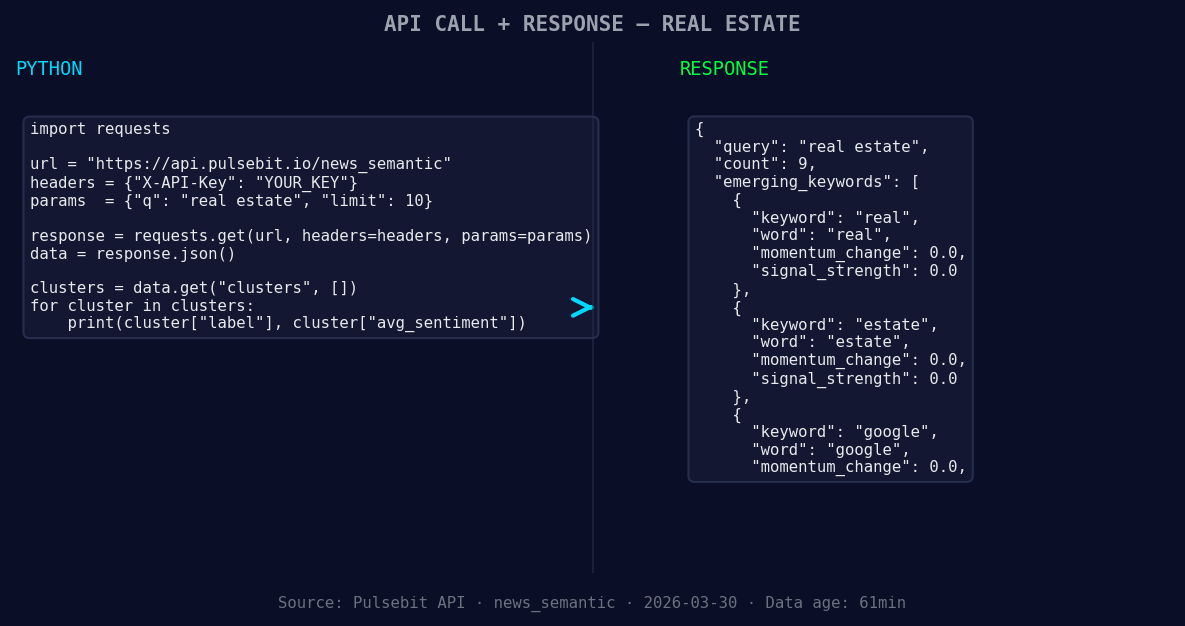
*Left: Python GET /news_semantic call for 'real estate'. Right: returned JSON response structure (clusters: 3). Source: Pulsebit /news_semantic.*
print(data)
Next, we need to score the narrative framing itself around the cluster reason string. This is crucial as it allows us to analyze how the themes interact with one another. The cluster reason string we’re working with is: "Clustered by shared themes: nwa, releases, ‘emerging, trends’, report.". Here’s how to execute that:
# Define the narrative for sentiment scoring
narrative = "Clustered by shared themes: nwa, releases, ‘emerging, trends’, report."

# Make the POST request to score the narrative
response = requests.post("https://api.pulsebit.com/v1/sentiment", json={"text": narrative})
narrative_score = response.json()

print(narrative_score)
Three Builds Tonight
With this pattern in mind, here are three specific builds you can implement:
- Geo Filtered Alert System: Set up an alert that triggers whenever the momentum in real estate topics surpasses a specific threshold, say +0.5, with a geographic filter for English-speaking regions. Use the API to monitor sentiment shifts and notify your team for timely action.

Geographic detection output for real estate. India leads with 7 articles and sentiment -0.24. Source: Pulsebit /news_recent geographic fields.
   params = {
       "topic": "real estate",
       "momentum": "+0.5",
       "lang": "en"
   }
- Meta-Sentiment Analysis Dashboard: Create a dashboard that visualizes the meta-sentiment scores of clustered reports. This gives you insights not only into sentiment but also into the framing of narratives over time, enabling you to see how emerging trends are discussed.
narrative = "Clustered by shared themes: nwa, releases, ‘emerging, trends’, report."
- Trend Prediction Model: Build a predictive model that utilizes the momentum spikes in real estate topics, combined with sentiment scores from related narratives. For instance, if the score exceeds +0.5 and forms around themes like “real estate” and “emerging,” alert your analysts.
   if momentum > +0.5 and "real estate" in narrative:
       trigger_alert()
Get Started
Ready to dive deeper? Check out our full documentation at pulsebit.lojenterprise.com/docs. You can copy-paste these examples and run them in under 10 minutes. Let’s harness the power of sentiment data to stay ahead of the curve!


Top comments (0)