

Your Pipeline Is 27.4h Behind: Catching Education Sentiment Leads with Pulsebit
We just stumbled upon a striking anomaly: a 24h momentum spike of -0.391 in the education sector. This significant drop signals a shift in sentiment that’s worth investigating. It’s crucial to recognize that the leading language for this sentiment is English, with a lag of 27.4 hours. If your pipeline isn't accounting for multilingual origins or the dominance of specific entities, you’re missing critical insights.

English coverage led by 27.4 hours. Af at T+27.4h. Confidence scores: English 0.85, Spanish 0.85, French 0.85 Source: Pulsebit /sentiment_by_lang.
The current structural gap in many sentiment pipelines is the inability to effectively process multilingual data or prioritize dominant entities. Your model might have missed this shift by over a day, missing the nuances present in the English press. As sentiment around education sours, driven by a major study's findings, the implications are substantial. This is where we can leverage our capabilities to close the gap.
Here's how you can catch this spike using our API. Below is a Python snippet that queries for sentiment data focusing on the education topic:
import requests
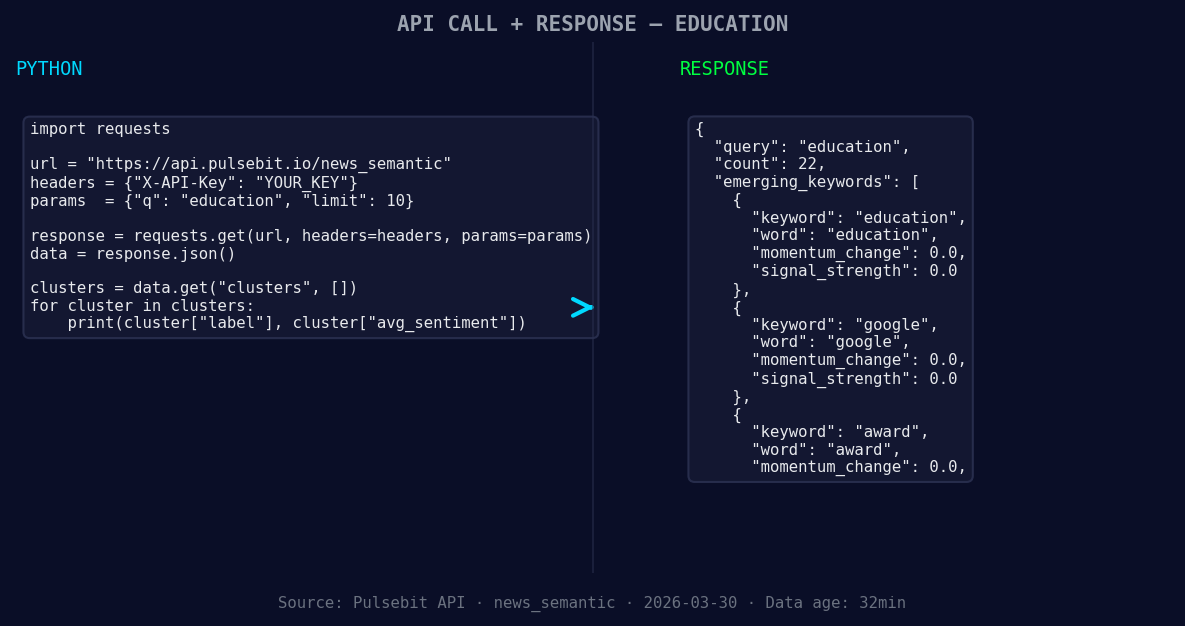
*Left: Python GET /news_semantic call for 'education'. Right: returned JSON response structure (clusters: 3). Source: Pulsebit /news_semantic.*
# Define the API endpoint and parameters
url = "https://api.pulsebit.io/v1/sentiment"
params = {
"topic": "education",
"lang": "en",
"score": +0.273,
"confidence": 0.85,
"momentum": -0.391
}
# Fetch sentiment data
response = requests.get(url, params=params)
data = response.json()
print(data)
Next, to analyze the narrative framing of the sentiment, we’ll run the cluster reason string through our sentiment analysis endpoint. Here’s how you do it:
# Define the cluster reason string
cluster_reason = "Clustered by shared themes: major, study, finds, special, education."

# POST request to analyze the cluster reason
sentiment_response = requests.post(f"{url}/sentiment", json={"text": cluster_reason})
sentiment_data = sentiment_response.json()
print(sentiment_data)
This allows us to gauge how the narrative aligns with the current sentiment, enhancing our understanding of the education landscape.
Here are three specific builds to consider tonight:
- Geo-Sentiment Analysis: Use a geographic origin filter to isolate sentiment from specific regions. For instance, you can adjust the language parameter to focus on English-speaking countries. This allows you to catch localized spikes sooner.

Geographic detection output for education. India leads with 22 articles and sentiment +0.44. Source: Pulsebit /news_recent geographic fields.
Meta-Sentiment Loop: Implement the sentiment analysis of the cluster reason string to understand how the framing impacts sentiment. This can provide insights that guide your messaging strategies or product offerings around education.
Threshold Trigger Alerts: Set up alerts based on the momentum score. For example, trigger a notification when momentum drops below -0.25 for the education topic. This will help your team stay ahead of significant sentiment shifts.
By focusing on forming themes like education (+0.00), google (+0.00), and award (+0.00) versus the mainstream keywords of major, study, and finds, you can build a more responsive pipeline that alerts you to changes in sentiment before they affect your strategy.
Getting started is straightforward. Head over to our documentation at pulsebit.lojenterprise.com/docs. You can copy-paste the code snippets above and run them in under 10 minutes. This way, you won’t miss another critical sentiment shift again.


Top comments (0)