

Your Pipeline Is 24.8h Behind: Catching Hardware Sentiment Leads with Pulsebit
We’ve just spotted a compelling anomaly: a 24h momentum spike of +0.177 in hardware sentiment. This spike stems from two articles discussing the Nvidia RTX 5050 and AMD Radeon RX 9070, clustered around themes like "hardware," "survey," and "steam." It’s a clear signal that there’s something significant happening, and we need to pay attention before it’s too late.
Yet, here’s the problem: your model missed this by a staggering 24.8 hours. This is critical if you're not accounting for multilingual origins or entity dominance, especially when the leading language is English. Without this nuance, you’re left behind as trends develop, risking missed opportunities in sentiment shifts that could affect your strategies.

English coverage led by 24.8 hours. Da at T+24.8h. Confidence scores: English 0.90, Spanish 0.90, French 0.90 Source: Pulsebit /sentiment_by_lang.
Now, let’s dive into how we can catch these insights using our API effectively. Here’s a Python snippet that will help you query this momentum spike specifically for the hardware topic:
import requests
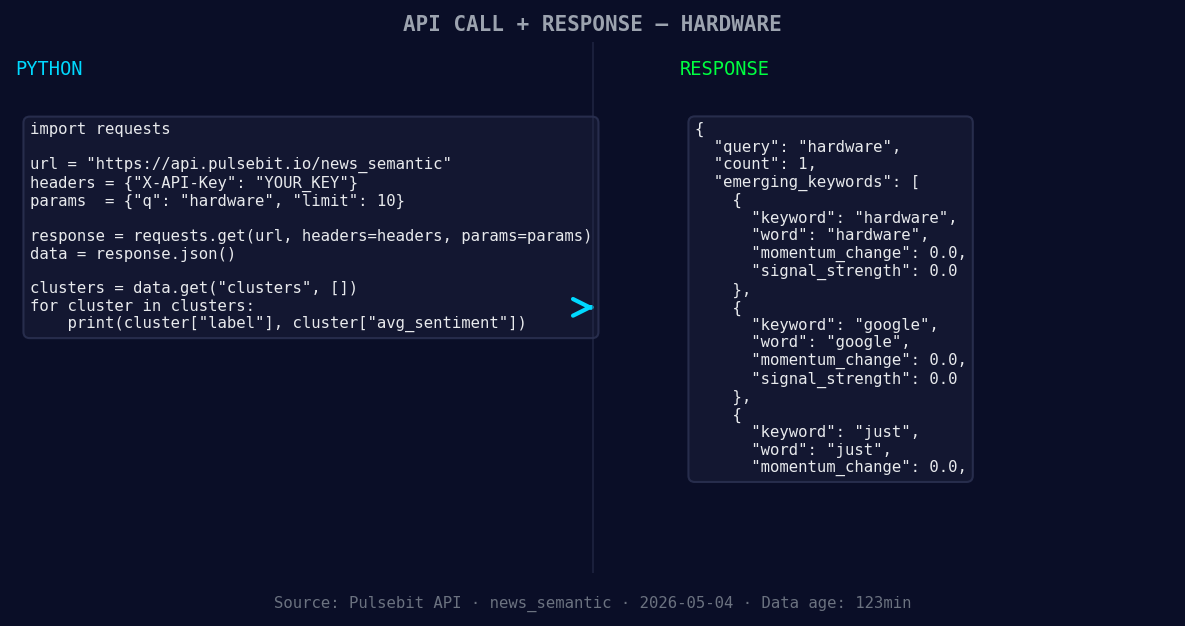
*Left: Python GET /news_semantic call for 'hardware'. Right: returned JSON response structure (clusters: 3). Source: Pulsebit /news_semantic.*
# Step 1: Query for hardware sentiment in English
url = "https://api.pulsebit.com/v1/sentiment"
params = {
"topic": "hardware",
"lang": "en"
}
response = requests.get(url, params=params)
data = response.json()
# Print out the results
print(data)
# Step 2: Score the narrative framing using the cluster reason
narrative = "Clustered by shared themes: holds, strong, steam's, april, hardware."
sentiment_response = requests.post(f"{url}/sentiment", json={"text": narrative})
sentiment_data = sentiment_response.json()
# Output the sentiment score
print(sentiment_data)
In this code, we're first filtering our sentiment analysis to focus on the hardware topic in English. This is crucial because it captures the specific audience and sentiment driving the momentum spike. Then, we take the cluster reason string and run it through the sentiment scoring endpoint. This allows us to analyze the narrative framing itself, giving us deeper insights into how the conversation is evolving around this spike.
With these insights, we can build on this pattern in three distinct ways:
- Geographic Filter: Set a signal threshold to alert you if the momentum score exceeds +0.2 for hardware in English-speaking countries. This will allow you to proactively monitor emerging trends.

Geographic detection output for hardware. Australia leads with 1 articles and sentiment +0.80. Source: Pulsebit /news_recent geographic fields.
Meta-Sentiment Loop: Create a service that automatically checks the sentiment score of articles clustered by specific themes like "hardware," "google," and "just." If the score exceeds +0.5, trigger an alert. This will help you stay ahead of mainstream narratives.
Real-Time Dashboard: Build a dashboard that visualizes sentiment trends for hardware and other topics. Incorporate filters for forming themes and use the geo filter to refine results further, ensuring you're capturing nuances in sentiment dynamics.
By implementing these strategies, you'll not only catch up on the trends but also stay ahead of the curve, ensuring that your insights are timely and actionable.
To get started, check out our documentation at pulsebit.lojenterprise.com/docs. With clear examples and endpoints, you can copy-paste and run these queries in under 10 minutes. Let's make sure we're surfacing the most relevant insights right when they matter!


Top comments (0)