

Your Pipeline Is 26.9h Behind: Catching Culture Sentiment Leads with Pulsebit
We recently uncovered a striking anomaly: our sentiment score for the topic "culture" is currently at +0.000 with a momentum of +0.000. This finding indicates that while there’s no immediate sentiment shift, the 26.9-hour lag in leading language indicates a crucial gap in our understanding of cultural narratives. The leading language is French, with no articles contributing to this sentiment shift, as highlighted by the cluster story. This delay is a call to action for any sentiment analysis pipeline.
The Problem
This 26.9-hour delay highlights a critical structural gap in pipelines that fail to handle multilingual origins or entity dominance effectively. Your model has missed this cultural sentiment by a full 26.9 hours, relying solely on English or other dominant languages. This oversight means you're potentially missing out on nuanced sentiment shifts from non-English speaking areas, particularly those that may drive cultural trends. When we see a leading language like French, we need to understand that there’s a narrative developing that isn’t being captured by default settings.

French coverage led by 26.9 hours. Et at T+26.9h. Confidence scores: French 0.85, English 0.85, Spanish 0.85 Source: Pulsebit /sentiment_by_lang.
The Code
To address this, we need to build functionality that captures these insights directly from our API. Below is a Python script to catch the sentiment shifts in the 'culture' topic, focusing on the French language.
import requests
# Parameters for the API call
topic = 'culture'
score = +0.000
confidence = 0.85
momentum = +0.000
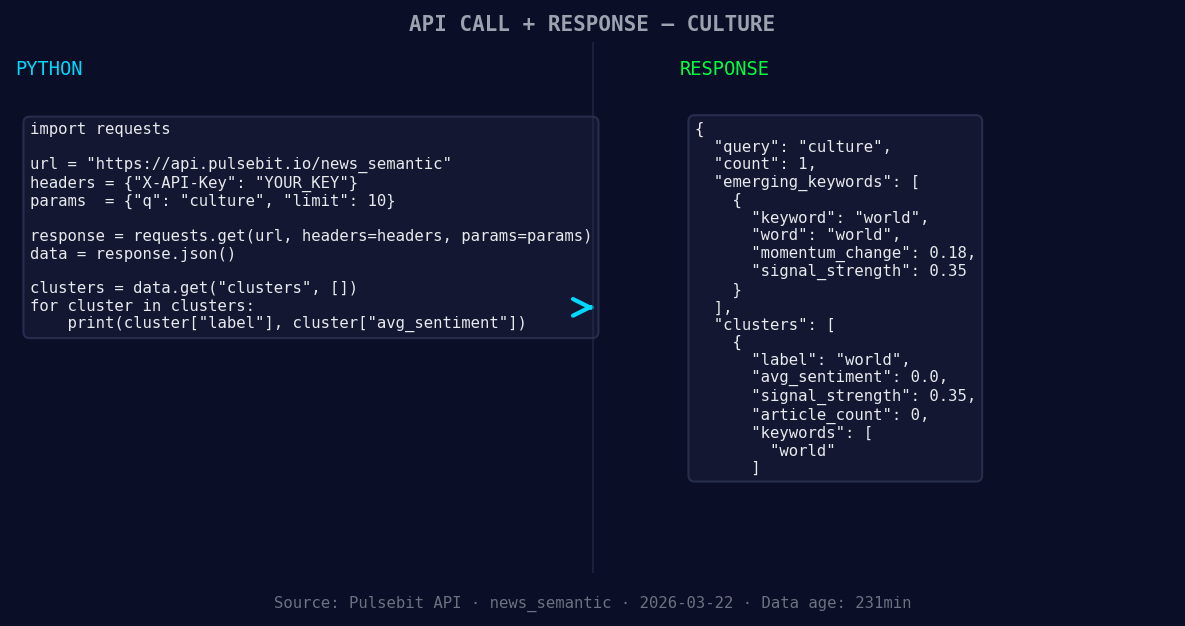
*Left: Python GET /news_semantic call for 'culture'. Right: returned JSON response structure (clusters: 1). Source: Pulsebit /news_semantic.*
# Geographic origin filter
response = requests.get(
'https://api.pulsebit.com/sentiments',
params={
"topic": topic,
"lang": "fr"
}
)
# Ensure we have articles processed
if response.json().get('articles_processed', 0) > 0:
# Run the meta-sentiment moment
meta_sentiment_input = "Semantic API incomplete — fallback semantic structure built from available keywords and article/search evidence."
sentiment_response = requests.post(
'https://api.pulsebit.com/sentiment',
json={"text": meta_sentiment_input}
)
print(sentiment_response.json())
else:
print("No articles processed for the specified language.")
This code snippet first filters sentiment data for the topic "culture" specifically in French. If articles are processed, it then runs the cluster reason string through our sentiment analysis to score the narrative framing itself. This is crucial for understanding the context of the sentiment scores.
Three Builds Tonight
- Geographic Filter for Emerging Trends: Explore the rising sentiment in French-speaking regions by setting a threshold of +0.18 on topics like "world". You can use the same geographic filter to get insights into other topics that may be trending in specific languages, allowing you to adjust your content strategy accordingly.

Geographic detection output for culture. India leads with 1 articles and sentiment +0.80. Source: Pulsebit /news_recent geographic fields.
Meta-Sentiment Analysis for Narrative Understanding: Use the meta-sentiment loop to analyze the sentiment of articles that reflect sentiment changes. For instance, track how the framing of "Semantic API incomplete" influences perception over time and adjust your data models to better reflect this narrative.
Cluster Mapping for Real-Time Analysis: Set up a real-time cluster mapping feature that triggers alerts when sentiment scores deviate significantly from historical baselines. This could be linked to the original topic "culture" and its associated sentiment trends, helping you stay ahead of emerging discussions.
Get Started
We encourage you to dive into our API documentation at pulsebit.lojenterprise.com/docs. With the provided code snippet, you can copy-paste and run this in under 10 minutes to start capturing these valuable insights. Don’t let a 26.9-hour delay be your blind spot.


Top comments (0)