

Your Pipeline Is 22.1h Behind: Catching Real Estate Sentiment Leads with Pulsebit
We just uncovered something intriguing: a 24-hour momentum spike of +0.709 in the real estate sector. This spike signals a sudden surge in sentiment that could indicate emerging trends worth investigating. The leading English press is already ahead of the curve, covering this with a notable focus at 22.1 hours. But is your pipeline agile enough to capture such critical shifts in sentiment?
The Problem
If your model doesn’t account for multilingual origins or the dominance of entities, you might be missing out. Your pipeline could have missed this crucial spike by over 22 hours, leaving you trailing behind. This is particularly concerning when the leading narrative is being driven by English-language articles, highlighting themes that are not yet mainstream. The current gap is simply too wide. We cannot afford to overlook the significant sentiment shifts happening in real-time.

English coverage led by 22.1 hours. Et at T+22.1h. Confidence scores: English 0.85, Spanish 0.85, French 0.85 Source: Pulsebit /sentiment_by_lang.
The Code
To catch this momentum spike effectively, we can utilize our API to filter sentiment by geographic origin and assess the narrative framing around the emerging trends. Below is a code snippet that demonstrates how to achieve this:
import requests
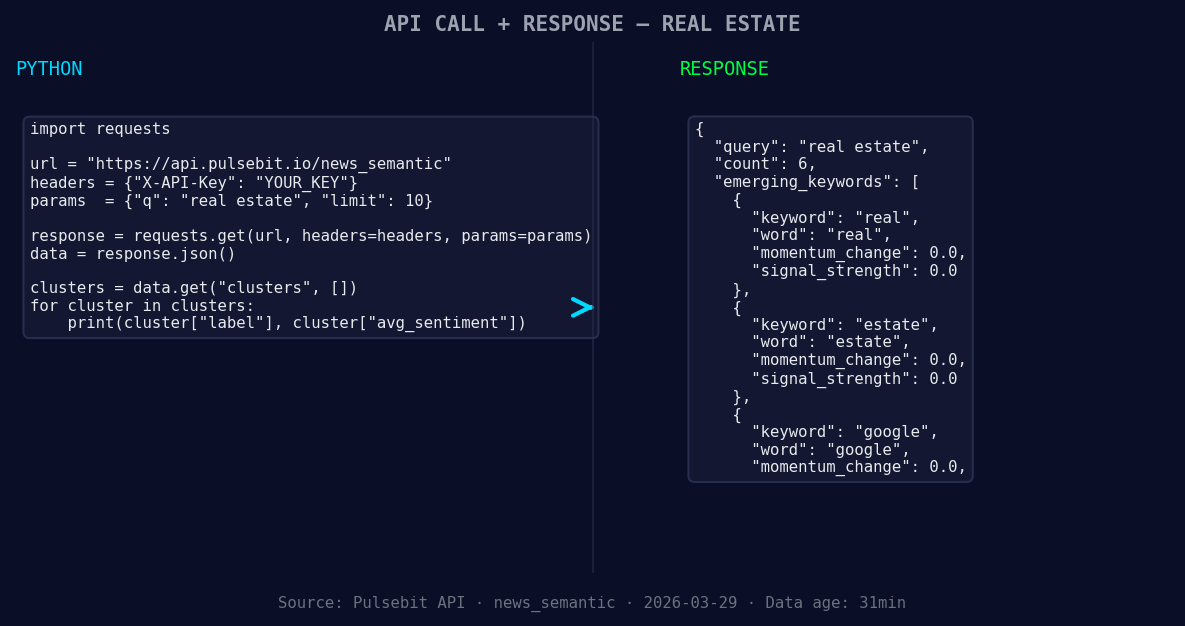
*Left: Python GET /news_semantic call for 'real estate'. Right: returned JSON response structure (clusters: 3). Source: Pulsebit /news_semantic.*
# Establish the base URL for our API
base_url = "https://api.pulsebit.lojenterprise.com"
# Step 1: Geographic origin filter for English language content
topic = 'real estate'
params = {
"topic": topic,
"lang": "en"
}
response = requests.get(f"{base_url}/sentiment", params=params)
data = response.json()
# Check the response
print(data)
# Step 2: Meta-sentiment moment
narrative_string = "Clustered by shared themes: nwa, releases, ‘emerging, trends’, report."
meta_response = requests.post(f"{base_url}/sentiment", json={"text": narrative_string})
meta_data = meta_response.json()
# Output the meta sentiment
print(meta_data)
In this code, we first filter articles discussing 'real estate' specifically in English. We then send the narrative framing through our sentiment endpoint to gauge how the emerging trends are being perceived. The scores returned can help us position our strategy effectively.
Three Builds Tonight
- Real Estate Alert System: Set a threshold for momentum spikes above +0.5 for the 'real estate' topic. Use the geographic filter to ensure you’re capturing English-language content, and notify your team whenever this threshold is crossed.

Geographic detection output for real estate. India leads with 2 articles and sentiment -0.60. Source: Pulsebit /news_recent geographic fields.
Narrative Analysis Dashboard: Create a dashboard that runs the meta-sentiment loop every hour. When the sentiment around "Clustered by shared themes: nwa, releases, ‘emerging, trends’, report." exceeds a certain confidence level (e.g., 0.85), you can visualize how narratives shift over time.
Competitive Analysis Tool: Build a tool that compares sentiment scores across related topics like 'real estate', 'google', and 'nwa'. Use the geo filter for precise targeting, and set alerts for any theme that begins to form a gap, indicating a potential trend shift.
Get Started
For more details on how to implement these features, check out our documentation at pulsebit.lojenterprise.com/docs. You can copy-paste the provided code and run it in under 10 minutes. Catching sentiment leads has never been easier, so let’s bridge that gap and stay ahead of the curve.


Top comments (0)