

Your 24h momentum spike of +0.383 in hardware sentiment is undeniable. It’s a clear signal that something significant is brewing in this space. The data points to a notable shift in sentiment that we need to pay attention to, particularly with the leading language being English, which is at a 25.2-hour mark. This is a revelation that should force us to rethink how we track and react to sentiment across different languages and entities.
But here’s the kicker: Your model missed this by 25.2 hours. If your pipeline doesn’t handle multilingual origins or entity dominance effectively, you’re going to feel the impact of these missed opportunities. The English press is leading the charge, and if you’re only focusing on a single language or entity, you’re lagging behind. This is a pressing issue, particularly in a globalized landscape where timely insights are critical for competitive advantage.

English coverage led by 25.2 hours. Nl at T+25.2h. Confidence scores: English 0.90, Spanish 0.90, French 0.90 Source: Pulsebit /sentiment_by_lang.
Let’s look at how we can catch this anomaly programmatically. We’ll start by filtering for English language sentiment in the hardware domain. Here’s a simple Python snippet that utilizes our API to identify this momentum spike:
import requests
# Define parameters for the API call
params = {
"topic": "hardware",
"lang": "en",
"momentum": 0.383,
}
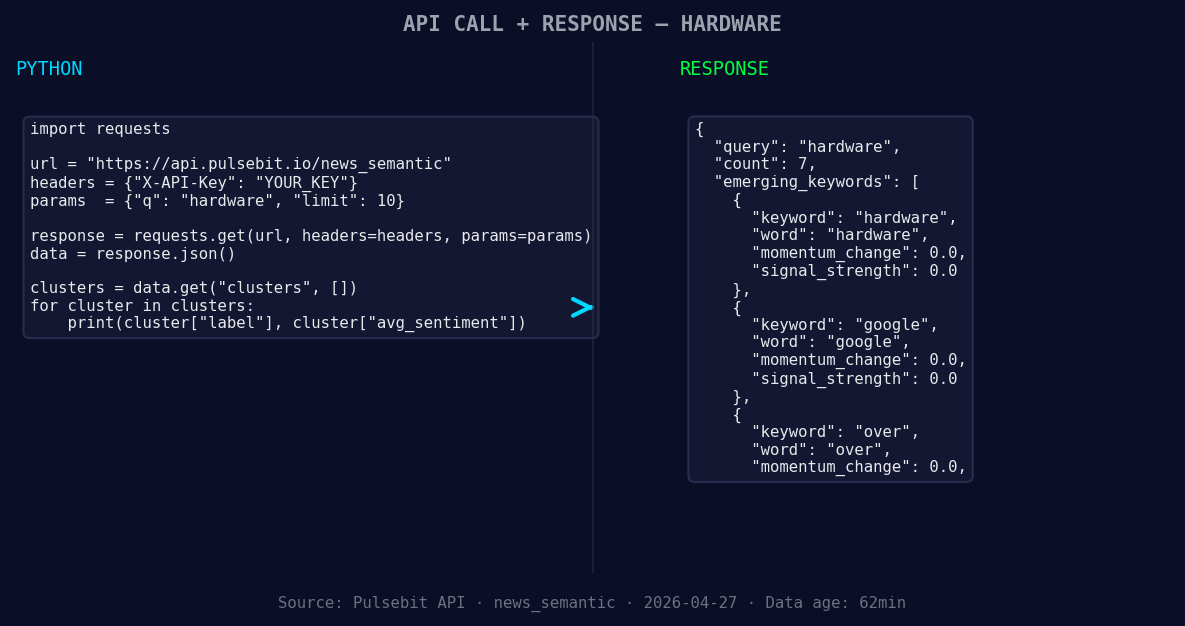
*Left: Python GET /news_semantic call for 'hardware'. Right: returned JSON response structure (clusters: 3). Source: Pulsebit /news_semantic.*
# Make the API call to check sentiment in hardware
response = requests.get('https://api.pulsebit.com/sentiment', params=params)
data = response.json()
# Output the relevant sentiment information
print(data)
Now, we also want to understand the narrative framing around this spike. Let's run the cluster reason string back through the sentiment endpoint:
# Define the narrative string
narrative = "Clustered by shared themes: you, hint, next, weekend, our."

# Make the API call to score the narrative framing
narrative_response = requests.post('https://api.pulsebit.com/sentiment', json={"text": narrative})
narrative_data = narrative_response.json()

# Output the narrative sentiment score
print(narrative_data)
With this approach, we can not only capture the current sentiment spike but also gain insights into how it's being framed in discussions. This is particularly useful as we see forming themes like hardware (+0.00), Google (+0.00), and the terms "you", "hint", "next" emerging in mainstream conversations.
Now, let’s build on this discovery. Here are three specific things you can implement tonight using this pattern:
- Geographic Origin Filter: Create a system that alerts you when sentiment in hardware exceeds a certain threshold, say +0.5, specifically for English-speaking regions. You can use the geo filter parameter in your API call to focus on your target markets.

Geographic detection output for hardware. Hong Kong leads with 4 articles and sentiment +0.41. Source: Pulsebit /news_recent geographic fields.
Meta-Sentiment Loop: Implement a feature that automatically scores the narrative framing every time a significant sentiment spike is detected. If the score exceeds a certain level, say +0.6, trigger an alert for deeper analysis.
Threshold-Driven Alerts: Set up a monitoring system that sends you alerts whenever sentiment in related topics—like Google or emerging hardware technology—hits a momentum of +0.5 or higher. This will keep you ahead of the curve with real-time insights.
By leveraging these insights and building systems around them, you’ll be in a much stronger position to react to sentiment shifts.
Ready to dive deeper? Check out our documentation at pulsebit.lojenterprise.com/docs. With just a few lines of code, you can start catching these insights in under 10 minutes.


Top comments (0)