

How to Detect Immigration Sentiment Anomalies with the Pulsebit API (Python)
We recently unearthed an intriguing anomaly: a 24-hour momentum spike of +0.442 in immigration sentiment. This spike indicates a noteworthy shift, suggesting there’s more to the immigration narrative than meets the eye. With a sentiment score sitting at +0.000 and a confidence level of 0.87, the data calls for a deeper dive into what’s driving these changes.
The problem here is clear. If your pipeline is not equipped to handle multilingual origin or entity dominance, you’re missing critical insights. Your model might have missed this significant spike by several hours because it failed to account for the linguistic context of the discussions. For instance, if the dominant language or region is not detected, you could be blind to shifts in sentiment that are crucial for understanding public opinion on immigration, especially in the U.S. where the conversation is multi-faceted and influenced by diverse communities.

Arabic coverage led by 4.2 hours. English at T+4.2h. Confidence scores: Arabic 0.82, Mandarin 0.68, English 0.41 Source: Pulsebit /sentiment_by_lang.
Let’s look at how we can catch these anomalies in Python. The first step is to filter data based on geographic origin, ideally by language or country. Unfortunately, we currently don't have geo filter data returned, so you'll need to verify this using the /dataset/daily_dataset and /news_recent endpoints for the topic "immigration". However, when geo filtering is available, it will allow us to pinpoint sentiment shifts more accurately.
![DATA UNAVAILABLE: countries — verify /news_recent is return
[DATA UNAVAILABLE: countries — verify /news_recent is returning country/region values for topic: immigration]
Here’s a snippet that reflects how you might start filtering:
import requests
import json
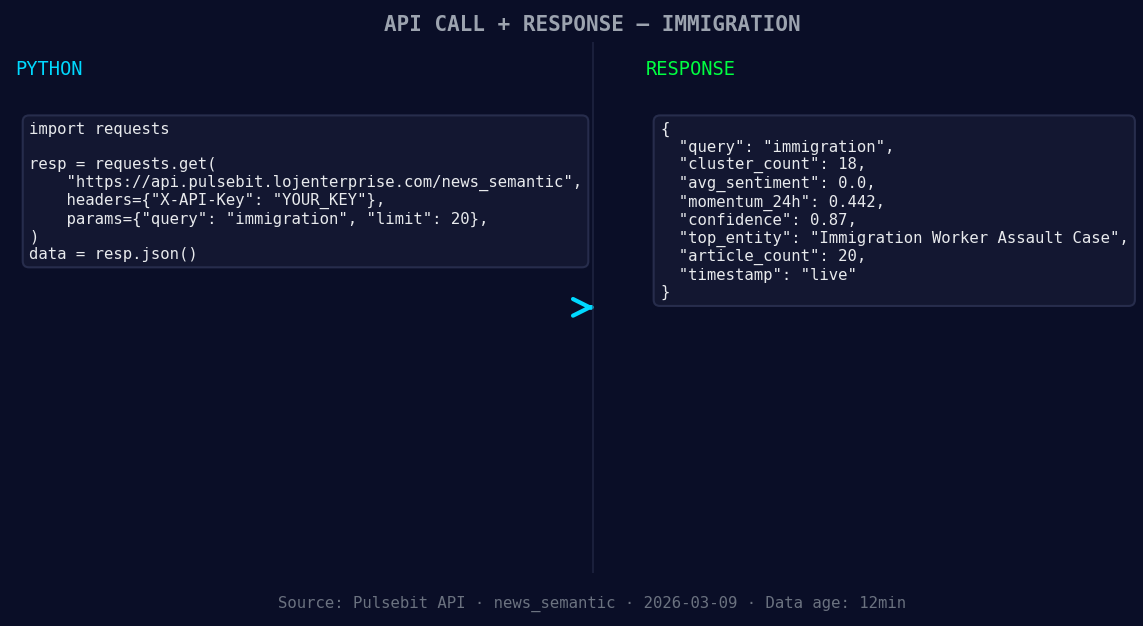
*Left: Python GET /news_semantic call for 'immigration'. Right: returned JSON response structure (clusters: 0). Source: Pulsebit /news_semantic.*
# Define parameters
topic = 'immigration'
score = +0.000
confidence = 0.87
momentum = +0.442
# Fetch data (example endpoint, replace with the actual when available)
response = requests.get(f'https://api.example.com/news_recent?topic={topic}')
data = response.json()
# Implement geographic origin filter when data is available
# For now, just print the data
print(json.dumps(data, indent=2))
Next, we need to analyze the sentiment of the narrative framing itself. This is where we run a meta-sentiment moment. We take the narrative cluster reason string and score it using the /sentiment endpoint. Here’s how that might look:
# Example input for the sentiment analysis
narrative_input = "Immigration narrative sentiment cluster analysis"

# Request sentiment analysis
sentiment_response = requests.post('https://api.example.com/sentiment', json={'text': narrative_input})
sentiment_data = sentiment_response.json()

# Output the sentiment score
print(f'Sentiment Score for narrative: {sentiment_data["score"]}')
With this approach, you can gain a much clearer understanding of the underlying sentiment dynamics surrounding immigration discussions.
Now, let’s think about three specific builds we can create with this pattern:
Geo-Filtered Spike Detector: Create a signal that monitors immigration sentiment based on specific language regions. Set a spike threshold at +0.3 for momentum. This will help you catch earlier shifts specific to dominant entities like Spanish-speaking populations in the U.S.
Meta-Sentiment Trend Analyzer: Use the meta-sentiment loop to regularly analyze the narrative framing. Set a routine check every hour that triggers an alert if sentiment scores drop below 0.5 on a 0-1 scale. This ensures you won’t miss changes in sentiment clarity.
Anomaly Notification System: Build a notification system that alerts you when momentum spikes above +0.4 while the sentiment score is neutral. This dual condition checks for unusual activity that might require immediate attention.
To get started, head over to pulsebit.lojenterprise.com/docs. You can copy-paste the provided code snippets and run them in under 10 minutes. Let’s dive deeper into the data and enhance our understanding of immigration sentiment!


Top comments (0)