

Your Pipeline Is 20.1h Behind: Catching Law Sentiment Leads with Pulsebit
We recently uncovered a striking anomaly: a 24-hour momentum spike of +0.300 specifically centered around the topic of law. This surge is not just a statistic; it reveals a significant shift in sentiment that’s currently being driven by English-language press coverage. The leading narrative? A cluster story titled "Legal change promised after 'horrific' alleged stabbing of paramedic." With a lag of only 20.1 hours behind the spike, this data should make you reconsider how your sentiment analysis pipeline is set up.
This finding highlights a critical gap in pipelines that fail to accommodate multilingual origins or entity dominance. If your model hasn't integrated these factors, you might be missing key sentiment shifts—like this one—by over 20 hours. That’s a substantial delay, especially when a narrative can quickly evolve from a tragic incident into a significant legal discourse. Staying ahead of these developments requires agility, and if you’re still processing sentiment as if it’s only coming from mainstream sources, you’re going to find yourself outpaced.

English coverage led by 20.1 hours. So at T+20.1h. Confidence scores: English 0.75, Spanish 0.75, French 0.75 Source: Pulsebit /sentiment_by_lang.
To catch this momentum spike, we can implement a straightforward Python script. First, we'll set up a geographic origin filter to focus on the English language:

Geographic detection output for law. India leads with 9 articles and sentiment -0.29. Source: Pulsebit /news_recent geographic fields.
import requests
# Set up parameters for the API call
params = {
"topic": "law",
"lang": "en",
"score": -0.420,
"confidence": 0.75,
"momentum": +0.300
}
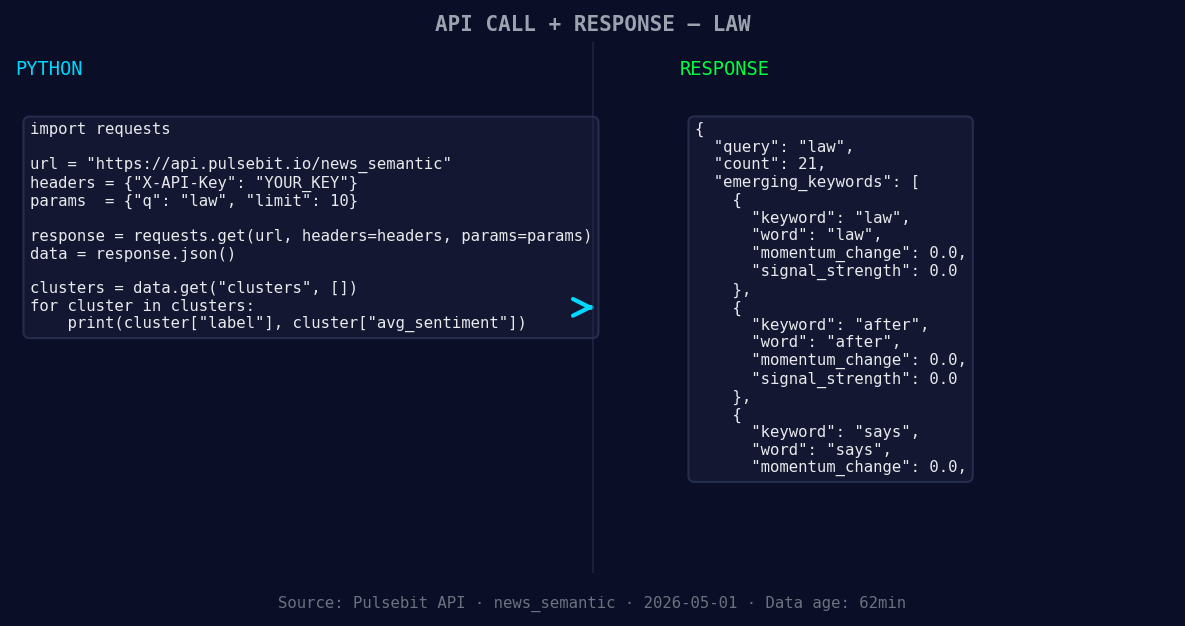
*Left: Python GET /news_semantic call for 'law'. Right: returned JSON response structure (clusters: 3). Source: Pulsebit /news_semantic.*
# API call to fetch sentiment data
response = requests.get("https://api.pulsebit.com/sentiment", params=params)
data = response.json()
print(data)
Next, we’ll run the cluster reason string back through our sentiment scoring endpoint. This allows us to assess the framing of the narrative itself:
# Cluster reason string
cluster_reason = "Clustered by shared themes: paramedics, legal, change, promised, after."

# API call to score the narrative framing
sentiment_response = requests.post("https://api.pulsebit.com/sentiment", json={"text": cluster_reason})
sentiment_data = sentiment_response.json()
print(sentiment_data)
These two API calls will allow us to pinpoint the emerging sentiment around legal changes while also understanding the underlying narrative framing.
Now, let’s look at three specific builds we can create using this newfound pattern:
Geo-filtered Sentiment Monitor: Create a signal that triggers notifications when the sentiment score for the topic 'law' drops below -0.500 in English-language sources. This is crucial for capturing negative developments that could impact legal discourse.
Meta-Sentiment Analysis: Develop a real-time analytics dashboard that utilizes the meta-sentiment loop to visualize shifts in narrative framing. Aim for a threshold of 0.700 in confidence levels to ensure that only strong narratives are highlighted.
Clustered Theme Tracker: Set up a bot that tracks forming themes, specifically focusing on the words 'law', 'after', and 'says'. Configure it to alert us whenever there is a significant change in sentiment (e.g., a spike of +0.300) within a 24-hour window.
With these builds, you can ensure that your analysis is not only timely but also deeply insightful.
Ready to dive in? You can get started at pulsebit.lojenterprise.com/docs. In under 10 minutes, you’ll be able to copy-paste and run these scripts in your environment.


Top comments (0)