

Your pipeline just missed a significant 24-hour momentum spike of +0.315 in the finance sector. This anomaly reveals how critical it is to stay ahead of emerging trends, especially when it comes to multilingual sentiment analysis. The leading language for this spike was English, with a reporting time lag of 28.8 hours. If your model isn't equipped to handle this data effectively, it fell behind by nearly a full day. The finance content that emerged from this spike was clustered around themes of Africa and the Middle East, highlighting the urgency to capture sentiment shifts in real time.

English coverage led by 28.8 hours. Af at T+28.8h. Confidence scores: English 0.85, Spanish 0.85, French 0.85 Source: Pulsebit /sentiment_by_lang.
The failure to catch this spike exposes a structural gap in any pipeline that doesn’t handle multilingual origins or entity dominance. Your model missed this by 28.8 hours, specifically in English-language coverage. This means that while you were analyzing historical data, valuable insights were forming elsewhere. Ignoring the impact of multilingual sources can lead to blind spots, especially when stories clustered around critical themes like "Africa Finance in Brief" begin to rise in prominence.
Let’s look at how to catch this spike programmatically. We can use our API to filter the data by geographic origin, targeting English content around finance. Here’s how you can do that:

Geographic detection output for finance. France leads with 1 articles and sentiment -0.60. Source: Pulsebit /news_recent geographic fields.
import requests
# Define the parameters
params = {
"topic": "finance",
"lang": "en",
}
# Make the API call for sentiment analysis
response = requests.get("https://api.pulsebit.com/sentiment", params=params)
data = response.json()
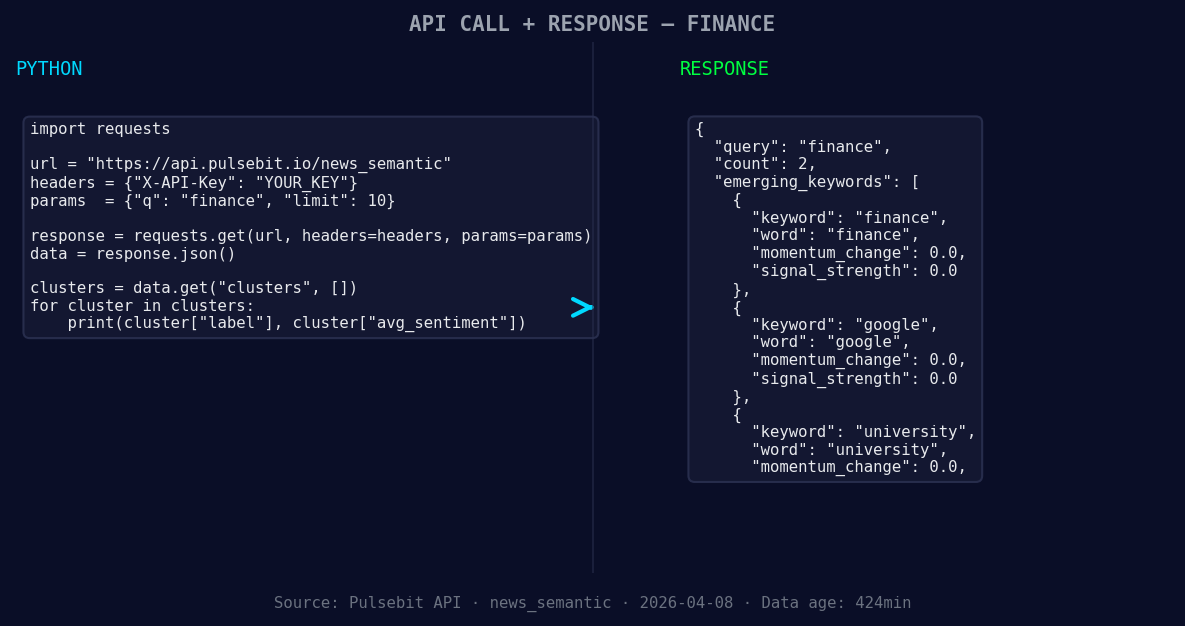
*Left: Python GET /news_semantic call for 'finance'. Right: returned JSON response structure (clusters: 3). Source: Pulsebit /news_semantic.*
# Output the relevant data
print(data)
With this request, you’re specifically querying for English language articles related to finance, ensuring that your analysis is targeted and relevant.
Next, to assess the narrative framing of the emerging cluster, we need to score the reasoning string itself. Let’s run the cluster reason string through our sentiment analysis endpoint:
# Define the cluster reason string
cluster_reason = "Clustered by shared themes: africa, finance, breif:, middle, east."

# Make a POST request for sentiment analysis
response = requests.post("https://api.pulsebit.com/sentiment", json={"text": cluster_reason})
sentiment_data = response.json()

# Output the sentiment data
print(sentiment_data)
This step allows us to evaluate how the narrative is structured, adding another layer of insight to our analysis. By scoring the reasoning, we can understand the sentiment context around the emerging trends more effectively.
Here are three specific builds that can be implemented based on this momentum spike:
Real-time Alert System: Create a signal that triggers alerts whenever the momentum in the finance topic exceeds a threshold of +0.2. Use the geo filter to target only English sources, ensuring timely notifications for relevant content.
Meta-Sentiment Dashboard: Develop a dashboard that visualizes the sentiment score of clustered narratives, particularly focusing on the topics forming around finance and Africa. Use the meta-sentiment loop to display trends over time, allowing for quick identification of shifts in public sentiment.
Engagement Metrics: Build a tool that aggregates engagement metrics (likes, shares, comments) for articles that fall within the emerging themes. This will help you quantify the impact of sentiment changes on public discourse around finance, education, and technology.
If you're ready to implement these ideas, head over to our documentation at pulsebit.lojenterprise.com/docs. You can copy-paste the code snippets above and run them in under 10 minutes to start capturing these insights. Let’s leverage this spike in momentum to enhance our analytical capabilities.


Top comments (0)