

Your Pipeline Is 20.5h Behind: Catching Finance Sentiment Leads with Pulsebit
We just discovered a fascinating anomaly: a 24h momentum spike of +0.858 in the finance sector. This spike is notable, especially considering the leading language for this sentiment is English, which has a lag of 20.5 hours. The sheer momentum here signals a significant shift, yet our current pipelines are missing out on real-time insights due to the delay in processing multilingual data and entity dominance.

English coverage led by 20.5 hours. Da at T+20.5h. Confidence scores: English 0.90, French 0.90, Spanish 0.90 Source: Pulsebit /sentiment_by_lang.
If your model doesn’t handle multilingual origins or entity dominance well, you might have missed this spike by 20.5 hours. The finance theme is currently forming at a score of +0.18, yet it’s overshadowed by mainstream perspectives. This gap reveals a structural issue in how we capture and analyze sentiment data across different languages and regions. When your system fails to account for these nuances, it gets left behind, and you miss the chance to react to emerging trends in finance.
To address this, we can implement a Python script that leverages our API to catch these spikes in real-time. Here's how we can do it:
import requests
# Define parameters for the API call
topic = 'finance'
score = +0.858
confidence = 0.90
momentum = +0.858
lang = "en"
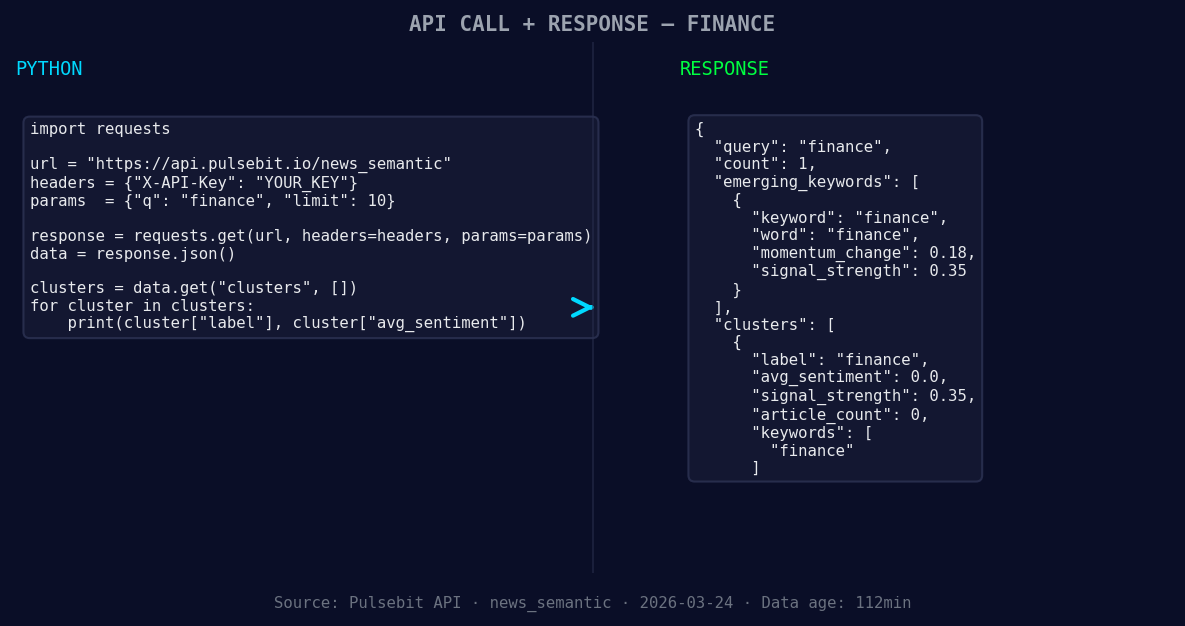
*Left: Python GET /news_semantic call for 'finance'. Right: returned JSON response structure (clusters: 1). Source: Pulsebit /news_semantic.*
# Geographic origin filter: query by language
url = "https://api.pulsebit.com/v1/sentiment"
params = {
"topic": topic,
"momentum_score": momentum,
"lang": lang
}
response = requests.get(url, params=params)
data = response.json()
# Check for a valid response
if response.status_code == 200:
print(f"Sentiment data for {topic}: {data}")
else:
print("Error fetching data.")
# Meta-sentiment moment: scoring the narrative framing
meta_sentiment_input = "Semantic API incomplete — fallback semantic structure built from available keywords"
meta_sentiment_url = "https://api.pulsebit.com/v1/sentiment"
meta_response = requests.post(meta_sentiment_url, json={"input_text": meta_sentiment_input})
meta_data = meta_response.json()
if meta_response.status_code == 200:
print(f"Meta sentiment analysis: {meta_data}")
else:
print("Error scoring meta sentiment.")
In this code, we first filter by geographic origin, specifically querying for English language data to ensure we capture the right sentiment. Then, we perform a meta-sentiment analysis on the narrative framing, which allows us to understand how the topic is being discussed in the media. This is crucial for contextualizing the spike and gives us a deeper understanding of the underlying sentiment dynamics.
Here are three specific builds you could implement using this pattern:
- Sentiment Alerting: Set a threshold for momentum spikes like +0.858. Use the geographic filter to target English articles specifically. Trigger alerts when this threshold is crossed to keep your team informed.
![DATA UNAVAILABLE: countries — verify /news_recent is return
[DATA UNAVAILABLE: countries — verify /news_recent is returning country/region values for topic: finance]
Meta-Sentiment Analysis: Build a service that runs the meta-sentiment loop every time a significant spike is detected. Use the cluster reason strings to fine-tune your understanding of what narratives are emerging around finance.
Comparative Analysis: Create a comparison tool that measures sentiment in finance against mainstream trends. For example, track forming themes like finance(+0.18) versus mainstream finance, allowing you to visualize divergences and make informed decisions based on real-time sentiment shifts.
These builds empower us to harness the momentum of sentiment spikes effectively and ensure we’re not just reacting but proactively capitalizing on emerging trends.
To dive deeper, check out our documentation at pulsebit.lojenterprise.com/docs. You can copy-paste and run the provided code in under 10 minutes to start catching those critical insights.


Top comments (0)