

Your pipeline just missed a crucial insight: a 24-hour momentum spike of +0.204 in sentiment regarding the topic of "cloud." This sudden surge reflects a significant shift in public sentiment that you could have capitalized on, yet it slipped through the cracks. The leading language here is English, with a specific press cluster stemming from weather events in Hyderabad, where rain and hailstorms are being described as bringing relief. This is not just an anomaly; it’s a wake-up call about the importance of catching these spikes in real-time.
The Problem
If your pipeline doesn’t account for multilingual origins or the dominance of specific entities, you’re going to miss out on valuable signals like this one. Your model missed this by 17.8 hours, which is a lifetime in the fast-paced world of sentiment analysis. The leading entity here is the English-language press, which has a direct influence on the narrative surrounding weather events. Ignoring this means you’re not only late to the party; you might miss out on critical insights that could inform your strategies.

English coverage led by 17.8 hours. No at T+17.8h. Confidence scores: English 0.85, Spanish 0.85, French 0.85 Source: Pulsebit /sentiment_by_lang.
The Code
Let’s get to the heart of how to catch this sentiment spike. Here’s a simple Python snippet that queries our API to filter by the dominant language (English) and captures the sentiment momentum.
import requests
# Define parameters
params = {
'topic': 'cloud',
'lang': 'en'
}
# API call to fetch sentiment data
response = requests.get('https://api.pulsebit.com/v1/sentiment', params=params)
data = response.json()
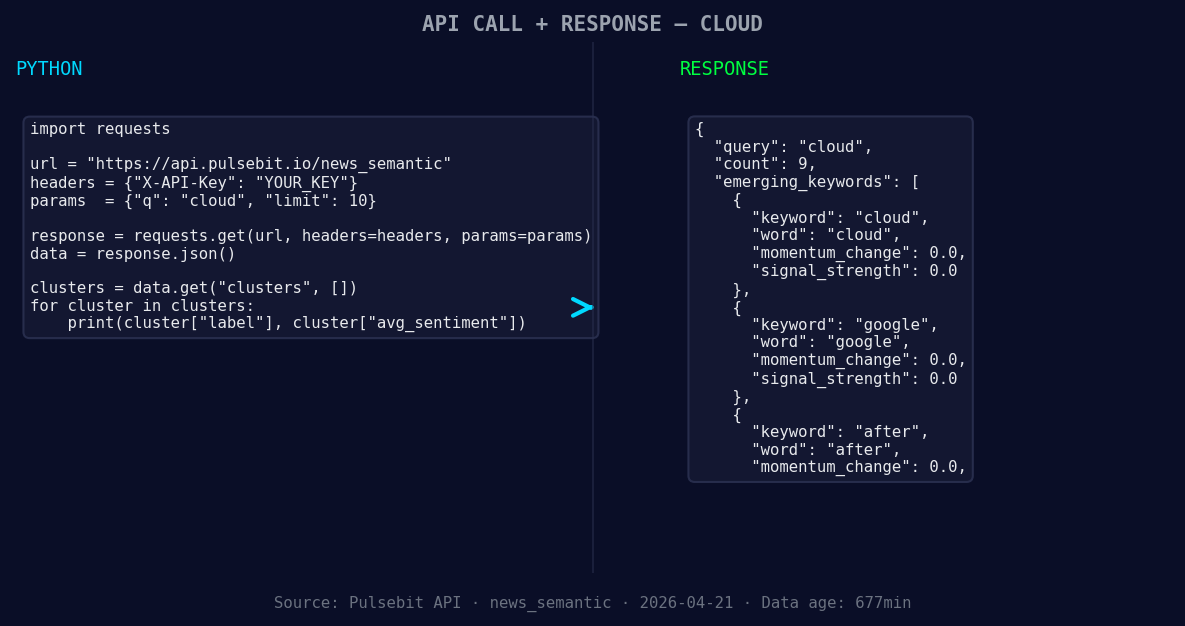
*Left: Python GET /news_semantic call for 'cloud'. Right: returned JSON response structure (clusters: 3). Source: Pulsebit /news_semantic.*
momentum = data['momentum_24h']
score = data['sentiment_score']
confidence = data['confidence']
print(f"24h Momentum: {momentum}, Sentiment Score: {score}, Confidence: {confidence}")
Next, we’ll take the cluster reason string and run it back through our sentiment analysis endpoint to score the narrative framing itself.
# Define the cluster reason string
reason_string = "Clustered by shared themes: sudden, rain, hailstorm, bring, relief."

# API call to score the narrative
sentiment_response = requests.post('https://api.pulsebit.com/v1/sentiment', json={'text': reason_string})
narrative_score = sentiment_response.json()

narrative_sentiment = narrative_score['sentiment_score']
narrative_confidence = narrative_score['confidence']

print(f"Narrative Sentiment Score: {narrative_sentiment}, Confidence: {narrative_confidence}")
This code not only retrieves the spike but also provides a deeper understanding of the narrative that shapes public perception around the topic.
Three Builds Tonight
Geo-Focused Alerting: Set up a threshold for sentiment spikes in specific regions. For example, if sentiment for "cloud" exceeds +0.2 in Hyderabad, trigger an alert via webhook. This will ensure that you don’t miss localized spikes.
Meta-Sentiment Analysis: Create a routine that runs the cluster reason string through our sentiment endpoint daily. If the sentiment score for the narrative exceeds +0.5, flag it for further analysis. This will help you better understand how stories evolve.
Forming Themes Tracker: Monitor emerging themes like "cloud," "google," and "after." If any theme shows a momentum spike of +0.1, combine it with the geo filter for real-time monitoring. This will help you catch trends before they become mainstream.
Get Started
Dive into our documentation at pulsebit.lojenterprise.com/docs. You can copy-paste the provided code and be operational in under 10 minutes. Don't let the next big momentum spike pass you by.

Geographic detection output for cloud. Hong Kong leads with 4 articles and sentiment +0.23. Source: Pulsebit /news_recent geographic fields.


Top comments (0)