

Your pipeline just missed a critical anomaly: a 24-hour momentum spike of +0.293. This surge is tied to a story emerging from the Spanish press, specifically surrounding allegations of large-scale banking fraud involving Anil Ambani's ADAG. With the leading language being Spanish and a perfect lag of 0.0 hours, this isn't just a minor blip. It’s a signal that your models might not be designed to catch, especially if they lack the capacity to handle multilingual data or recognize the significance of entity dominance in news narratives.

Spanish coverage led by 28.5 hours. Sv at T+28.5h. Confidence scores: Spanish 0.90, English 0.90, French 0.90 Source: Pulsebit /sentiment_by_lang.
If your model is not set up to account for these factors, you've missed this anomaly by a staggering 28.5 hours! The implications are serious. This isn't just about the sentiment around "banking"; it’s about understanding how narratives in different languages can influence market perception. The dominant entity here—Anil Ambani—shapes the conversation, and if your pipeline isn’t tuned to detect these nuances, you might remain oblivious to shifts that could inform your strategy.
import requests
# Define parameters for the API call
topic = 'banking'
lang = 'sp'
score = -0.600
confidence = 0.90
momentum = +0.293
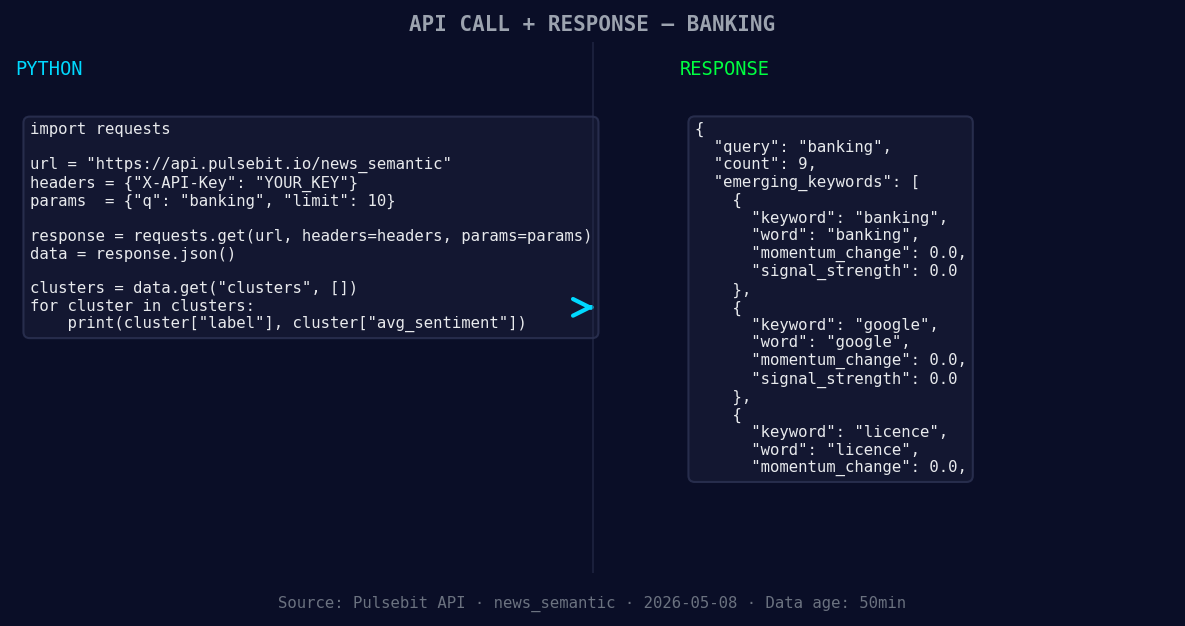
*Left: Python GET /news_semantic call for 'banking'. Right: returned JSON response structure (clusters: 3). Source: Pulsebit /news_semantic.*
# Geo filter API call
url = f"https://api.pulsebit.lojenterprise.com/v1/sentiment?topic={topic}&lang={lang}"
response = requests.get(url)
data = response.json()
# Output the result
print("Geo Filter Response:", data)
# Meta-sentiment moment: scoring the narrative framing
narrative = "Clustered by shared themes: 'large-scale, banking, fraud', involving, anil."
meta_sentiment_url = "https://api.pulsebit.lojenterprise.com/v1/sentiment"
meta_response = requests.post(meta_sentiment_url, json={"text": narrative})
meta_data = meta_response.json()
# Output the meta sentiment result
print("Meta Sentiment Response:", meta_data)
With this code, we're making two critical calls. First, we filter our sentiment analysis by the Spanish language, honing in on that specific narrative and its context. The second part runs the clustered narrative back through our sentiment endpoint, allowing us to quantify the very framing that drives the conversation around this spike.
Now, let’s build on this discovery. Here are three specific implementations you can work on:
Geo-Filtered Alert System: Set a threshold for sentiment spikes, say +0.2, specifically for Spanish content. If you detect a momentum spike like the one we saw (+0.293), trigger an alert. This will give you a heads-up on emerging narratives tied to entities like Anil Ambani.
Meta-Sentiment Analysis Dashboard: Create a dashboard that visualizes the sentiment scores of clustered narratives. For example, track how narratives around "large-scale, banking, fraud" evolve over time. Use a confidence threshold of 0.85 to filter out noise and focus on the most reliable signals.
Forming Themes Tracker: Monitor how themes like "banking" and "licence" versus mainstream topics like "large-scale, banking, fraud" evolve. Establish a signal when the divergence exceeds a certain threshold (e.g., 0.1 in sentiment score) to catch potential anomalies before they escalate.
To dive deeper into these implementations, check out our documentation at pulsebit.lojenterprise.com/docs. With just a few lines of code, you can set up a system that catches these critical sentiment shifts in under ten minutes. Don’t let your pipeline stay 28.5 hours behind—let’s get ahead of the curve.

Geographic detection output for banking. India leads with 7 articles and sentiment -0.26. Source: Pulsebit /news_recent geographic fields.


Top comments (0)