

Your Pipeline Is 24.9h Behind: Catching Software Sentiment Leads with Pulsebit
We just noticed a 24-hour momentum spike of -0.713 in sentiment surrounding the software sector. This anomaly, coupled with the leading language of English press emerging at 24.9 hours, reveals a significant disconnect in how sentiment is being captured and processed. Specifically, two articles clustered around the recent acquisition of Vertica by Rocket Software highlight the need for real-time responsiveness in our data pipelines.
If your pipeline doesn't account for multilingual origins or entity dominance, you might have missed this insight by nearly 25 hours. The leading language—English—indicates that the dominant sentiment and narrative are emerging from a specific geographic context. This could mean that valuable signals are lost, especially if you're relying solely on a traditional, monolingual pipeline.

English coverage led by 24.9 hours. Et at T+24.9h. Confidence scores: English 0.85, Spanish 0.85, French 0.85 Source: Pulsebit /sentiment_by_lang.
To catch this anomaly, we can use our API effectively. Below is the Python code that fetches relevant data, specifically focusing on the topic of "software," with a sentiment score of +0.079 and a momentum of -0.713. We’ll start by filtering entities based on geographic origin:
import requests
# API call to get sentiment data
url = "https://api.pulsebit.com/sentiment"
params = {
"topic": "software",
"score": +0.079,
"confidence": 0.85,
"momentum": -0.713,
"lang": "en" # Geographic origin filter
}
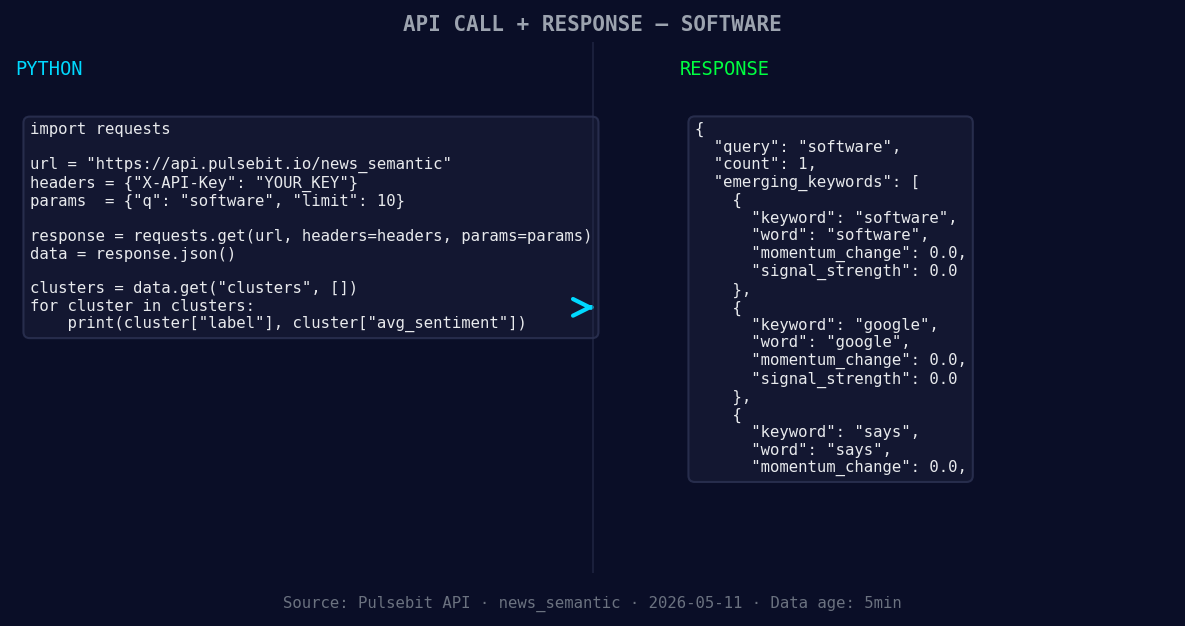
*Left: Python GET /news_semantic call for 'software'. Right: returned JSON response structure (clusters: 3). Source: Pulsebit /news_semantic.*
response = requests.get(url, params=params)
data = response.json()
print(data)
Next, we need to examine the narrative framing around the sentiment. The clustering reason provides a thematic summary: "Clustered by shared themes: software, completes, acquisition, vertica, rocket." We'll run this string through our sentiment scoring endpoint to score the narrative itself:
# Meta-sentiment moment
meta_sentiment_url = "https://api.pulsebit.com/sentiment"
meta_params = {
    "text": "Clustered by shared themes: software, completes, acquisition, vertica, rocket."
}

meta_response = requests.post(meta_sentiment_url, json=meta_params)
meta_data = meta_response.json()
print(meta_data)
By capturing both the specific sentiment score and the underlying narrative, we can better understand the dynamics at play in the software sector.
Now, let’s consider three specific builds we can implement using this pattern:
Sentiment Alert System: Create a real-time alert for any sentiment score that drops below a threshold of +0.05 for the topic "software" using the geo filter. This will allow us to catch early signs of negative sentiment specific to English-speaking regions.
Meta-Sentiment Dashboard: Build a dashboard that visualizes meta-sentiment scores for clusters of articles, using the narrative framing as input. For example, we can set up a trigger whenever the cluster themes include “software” and “acquisition,” maintaining a specific threshold for sentiment score changes.
Comparative Analysis Tool: Develop a comparative tool that contrasts sentiment scores from our API with historical baselines for "software." This tool can focus on spikes of momentum, particularly tracking the last 48 hours against the mainstream themes like "consolidated" and "sonata."
By building these specific applications, we can ensure that we are not only capturing sentiment but also acting on it before our competitors do.
If you’re interested in diving deeper, check out our documentation at pulsebit.lojenterprise.com/docs. You can copy-paste and run this in under 10 minutes to start catching those critical sentiment leads.


Top comments (0)