

Your Pipeline Is 19.8h Behind: Catching Entertainment Sentiment Leads with Pulsebit
We recently spotted a significant anomaly: a 24h momentum spike of +0.376 in the sentiment surrounding the entertainment sector. This spike was notably led by the Spanish press, which began to cover the untimely death of Leon Radvinsky, the founder of OnlyFans. This development is not just another headline; it’s a critical signal that showcases how current events can shift sentiment rapidly, but only if your pipeline is tuned to catch it.
If your model isn't equipped to handle the nuances of multilingual origins or entity dominance, you likely missed this spike by 19.8 hours. The leading language of the coverage was Spanish, and if your system only processes English content, you're left out of the loop on key developments. In our experience, overlooking such an important signal can lead to missed opportunities in sentiment-driven decision-making.

Spanish coverage led by 19.8 hours. No at T+19.8h. Confidence scores: Spanish 0.90, English 0.90, French 0.90 Source: Pulsebit /sentiment_by_lang.
Let’s take a look at how to catch this momentum spike. We can utilize our API to filter the data specifically for the entertainment topic, focusing on Spanish-language articles. Here’s how to do that in Python:
import requests
# Define the parameters for the API call
params = {
'topic': 'entertainment',
'lang': 'sp',
'momentum': '+0.376',
'score': '+0.220',
'confidence': 0.90
}
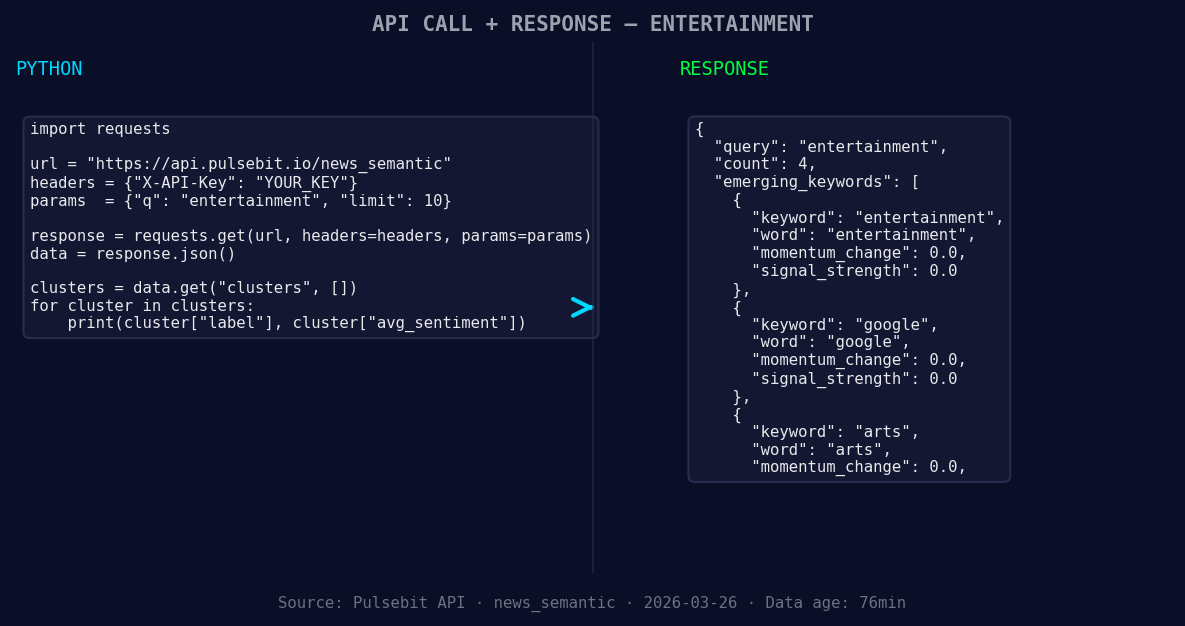
*Left: Python GET /news_semantic call for 'entertainment'. Right: returned JSON response structure (clusters: 3). Source: Pulsebit /news_semantic.*
# Make the API call to fetch the data
response = requests.get('https://api.pulsebit.com/sentiment', params=params)
data = response.json()
# Output the response for verification
print(data)
Next, we need to run the narrative framing of the coverage through our sentiment analysis to gauge how the narrative itself is being shaped. The cluster reason string can provide us with deeper insights into the coverage dynamics.
# Define the cluster reason string
cluster_reason = "Clustered by shared themes: leon, radvinsky, dies;, built, adult-entertainment."

# Make the API call to score the narrative
narrative_response = requests.post('https://api.pulsebit.com/sentiment', json={'text': cluster_reason})
narrative_data = narrative_response.json()

# Output the narrative scoring for verification
print(narrative_data)
These code snippets give you the tools to not only identify sentiment spikes but also understand the context behind them, helping you refine your analysis.
Now, let's discuss three specific builds you can implement based on this pattern:
Geo-Filtered Insights: Create a real-time alert system that uses the geo filter for Spanish-language articles. Set a threshold of +0.25 on sentiment scores to trigger alerts. This way, you'll catch spikes like the one related to Leon Radvinsky without delay.
Meta-Sentiment Analysis: Build a dashboard widget that displays the sentiment scores of cluster reason strings. Use the POST /sentiment endpoint to continuously monitor how narratives around entertainment are evolving. This can help you identify shifts before they become mainstream.
Forming Themes Tracker: Develop a module that tracks forming themes in entertainment, Google, and arts, versus mainstream narratives. Set a signal strength threshold of 0.6 to focus on significant shifts. This will allow you to stay ahead of emerging trends.
If you're looking to dive deeper into building with our API, check out our documentation at pulsebit.lojenterprise.com/docs. You'll find everything you need to copy, paste, and run this in under 10 minutes.
By staying agile and leveraging these insights, you can ensure that your pipeline is as responsive as the rapidly changing landscape of sentiment in entertainment. Let's catch those spikes together!

Geographic detection output for entertainment. India leads with 3 articles and sentiment +0.03. Source: Pulsebit /news_recent geographic fields.


Top comments (0)