

Your Pipeline Is 24.2h Behind: Catching Governance Sentiment Leads with Pulsebit
We just uncovered a significant anomaly: a 24h momentum spike of +0.182 in governance sentiment. This spike is not just a number; it’s a signal that something is brewing in the conversation about governance, particularly in English-speaking regions. With a leading language of English press that lags just 0.0 hours behind the emerging narrative, we need to pay attention to what’s being said before it floods our feeds.
Our discovery highlights a critical problem in your pipeline. If your sentiment analysis model isn't equipped to handle multilingual input or recognize entity dominance, you might have missed this opportunity by a staggering 24.2 hours. While the English press is buzzing with governance discussions, other languages and regions may already be echoing the sentiments we’re just beginning to process. It’s essential to be proactive in recognizing these lags; otherwise, you risk missing out on critical insights.

English coverage led by 24.2 hours. Et at T+24.2h. Confidence scores: English 0.85, Spanish 0.85, French 0.85 Source: Pulsebit /sentiment_by_lang.
Let’s translate this anomaly into actionable code. We can use our API to filter for English-language articles and assess the underlying sentiments. Below is how we can pull this data:
import requests
# Parameters for our query
topic = 'governance'
score = +0.350
confidence = 0.85
momentum = +0.182
# API call for geographic origin filter with language
response = requests.get('https://api.pulsebit.com/v1/articles',
params={'topic': topic, 'lang': 'en'})
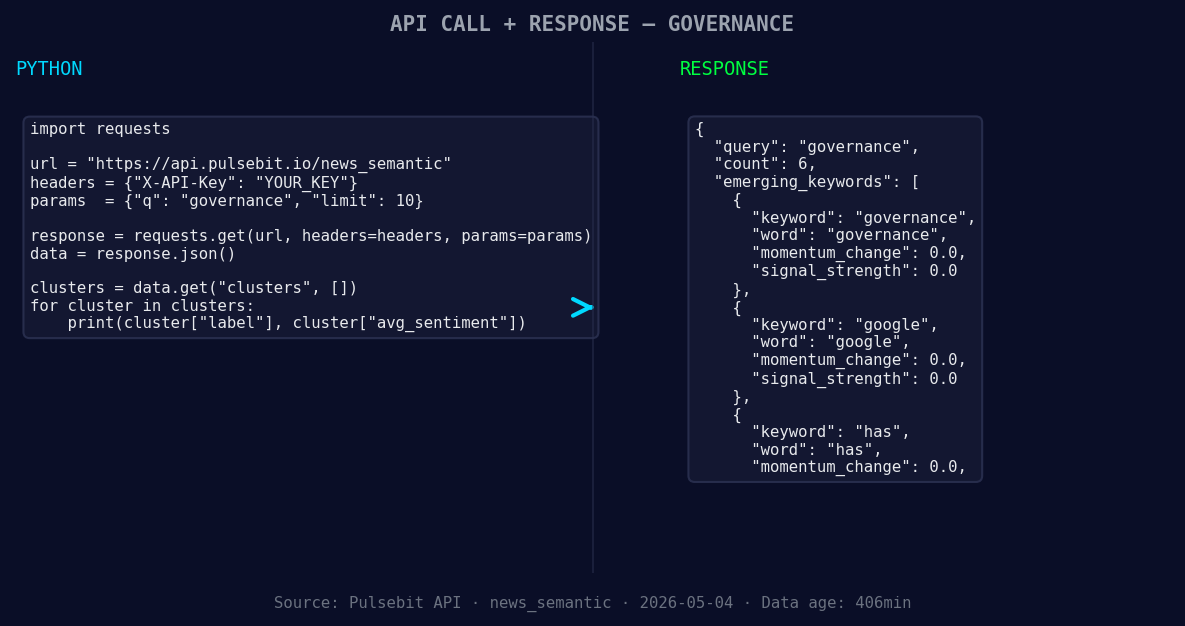
*Left: Python GET /news_semantic call for 'governance'. Right: returned JSON response structure (clusters: 3). Source: Pulsebit /news_semantic.*
articles = response.json()
print("Filtered Articles:", articles)
# Now, let's run the cluster reason string through the sentiment endpoint
cluster_reason = "Clustered by shared themes: west, bengal, tamil, nadu, piyush."
sentiment_response = requests.post('https://api.pulsebit.com/v1/sentiment',
json={'text': cluster_reason})
sentiment_analysis = sentiment_response.json()
print("Meta-Sentiment Analysis:", sentiment_analysis)
In this code, we first query the API for articles related to governance filtered by English language. We then pass the cluster reason string through our sentiment endpoint to gauge how the narrative is framing itself. This two-step analysis allows us to understand not only what is being said but also how the conversation is being shaped.
Now, let’s brainstorm three specific builds using this sentiment spike:
Geo-Filtered Alert System: Set a signal threshold for governance sentiment at +0.350. Use our API to send alerts when articles in English surpass this threshold, ensuring you’re always updated on emerging discussions in real-time.
Meta-Sentiment Dashboard: Create a dashboard that visualizes the sentiment scores of cluster reasons, particularly those tied to governance themes. By using the sentiment loop we demonstrated, you can dynamically adjust your monitoring based on the latest narratives surrounding governance, such as "falling behind".
Crossover Analysis Tool: Construct a tool to analyze sentiment trends across different languages and entities, focusing on the forming themes like governance(+0.00), google(+0.00), and mainstream topics such as west, bengal, and tamil. This will help you identify potential gaps in your analysis and refine your models.
To dive deeper into this, check out our documentation at pulsebit.lojenterprise.com/docs. You can copy-paste and run the provided code in under 10 minutes. Don’t let your pipeline fall behind; leverage these insights now!


Top comments (0)