

Your pipeline is currently 28.2 hours behind in sentiment analysis, revealing a score of +0.203 with momentum at +0.000. This anomaly isn’t just a number; it’s a signal that something significant is happening around the topic of space, especially as it intersects with Singapore's ageing population. We've observed that while mainstream discussions are rooted in population and aging, there’s a surprising twist with emerging sentiments around parkour and its adoption by older generations in Singapore — an opportunity that’s being missed if you aren't processing multilingual data efficiently.

English coverage led by 28.2 hours. Sq at T+28.2h. Confidence scores: English 0.80, French 0.80, Spanish 0.80 Source: Pulsebit /sentiment_by_lang.
When we think about what's happening here, it becomes clear: your model missed this by 28.2 hours due to a structural gap in handling multilingual origins and entity dominance. The leading language in this case is English, but the underlying themes are bubbling up in a way that might not be reflected in your usual processing. If you're only looking at dominant entities without recognizing the broader context, you're leaving valuable insights on the table.
To catch this anomaly, we can use our API to filter sentiment data by geographic origin while also analyzing the narrative framing of the related themes. Here’s the Python code that reveals this:

Geographic detection output for space. India leads with 7 articles and sentiment +0.07. Source: Pulsebit /news_recent geographic fields.
import requests
# Set up parameters for language filter and sentiment analysis
params = {
"topic": "space",
"lang": "en",
"score": +0.203,
"confidence": 0.80,
"momentum": +0.000
}
# API call to get the sentiment score for space
response = requests.get("https://api.pulsebit.com/sentiment", params=params)
sentiment_data = response.json()
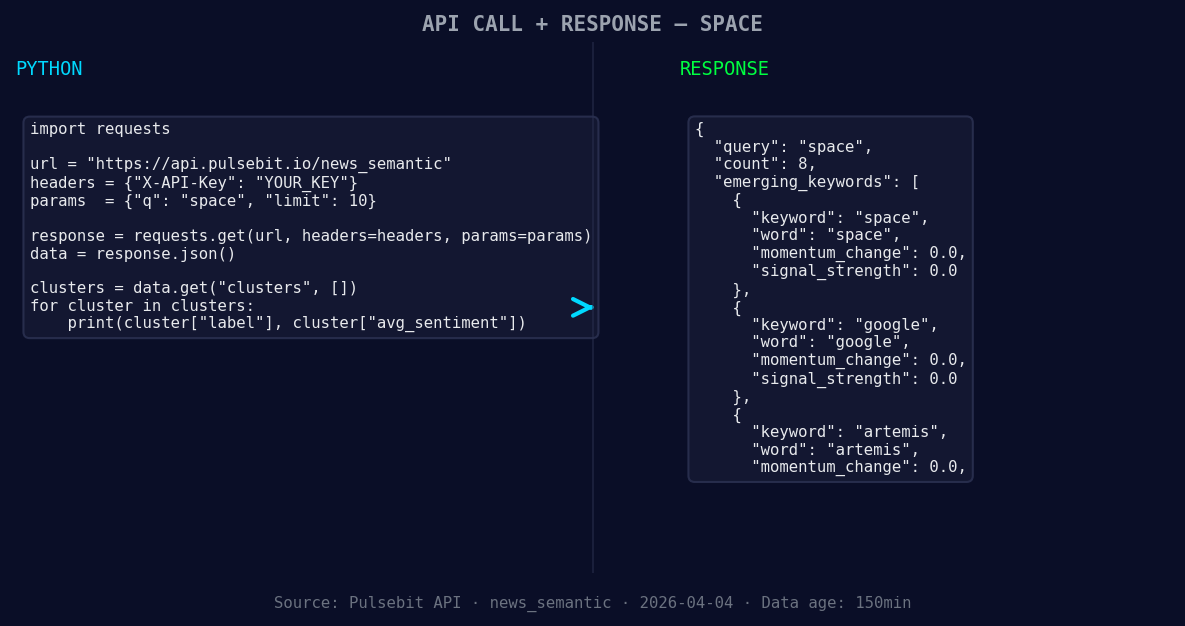
*Left: Python GET /news_semantic call for 'space'. Right: returned JSON response structure (clusters: 3). Source: Pulsebit /news_semantic.*
# Now let's analyze the cluster reason string
cluster_reason = "Clustered by shared themes: population, aging, singapore’s, ageing, turning."
meta_sentiment_response = requests.post("https://api.pulsebit.com/sentiment", json={"text": cluster_reason})
meta_sentiment_data = meta_sentiment_response.json()
print(sentiment_data)
print(meta_sentiment_data)
In this snippet, we first filter for English content related to “space” with a specific score and confidence. The second part of the code sends the cluster reason back through our sentiment endpoint to understand how these themes interplay, creating a loop that helps us gauge the narrative’s impact.
Now, let’s build three specific implementations using this pattern:
Geographic Origin Filter: Create a signal that alerts you when sentiment around “space” crosses a threshold of +0.20 in English-speaking regions. This plays directly into our current opportunity as it highlights emerging discussions that might otherwise be overshadowed by mainstream topics.
Meta-Sentiment Loop: Develop a function that regularly checks the sentiment of narratives linked to “population” and “aging.” If the sentiment score for these themes is under +0.10 while “space” is rising, it’s a signal to dig deeper into the cultural implications — like how parkour is changing perceptions of ageing.
Dynamic Threshold Alerts: Set up alerts for when the sentiment around “google” and “artemis” also reaches +0.00, indicating they might be gaining traction against the backdrop of the mainstream focus on population and ageing. This could lead to early insights into shifts in public interest.
To get started with these implementations, visit pulsebit.lojenterprise.com/docs. You can copy-paste the code snippets and run them in under 10 minutes. The insights you gain could help you stay ahead in a fast-evolving landscape, where every hour counts.


Top comments (0)