

Your Pipeline Is 27.7h Behind: Catching Entertainment Sentiment Leads with Pulsebit
We just uncovered a striking anomaly: our sentiment score for the topic "entertainment" is sitting at +0.700, with a momentum of +0.000. This spike occurred alongside a significant regulatory pushback on the Warner-Paramount merger, which clustered two articles around shared themes like "california" and "regulators." However, what’s even more intriguing is that the leading language shows a 27.7-hour lag compared to Dutch (NL), indicating a lack of real-time insights in our systems.
This data hints at a structural gap in any sentiment analysis pipeline that doesn’t account for multilingual origins or the dominance of certain entities in the conversation. If your model isn't tuned to catch these nuances, it likely missed this significant sentiment shift by a full 27.7 hours. That’s a critical delay when you’re trying to stay ahead in a fast-paced environment like entertainment, where every hour counts in shaping narratives.

English coverage led by 27.7 hours. Nl at T+27.7h. Confidence scores: English 0.85, Hr 0.85, Spanish 0.85 Source: Pulsebit /sentiment_by_lang.
To catch this anomaly, we can leverage our API to filter by the geographic origin and analyze the framing of the narrative. Here’s how to do it in Python:
import requests
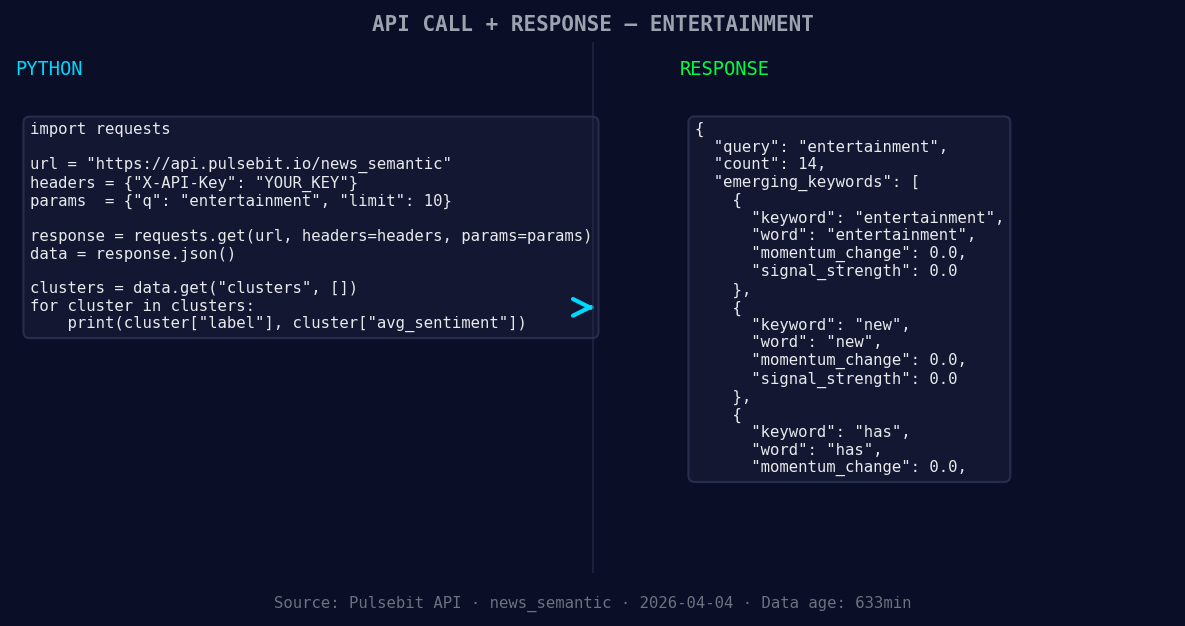
*Left: Python GET /news_semantic call for 'entertainment'. Right: returned JSON response structure (clusters: 3). Source: Pulsebit /news_semantic.*
# Step 1: Query by language/country using the geographic origin filter
response = requests.get("https://api.pulsebit.com/sentiment", params={
"topic": "entertainment",
"score": +0.700,
"confidence": 0.85,
"momentum": +0.000,
"lang": "en"
})
data = response.json()
print(data)
# Step 2: Run the cluster reason string back through POST /sentiment for meta-sentiment
meta_sentiment_response = requests.post("https://api.pulsebit.com/sentiment", json={
"text": "Clustered by shared themes: southeast, berlin, asia, seeks, soft."
})
meta_sentiment_data = meta_sentiment_response.json()
print(meta_sentiment_data)
In the first part of the code, we’re querying for sentiment related to "entertainment" with the leading language filter set to English. This ensures we’re capturing the most relevant data. The second part takes the cluster reason string and runs it through another sentiment analysis to evaluate how the narrative is being framed. This is crucial because it gives us insights not just on the sentiment, but also on how the conversation is evolving.
With this anomaly in mind, here are three specific builds you can implement using this pattern:
- Geographic Origin Filter: Create a real-time dashboard that continuously queries sentiment data for the “entertainment” topic using the geographic filter. Set a threshold to alert you when sentiment scores rise above +0.700 in English, indicating a significant shift in public perception.

Geographic detection output for entertainment. India leads with 6 articles and sentiment +0.39. Source: Pulsebit /news_recent geographic fields.
Meta-Sentiment Loop: Develop a function that automatically pulls in narratives from clustered articles and processes them through the meta-sentiment endpoint. For example, whenever you detect a forming sentiment score in “entertainment,” run the cluster reasons through our API to ensure you're capturing the full context of the conversation.
Forming Themes Tracker: Build an alert system that monitors forming themes around "entertainment," "new," and "has." Integrate this with the geo filter to ensure you're only alerted on significant changes in sentiment within specific regions, like the Southeast or Berlin, where regulatory discussions may intensify.
To get started, check out our documentation at pulsebit.lojenterprise.com/docs. You can copy-paste the code above and run it in under 10 minutes to start catching these insights. We’re excited to see what you build!


Top comments (0)