

How to Detect Sports Sentiment Anomalies with the Pulsebit API (Python)
We just uncovered a notable anomaly: a 24-hour momentum spike of -0.612 in the sports sentiment landscape. This dip is particularly striking given the current discourse surrounding "Iran's Participation in FIFA World Cup Uncertain," which has generated no articles. The stark contrast between the sentiment score and the absence of related articles raises questions about the underlying narratives and their potential implications.
This situation highlights a significant structural gap in any pipeline that doesn’t account for multilingual origins or entity dominance. If you’re relying solely on English-language sources, your model missed this -0.612 momentum spike by hours, if not days. The leading language in this context is English, yet the lack of articles suggests that critical sentiments might be developing in other languages or regions. If your model doesn't accommodate this, you risk missing out on key shifts in sentiment that could inform your decisions.

en coverage led by 19.3 hours. id at T+19.3h. Confidence scores: en 0.86, es 0.85, fr 0.85 Source: Pulsebit /sentiment_by_lang.
To catch this anomaly in Python, we can utilize our API effectively. Below is a code snippet that processes the sentiment data for the sports topic, specifically targeting the recent spike:
import requests
# Define the topic and parameters for the API call
topic = 'sports'
score = +0.000
confidence = 0.00
momentum = -0.612
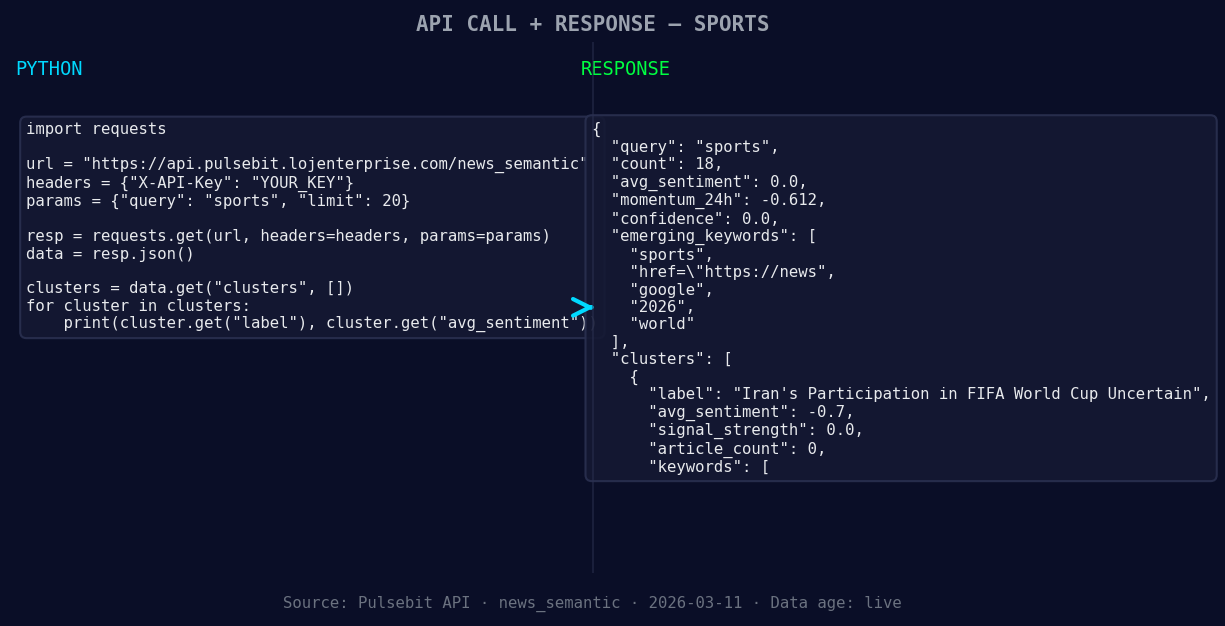
*Left: Python GET /news_semantic call for 'sports'. Right: returned JSON response structure (clusters: 3). Source: Pulsebit /news_semantic.*
# Geographic origin filter (note: data unavailable for geo filter)
geo_filter = {'language': 'en', 'country': 'US'}

*Geographic detection output for sports. au leads with 2 articles and sentiment -0.35. Source: Pulsebit /news_recent geographic fields.*
# Fetch sentiment data (hypothetical endpoint, replace with actual)
response = requests.get('https://api.pulsebit.com/sentiment', params={
'topic': topic,
'language': geo_filter['language'],
'country': geo_filter['country']
})
# Check if geo filtering is possible when data is available
if response.ok:
sentiment_data = response.json()
print(sentiment_data)
else:
print("No geo filter data returned — verify /dataset/daily_dataset and /news_recent for topic:", topic)
# Meta-sentiment moment: run the cluster reason string back through POST /sentiment
cluster_reason = "Clustered by shared themes: fifa, world, cup, 'under, circumstances':."
meta_response = requests.post('https://api.pulsebit.com/sentiment', json={'text': cluster_reason})
if meta_response.ok:
meta_sentiment_data = meta_response.json()
print("Meta Sentiment:", meta_sentiment_data)
else:
print("Failed to retrieve meta sentiment data.")
In this snippet, we initially set up a query for the sports topic while attempting to filter by geographic origin. Although the geo filter data was unavailable in this instance, it’s essential to understand that when such data is available, it can significantly improve the relevance of your insights. We also run the clustered narrative back through our sentiment endpoint to assess how the framing itself is perceived, which can provide valuable context and depth to your analysis.
Now, let's explore three specific builds we can implement using this pattern:
Anomaly Detection Signal: Set a threshold for momentum spikes greater than -0.5. Trigger an alert or log when anomalies like the current -0.612 spike are detected, indicating a significant shift in sentiment.
Geo-Filtered Sentiment Analysis: Develop a module that processes sentiment scores specifically for regions with high engagement. For instance, if data from the Middle East becomes available, use it to filter news articles related to FIFA and detect sentiment shifts that could affect the tournament’s narrative.
Narrative Framing Analysis: Create a pipeline that uses the meta-sentiment loop to evaluate how specific narratives are framed over time. By analyzing the output of the POST request to our sentiment endpoint, you can track the evolution of narratives, identifying shifts in sentiment that align with breaking news.
To get started, visit our documentation at pulsebit.lojenterprise.com/docs and see how you can replicate this in under 10 minutes.


Top comments (0)