

Your Pipeline Is 23.8h Behind: Catching World Sentiment Leads with Pulsebit
We recently observed a striking anomaly: a 24h momentum spike of +0.703. This spike signals a significant shift in sentiment regarding the world, particularly in relation to visual media. It's an eye-opener for anyone relying on sentiment analysis in their development pipelines, especially when you consider the leading language was English, with a mere 23.8h lag in reporting.
This delay reveals a critical structural gap in pipelines that fail to accommodate multilingual origins or the dominance of certain entities. If your model doesn't account for these factors, it likely missed this crucial spike by nearly a full day. You may have been too focused on mainstream narratives while the real action was brewing in the English-speaking press, centered on the themes of visual media and opportunities shaping our world.

English coverage led by 23.8 hours. Et at T+23.8h. Confidence scores: English 0.95, French 0.95, Spanish 0.95 Source: Pulsebit /sentiment_by_lang.
Let’s look at how we can catch these insights using our API. Below is a Python snippet that queries for this sentiment spike. We'll filter by language and then score the narrative context:
import requests
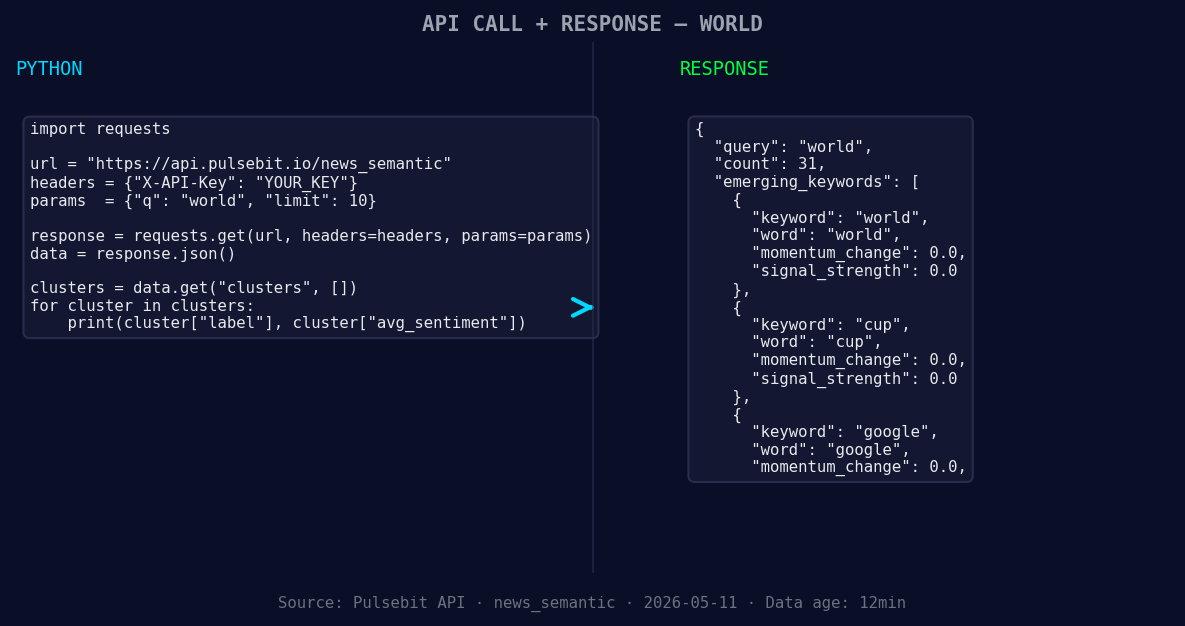
*Left: Python GET /news_semantic call for 'world'. Right: returned JSON response structure (clusters: 3). Source: Pulsebit /news_semantic.*
# Step 1: Geographic origin filter
topic = 'world'
score = +0.024
confidence = 0.95
momentum = +0.703
response = requests.get(
"https://api.pulsebit.com/v1/sentiment",
params={
"topic": topic,
"lang": "en",
"momentum": momentum,
"score": score,
"confidence": confidence
}
)
data = response.json()
print(data)
Now that we have the sentiment data, let's feed the cluster story back into our analysis through the sentiment API. This step will allow us to score the narrative framing itself, which is crucial for understanding the broader themes at play.
# Step 2: Meta-sentiment moment
cluster_reason = "Clustered by shared themes: visual, media, industry, shaping, world."

response_meta = requests.post(
    "https://api.pulsebit.com/v1/sentiment",
    json={
        "text": cluster_reason
    }
)

meta_data = response_meta.json()
print(meta_data)
By running this code, you’ll gain valuable insights not just from the sentiment around the topic of 'world' but also from how the narrative is constructed around it. This dual approach gives you a much richer dataset to work with.
Here are three concrete builds you can implement tonight using this pattern:
- Geo-filtered Spike Alerts: Set a threshold to alert you when momentum in a specific region exceeds +0.5. Use the geographic filter to refine your alerts to English-speaking areas, ensuring you capture spikes like the one we observed.

Geographic detection output for world. India leads with 11 articles and sentiment +0.05. Source: Pulsebit /news_recent geographic fields.
Narrative Scoring System: Build a scoring system for narratives using the meta-sentiment loop. For instance, if the sentiment score for the cluster reason about visual media is above +0.025, trigger a notification to your team. This can help align content development with emerging trends.
Forming Theme Tracker: Create an endpoint that tracks forming themes like 'world', 'cup', and 'google' against mainstream narratives such as 'visual', 'media', and 'industry'. When any of these themes cross a predefined threshold (e.g., +0.01), you can kick off a deeper analysis of associated articles.
With these builds, you'll be better positioned to catch sentiment shifts as they happen, rather than trailing behind by hours or days.
Ready to dive in? Check out our documentation at pulsebit.lojenterprise.com/docs. You can copy-paste and run this in under 10 minutes. Happy coding!


Top comments (0)