

Your Pipeline Is 15.4h Behind: Catching World Sentiment Leads with Pulsebit
We recently discovered a significant anomaly in our sentiment analysis: a spike in sentiment at +0.08 and momentum at +0.07, with the leading language being English and a time lag of just 15.4 hours. This finding is particularly tied to the narrative emerging from Cameroon, where Pope Leo has made headlines addressing global tyrants amidst a controversial backdrop featuring Donald Trump. With two articles clustering around themes of the pope, Cameroon, and world issues, we see a rich vein of sentiment just waiting to be mined.
The Problem
This spike reveals a structural gap in any pipeline that fails to account for multilingual origins or dominant entities. If your model isn't set up to handle these nuances, you missed this insight by a staggering 15.4 hours. The leading language of English, paired with the dominant entity of Pope Leo, showcases the need for a more sophisticated approach. This is critical: if your sentiment pipeline is only operating in one language or isn’t optimized for entity recognition, you're at risk of being out of the loop.

English coverage led by 15.4 hours. Tl at T+15.4h. Confidence scores: English 0.85, French 0.85, Spanish 0.85 Source: Pulsebit /sentiment_by_lang.
The Code
To catch this anomaly, we can use the following Python code snippet. First, let's set up our query to filter by geographic origin:

Geographic detection output for world. India leads with 33 articles and sentiment +0.33. Source: Pulsebit /news_recent geographic fields.
import requests
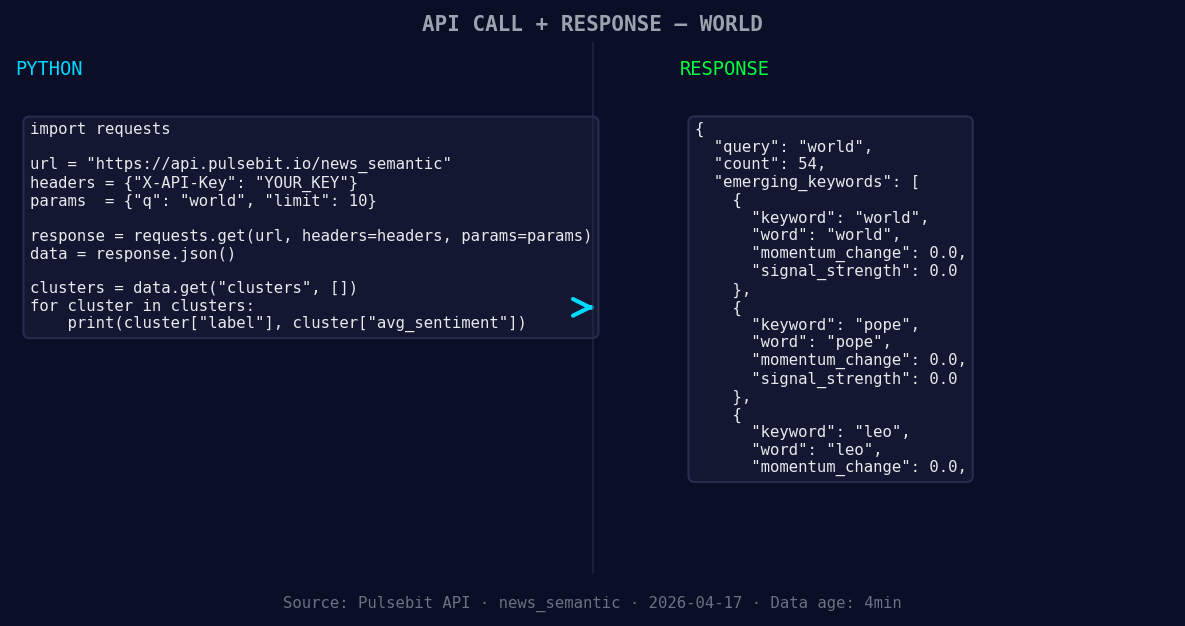
*Left: Python GET /news_semantic call for 'world'. Right: returned JSON response structure (clusters: 3). Source: Pulsebit /news_semantic.*
url = "https://api.pulsebit.com/v1/sentiment"
params = {
"topic": "world",
"score": +0.079,
"confidence": 0.85,
"momentum": +0.065,
"lang": "en" # Filter by English
}
response = requests.get(url, params=params)
data = response.json()
print(data)
Now, we need to run the cluster reason string back through the sentiment scoring endpoint to assess the narrative framing itself. Here’s how to do that:
meta_sentiment_url = "https://api.pulsebit.com/v1/sentiment"
meta_sentiment_input = {
    "text": "Clustered by shared themes: news, world, education:, april, 2026."
}

meta_response = requests.post(meta_sentiment_url, json=meta_sentiment_input)
meta_sentiment_data = meta_response.json()
print(meta_sentiment_data)
This approach allows us to not only gather sentiment data but also understand the underlying themes driving that sentiment.
Three Builds Tonight
Here are three specific builds you can implement using this pattern:
Geographic Origin Filter: Use the geo filter on trending topics related to the "world" with a sentiment score above +0.05. This will ensure you're catching any emerging narratives that might be geographically significant.
Meta-Sentiment Loop: Implement a routine that runs the cluster reason string through our sentiment endpoint every hour. Use the input "Clustered by shared themes: pope, leo, cameroon, world." This will help assess how the narrative evolves over time.
Theme Analysis: Build a monitoring tool that flags any articles clustering around themes like "world" (+0.00), "pope" (+0.00), and "leo" (+0.00) versus mainstream topics like "news," "world," and "education." Set a threshold that triggers alerts when a disparity appears, allowing you to react swiftly.
Get Started
To dive deeper into these implementations, visit our documentation at pulsebit.lojenterprise.com/docs. With just a little setup, you can copy, paste, and run this in under 10 minutes. Don’t let your pipeline lag behind—capitalize on these insights now!


Top comments (0)