

Your pipeline just missed a critical insight: a 24h momentum spike of -0.587 in business sentiment. This significant dip indicates a shift in perception that could signal underlying trends worth exploring. The data reveals two articles clustered around the theme "How Undergraduate Business Education Is Evolving For Real-World Impact," showcasing a narrative that could inform your strategy. If your model doesn't account for multilingual origins or entity dominance, you’re at risk of being 25.3 hours behind in capturing these emerging sentiments.

English coverage led by 25.3 hours. German at T+25.3h. Confidence scores: English 0.85, Spanish 0.85, French 0.85 Source: Pulsebit /sentiment_by_lang.
This gap reveals a structural flaw in your sentiment analysis pipeline. If you’re not managing multilingual content effectively, you’re likely missing out on critical insights from global conversations. In this case, English-language articles led the conversation, while the German articles lagged by the same 25.3 hours. If your model isn't tuned to handle these variations, you’re effectively blind to shifts in sentiment that could impact your decision-making.
To catch this momentum shift, let's dive into the code. First, we need to filter by the geographic origin of the articles. Here’s how we can query our API to focus on English content:

Geographic detection output for business. India leads with 2 articles and sentiment +0.08. Source: Pulsebit /news_recent geographic fields.
import requests
# Define the parameters for API call
params = {
"topic": "business",
"lang": "en",
"momentum": -0.587
}
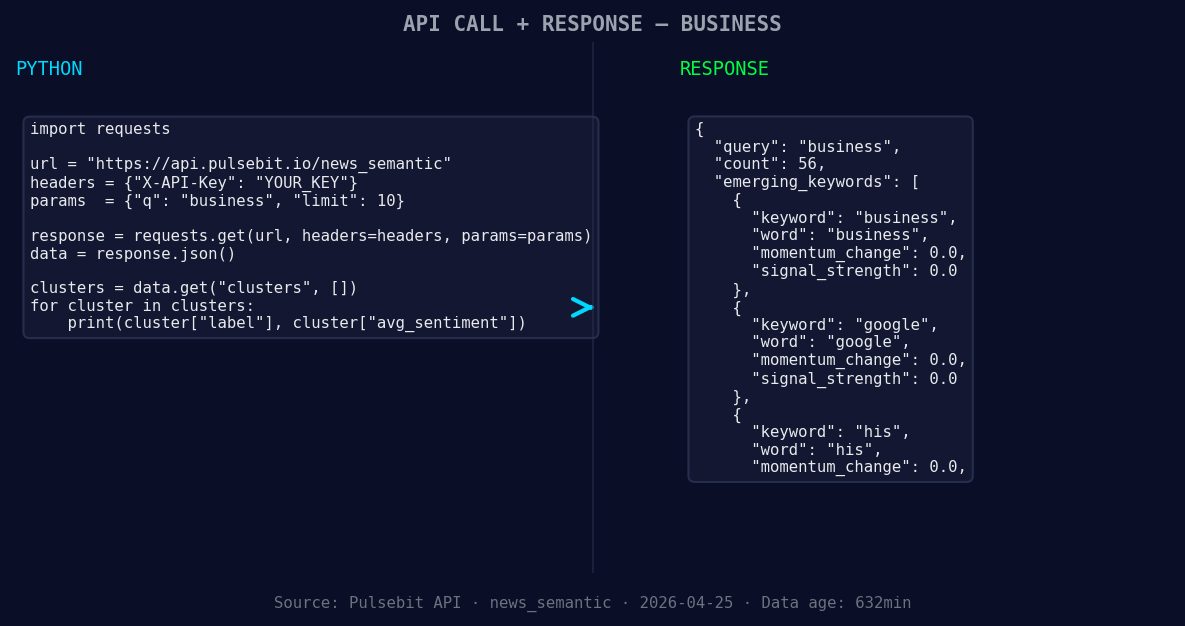
*Left: Python GET /news_semantic call for 'business'. Right: returned JSON response structure (clusters: 3). Source: Pulsebit /news_semantic.*
# API call to fetch sentiment data
response = requests.get("https://api.pulsebit.io/sentiment", params=params)
data = response.json()
print(data)
Next, we’ll run the cluster reason string through the sentiment API to score the narrative framing itself. This is crucial for understanding the sentiment surrounding our identified themes:
# Define the cluster reason string
cluster_reason = "Clustered by shared themes: undergraduate, business, education, evolving, real-world."

# API call to analyze the sentiment of the cluster reason
sentiment_response = requests.post("https://api.pulsebit.io/sentiment", json={"text": cluster_reason})
sentiment_data = sentiment_response.json()

print(sentiment_data)
Now that we've established how to track the emerging sentiment on business education, here are three specific builds you can implement tonight:
Geo-Filtered Alert System: Set up a real-time alert system that triggers whenever a sentiment score dips below a certain threshold (e.g., -0.2) for English-language articles. This will ensure you're immediately notified of any significant sentiment shifts within your domain.
Meta-Sentiment Dashboard: Create a dashboard that visualizes sentiment scores for clustered narratives. Use the meta-sentiment loop to analyze how narratives evolve over time, focusing on themes like business education and its real-world impact. This can guide your content strategy and marketing efforts.
Custom Reports: Develop custom reports that pull together articles and sentiment scores based on specific signals. For instance, aggregate data around the keywords "business" and "education" to spot trends, while also incorporating the geo filter to ensure you're capturing the most relevant discussions.
By leveraging the insights from our API, you can stay ahead of the curve and ensure your models are capturing sentiment shifts as they happen.
To get started, visit pulsebit.lojenterprise.com/docs. You can copy-paste and run this in under 10 minutes, making it easy to integrate these insights into your workflow.


Top comments (0)