

Your Pipeline Is 21.4h Behind: Catching World Sentiment Leads with Pulsebit
We just uncovered a striking anomaly: a 24h momentum spike of +0.257 in sentiment around the topic of “world.” This spike was led by English press coverage, specifically clustered around the fascinating match between Shaun Murphy and Wu Yize in the World Snooker Championship. This is not just a bump; it's a clear signal that something significant is happening, and it’s crucial to understand how to tap into these real-time insights.
Yet, if your pipeline doesn’t account for multilingual sources and entity dominance, you might have missed this momentum by a staggering 21.4 hours. The leading language here is English, but the themes are global. If your model is only tuned to one language or ignores the dominant entities, you’re not just lagging — you’re missing out on critical opportunities to engage with timely narratives that resonate with audiences worldwide.

English coverage led by 21.4 hours. Id at T+21.4h. Confidence scores: English 0.85, Spanish 0.85, French 0.85 Source: Pulsebit /sentiment_by_lang.
To catch these spikes, we can leverage our API effectively. Here’s how we can query for sentiment around the topic of “world” while focusing on English-language sources.
import requests
# Define parameters for API call
params = {
"topic": "world",
"score": +0.075,
"confidence": 0.85,
"momentum": +0.257,
"lang": "en" # Geographic origin filter
}
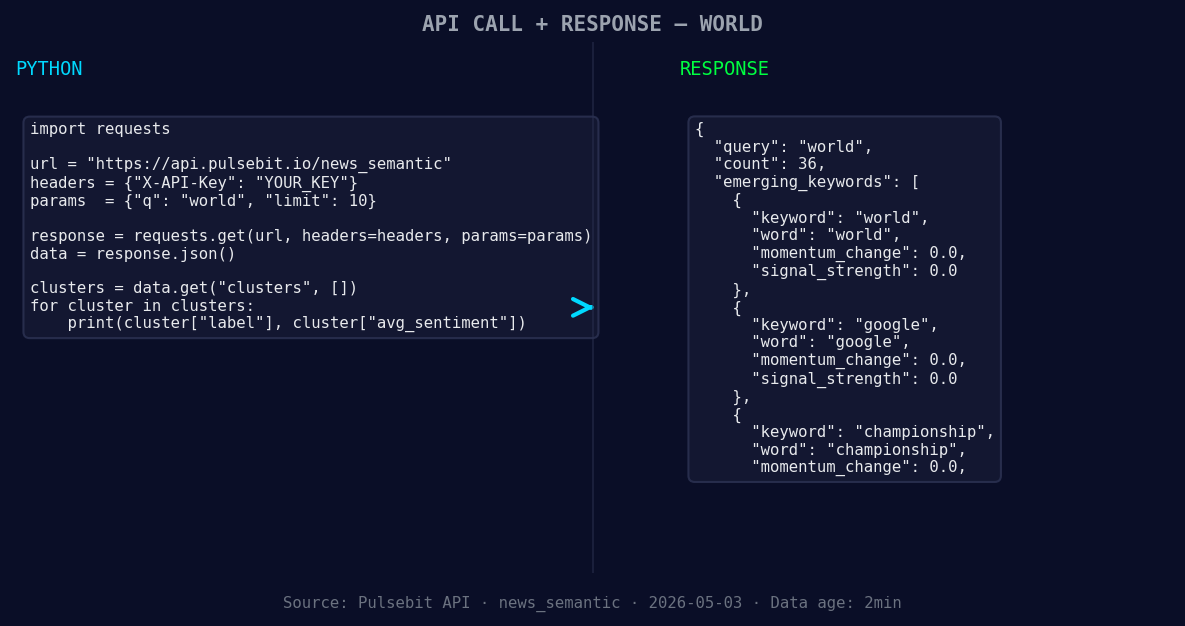
*Left: Python GET /news_semantic call for 'world'. Right: returned JSON response structure (clusters: 3). Source: Pulsebit /news_semantic.*
# Make the API call to retrieve sentiment data
response = requests.get('https://api.pulsebit.com/v1/sentiment', params=params)
data = response.json()
Next, we also want to understand how the narrative is framed around this momentum spike. We'll run the cluster reason string back through our sentiment scoring endpoint to evaluate how the themes interconnect.
# Define the cluster reason string
cluster_reason = "Clustered by shared themes: murphy, snooker, championship, final, world."

# Make a POST request to analyze the sentiment of the narrative framing
sentiment_response = requests.post('https://api.pulsebit.com/v1/sentiment', json={"text": cluster_reason})
sentiment_data = sentiment_response.json()
With this dual approach, we not only capture the spike in global sentiment but also get an understanding of how the narrative is constructed around it.
Now, let’s look at three specific builds we can create using this data.
- Geo-Filtered Alert System: Set a threshold for momentum spikes, such as +0.25. Use the geographic filter to notify you when the sentiment around “world” in English exceeds this threshold. This allows you to act quickly on rising trends.

Geographic detection output for world. France leads with 7 articles and sentiment +0.38. Source: Pulsebit /news_recent geographic fields.
Meta-Sentiment Dashboard: Create a dashboard that runs the cluster reason string through our API every hour. If the sentiment score shifts significantly (e.g., more than +0.1), alert your team. This keeps you ahead of the narrative shifts.
Content Strategy Alignment: Use the themes forming around “world”, “google”, and “championship” to guide content creation. Set a signal that triggers when these themes cluster together. This ensures your content strategy aligns with emerging narratives and maximizes audience engagement.
By leveraging these builds, you can ensure your pipeline is not just reactive but also proactive, catching sentiment leads before they become mainstream trends.
Ready to get started? Check out our documentation at pulsebit.lojenterprise.com/docs. You can copy-paste the code snippets above and run them in under 10 minutes to start capturing these valuable insights.


Top comments (0)