

Your Pipeline Is 8.8h Behind: Catching Climate Sentiment Leads with Pulsebit
We’ve just unearthed an intriguing anomaly: a 24h momentum spike of -0.505 in climate sentiment. This sudden drop suggests a significant shift in how the climate narrative is being perceived, led by English press coverage with a leading language timestamp of 8.8h. The implications of this data point are critical, especially if your pipeline isn’t equipped to handle multilingual origins or entity dominance.

English coverage led by 8.8 hours. So at T+8.8h. Confidence scores: English 0.85, Spanish 0.85, Ca 0.85 Source: Pulsebit /sentiment_by_lang.
If your model isn't set up to analyze and react to these dynamics, you could be missing critical insights by as much as 8.8 hours. In this case, the English language coverage is dominating the climate narrative, but the information flow is lagging behind. This gap could mean you’re not responding quickly enough to shifts in sentiment around crucial topics like energy and world events, both of which are forming strong clusters in this context.
Here’s how to catch these momentum shifts using our API. First, we’ll set up a geographic origin filter to focus on English-language articles. We’ll query our API to get the relevant sentiment data for the topic of climate using the following code:
import requests
# Define parameters for the API call
topic = 'climate'
score = -0.505
confidence = 0.85
momentum = -0.505
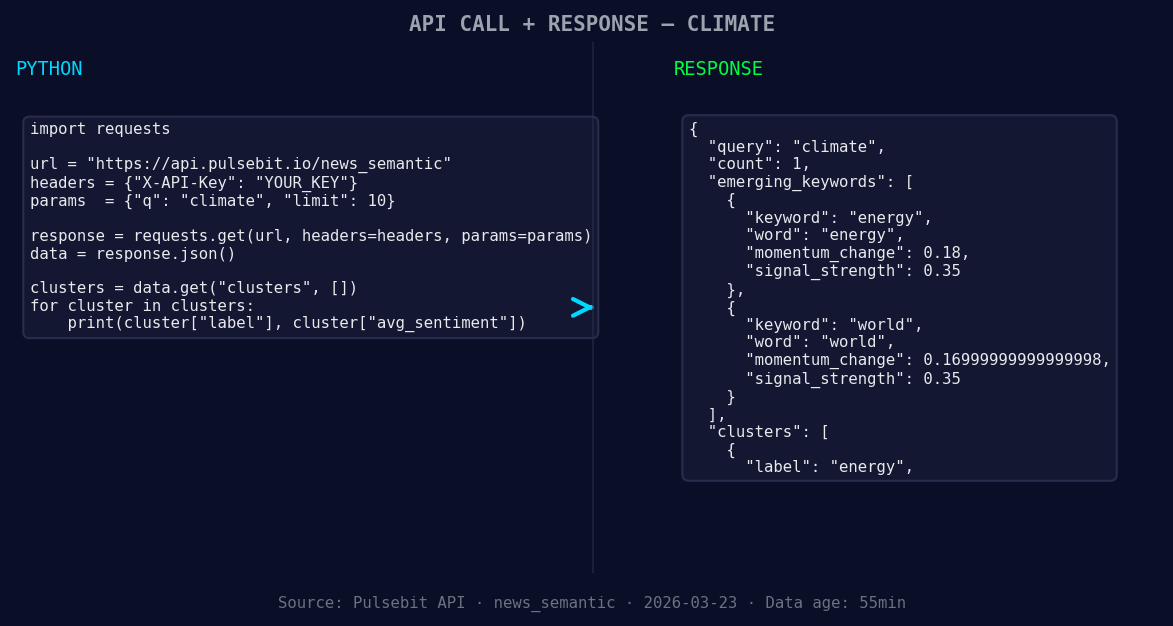
*Left: Python GET /news_semantic call for 'climate'. Right: returned JSON response structure (clusters: 1). Source: Pulsebit /news_semantic.*
# API endpoint for querying sentiment
url = 'https://api.pulsebit.com/sentiment'
params = {
'topic': topic,
'lang': 'en',
'score': score,
'confidence': confidence,
'momentum': momentum
}
# Make the API call
response = requests.get(url, params=params)
data = response.json()
print(data)
This code retrieves sentiment data specifically for climate topics in English, allowing us to focus on the most relevant narratives. But we won’t stop there. To deepen our analysis, we’ll run the cluster reason string through our sentiment endpoint to assess the framing of the narrative itself:
# Meta-sentiment moment
meta_sentiment_url = 'https://api.pulsebit.com/sentiment'

# Fallback string for sentiment scoring
fallback_string = "Semantic API incomplete — fallback semantic structure built from available keywords and article/search evidence."

# Make the API call for meta-sentiment
meta_response = requests.post(meta_sentiment_url, json={'text': fallback_string})
meta_data = meta_response.json()

print(meta_data)
By running this second call, we can get a better understanding of how the narrative is being constructed around climate topics, especially in light of emerging themes like energy and world events, which are forming positive sentiment clusters (+0.18 and +0.17, respectively).
Here are three actionable builds you can implement based on this discovery:
- Geographic Filtered Sentiment Analysis: Use the geographic filter to monitor sentiment shifts specifically in English-speaking regions. Focus on the topic of climate and set a threshold for significant sentiment changes, such as a score below -0.4.

Geographic detection output for climate. India leads with 1 articles and sentiment +0.00. Source: Pulsebit /news_recent geographic fields.
Meta-Sentiment Loop for Dynamic Framing: Create a service that runs the cluster reason strings through our sentiment endpoint to continuously analyze how the narratives are framed. You could set a regular interval (e.g., every hour) to catch shifts that may not be immediately evident.
Forming Theme Alerts: Set up alerts for forming themes like energy and world. If sentiment scores for these themes exceed a certain threshold, trigger notifications to your team so they can quickly respond to emerging narratives.
This approach not only keeps you ahead of the curve but also allows you to dynamically adjust your strategies based on real-time sentiment analysis.
To get started, check out our documentation at pulsebit.lojenterprise.com/docs. You can copy-paste and run these snippets in under 10 minutes to see how quickly you can catch critical sentiment shifts.


Top comments (0)