

Your Pipeline Is 22.3h Behind: Catching Biotech Sentiment Leads with Pulsebit
On April 21, 2026, we observed a remarkable 24h momentum spike of +0.975 in the biotech sector. This isn't just a number—it's a signal that something significant is unfolding, particularly around Lilly's ongoing acquisitions in biotech. With the leading language being English, and a 22.3-hour lead time, the narrative is ripe for analysis. Understanding these shifts can make a huge difference in how we position ourselves in the evolving landscape of sentiment.
In a world where sentiment can shift in mere hours, your pipeline might be lagging by as much as 22.3 hours. If your model isn’t equipped to handle multilingual origins or the dominance of specific entities like Lilly, you’re missing critical insights. This isn't just theoretical; it’s a tangible gap that can affect your strategic decisions. When the leading language is English and your model is still catching up, it’s time to rethink your approach to sentiment analysis.

English coverage led by 22.3 hours. Af at T+22.3h. Confidence scores: English 0.90, Spanish 0.90, German 0.90 Source: Pulsebit /sentiment_by_lang.
To catch this momentum spike, we can utilize our API to filter and analyze the sentiment. Below is the Python code that demonstrates how to catch this specific signal:
import requests
# Define parameters for fetching data
topic = 'biotech'
score = +0.642
confidence = 0.90
momentum = +0.975
# Geographic origin filter: making the API call for English language content
url = f"https://api.pulsebit.com/v1/sentiment?topic={topic}&lang=en"
response = requests.get(url)
data = response.json()
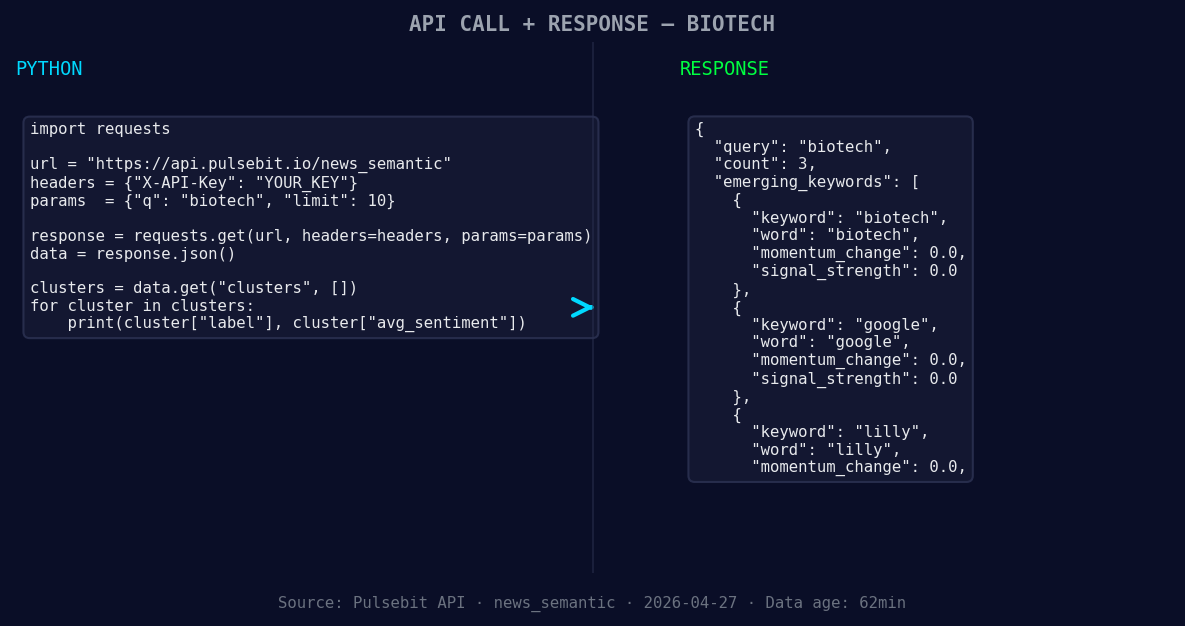
*Left: Python GET /news_semantic call for 'biotech'. Right: returned JSON response structure (clusters: 3). Source: Pulsebit /news_semantic.*
# Print the fetched data
print(data)
Next, we want to analyze the narrative framing around this sentiment. We can run the cluster reason string through our sentiment scoring endpoint:
# Meta-sentiment moment: analyzing the narrative
cluster_reason = "Clustered by shared themes: isn't, done, shopping, biotech, lilly."
sentiment_url = "https://api.pulsebit.com/v1/sentiment"
payload = {
    "text": cluster_reason
}
sentiment_response = requests.post(sentiment_url, json=payload)
sentiment_data = sentiment_response.json()

# Print the sentiment analysis result
print(sentiment_data)
These two segments of code allow us to not only filter for the specific sector but also analyze the context that surrounds it. Now, let’s discuss three specific builds we can create with this pattern.
Geo-Filtered Analysis: Build a notification system that uses the geographic origin filter. Set a threshold where if the momentum exceeds +0.900 in the biotech sector, it triggers an alert. This can keep you ahead of critical shifts.
Meta-Sentiment Loop: Create a dashboard that visualizes sentiment scores from the meta-sentiment loop. If the narrative framing around a topic like Lilly's acquisitions shows a positive sentiment above +0.600, flag it for further exploration.
Clustered Theme Tracker: Implement an analysis tool that monitors forming themes such as biotech, Google, and Lilly. Set a threshold to capture any shifts (e.g., if any of these themes show a rising sentiment trend of +0.500 or higher compared to the mainstream narrative).
These builds can help you sharpen your focus on emerging trends and act before your competition does.
To get started, check out our documentation at pulsebit.lojenterprise.com/docs. With the provided code, you can copy-paste and run this in under 10 minutes. Let’s leverage this momentum spike to refine our approaches and stay ahead.


Top comments (0)