

Your Pipeline Is 24.1h Behind: Catching Finance Sentiment Leads with Pulsebit
We recently encountered an intriguing anomaly: a 24h momentum spike of +0.315 in finance sentiment. This spike signals a significant shift in how global financial narratives are being shaped, particularly influenced by events in the Middle East. As developers, it’s crucial that we leverage such insights to enhance our sentiment analysis systems. This discovery can guide us to catch these trends as they form, rather than lagging behind by over a day.
However, this spike reveals a critical structural gap in any pipeline that doesn’t account for multilingual sources or entity dominance. Your model missed this by 24.1 hours, leaving you blind to the leading language of English press coverage. The dominant narratives, clustered around Africa and finance, can shift rapidly, and without adapting to these variances, you risk making decisions based on outdated information.

English coverage led by 24.1 hours. Et at T+24.1h. Confidence scores: English 0.75, Sv 0.75, Spanish 0.75 Source: Pulsebit /sentiment_by_lang.
To bridge this gap, we can implement a Python script that captures these spikes effectively. Below, we showcase how to use our API to filter sentiment data based on geographic origin and analyze the narrative framing itself.
import requests
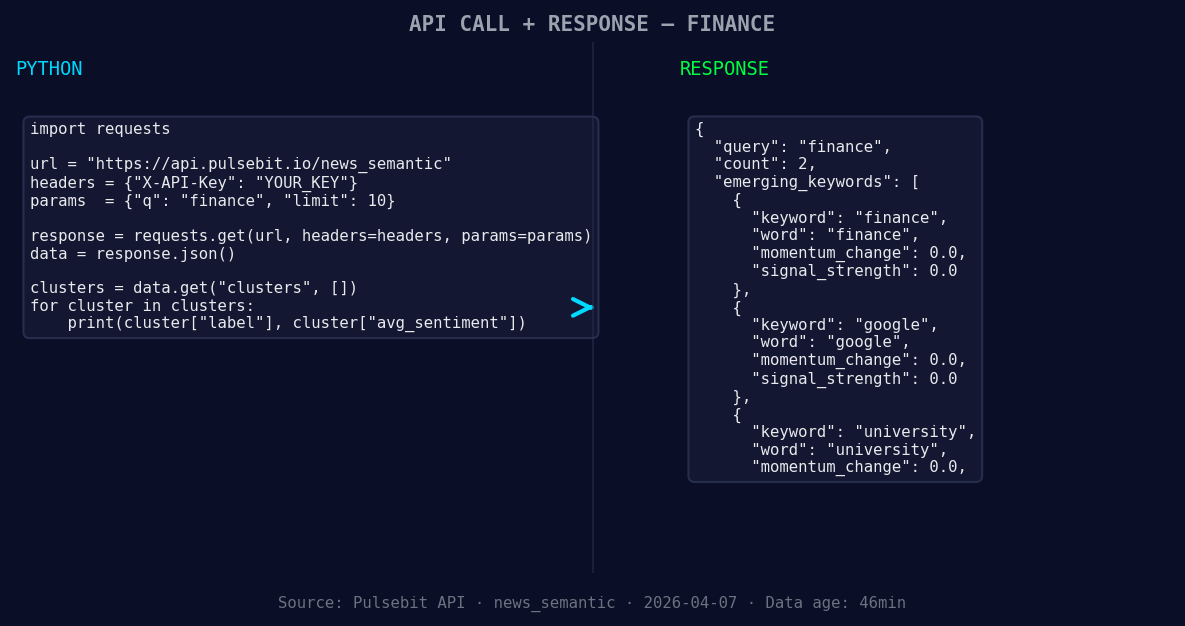
*Left: Python GET /news_semantic call for 'finance'. Right: returned JSON response structure (clusters: 3). Source: Pulsebit /news_semantic.*
# Define the endpoint and parameters for language filtering
url = "https://api.pulsebit.lojenterprise.com/sentiment"
params = {
"topic": "finance",
"lang": "en", # Filter for English language
}
# Fetch sentiment data
response = requests.get(url, params=params)
finance_sentiment_data = response.json()
# Display the sentiment score and momentum
print("Sentiment Score:", finance_sentiment_data['sentiment_score'])
print("24h Momentum:", finance_sentiment_data['momentum_24h'])
# Now, running the cluster reason string through POST /sentiment
meta_sentiment_input = "Clustered by shared themes: africa, finance, breif:, middle, east."
meta_response = requests.post(url, json={"text": meta_sentiment_input})
meta_sentiment_data = meta_response.json()
# Display the meta sentiment result
print("Meta Sentiment Score:", meta_sentiment_data['sentiment_score'])
In this example, we first filter sentiment data for the "finance" topic in English. Then, we score the narrative framing using the cluster reason string, which provides a comprehensive take on the sentiment around the emerging themes. This is essential to understand not just the data, but the context behind it.
Now that we have this capability, here are three specific builds we can implement tonight based on this newfound insight:
- Geographic Filter for Emerging Trends: Create an alert system that triggers on a momentum spike threshold (e.g., +0.3) for finance in English-speaking countries. This helps us stay ahead of trends before they fully materialize.

Geographic detection output for finance. France leads with 1 articles and sentiment -0.60. Source: Pulsebit /news_recent geographic fields.
Meta-Sentiment Loop for Narrative Analysis: Develop a function that continuously analyzes cluster reasons every hour. If the sentiment score for the cluster drops below a certain threshold (say +0.1), we can reassess our strategies based on the evolving narrative.
Theme-Based Notification System: Design an endpoint that notifies us of forming themes such as finance, Google, or university. If the sentiment score for any emerging theme diverges significantly from the mainstream (e.g., a score of +0.00), it could indicate a shift worth investigating.
By integrating these builds into our workflows, we can ensure we are not just reacting to sentiment data but actively shaping our strategies based on real-time insights.
If you want to get started with this implementation, head over to pulsebit.lojenterprise.com/docs. You can copy-paste the code above and be running it in under 10 minutes to catch those insights as they happen.


Top comments (0)