

Your Pipeline Is 22.7h Behind: Catching Tech Sentiment Leads with Pulsebit
We’ve just uncovered a fascinating anomaly: a 24h momentum spike of +0.797 in tech sentiment. This spike, driven largely by a single article on "Samsung's Initiative for Future-Tech Skills Training," highlights a significant shift in sentiment that you might have missed if your pipeline isn't tuned to handle multilingual origins or entity dominance. With the leading language being English and the article emerging 22.7 hours ago, it’s a clear indicator that there’s a lag in your model that needs addressing.

English coverage led by 22.7 hours. Cy at T+22.7h. Confidence scores: English 0.90, French 0.90, Spanish 0.90 Source: Pulsebit /sentiment_by_lang.
The structural gap in your pipeline becomes glaringly obvious when you realize that your model missed this significant sentiment shift by a full 22.7 hours. The leading entity here, Samsung, combined with themes of students and skills, emphasizes how critical it is to capture emerging narratives quickly—especially in a multilingual context. Without this capability, you risk being out of sync with the latest developments, which can lead to misguided insights and ineffective strategies.
Here’s how you can catch this momentum spike using our API. First, we’ll filter our query to focus on English language articles related to tech:
import requests
# Set the parameters for our API call
topic = 'tech'
score = +0.797
confidence = 0.90
momentum = +0.797
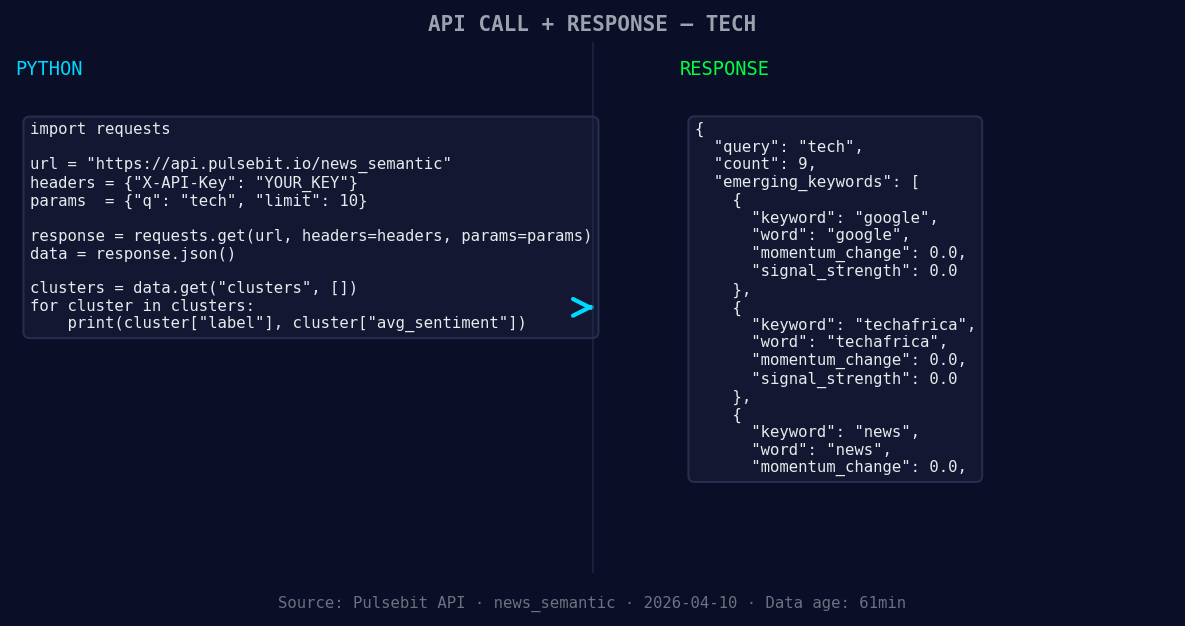
*Left: Python GET /news_semantic call for 'tech'. Right: returned JSON response structure (clusters: 3). Source: Pulsebit /news_semantic.*
# Geographic origin filter: English language articles
response = requests.get(
'https://api.pulsebit.com/v1/articles',
params={
'topic': topic,
'lang': 'en',
'score': score,
'confidence': confidence,
'momentum': momentum
}
)
articles = response.json()
Next, we’ll run the cluster reason string through our sentiment scoring endpoint to gauge the narrative framing:
# Meta-sentiment moment
cluster_reason = "Clustered by shared themes: samsung, students, skills, trains, 5000."
sentiment_response = requests.post(
    'https://api.pulsebit.com/v1/sentiment',
    json={'text': cluster_reason}
)

sentiment_score = sentiment_response.json()
With these two steps, you're ensuring that your model captures not just the current sentiment spike, but also understands the context behind it.
Now that we have this anomaly in our sights, here are three specific builds you can implement immediately:
- Anomaly Detection with Geo Filter: Set up a threshold for sentiment spikes above +0.5 specifically for English articles. Use the geographic filter to narrow down your dataset. This will help you identify localized sentiment trends that could affect broader narratives.

Geographic detection output for tech. India leads with 8 articles and sentiment +0.38. Source: Pulsebit /news_recent geographic fields.
Meta-Sentiment Analysis: Create a secondary pipeline that focuses on the meta-sentiment of narratives clustered around emerging themes. Use the sentiment loop for phrases like "samsung, students, skills" and set a score threshold of +0.6 to trigger alerts for potential opportunities.
Comparative Analysis: Implement a comparison algorithm that evaluates the sentiment of forming themes (like google(+0.00), techafrica(+0.00), and news(+0.00)) against mainstream narratives. If the mainstream sentiment is significantly higher, flag it for further investigation—this can indicate a shift in public perception.
Getting started is straightforward. Head to our documentation at pulsebit.lojenterprise.com/docs. With the code snippets provided, you can copy-paste and run this in under 10 minutes, ensuring you’re always in tune with the latest tech sentiment trends.


Top comments (0)