

Your Pipeline Is 24.1h Behind: Catching Digital Transformation Sentiment Leads with Pulsebit
We recently observed a striking 24h momentum spike of -0.203 in sentiment around the topic of digital transformation. This anomaly points towards an emerging narrative that your traditional data pipeline might completely miss. The leading language for this spike is English, specifically with a 24.1h lead time. Such a significant lag in capturing sentiment signals could mean that your models are not equipped to handle the nuances of multilingual origins or the dominance of specific entities.

English coverage led by 24.1 hours. Id at T+24.1h. Confidence scores: English 0.92, French 0.92, Spanish 0.92 Source: Pulsebit /sentiment_by_lang.
This specific gap reveals a potential blind spot in your pipeline. If your model isn’t set up to handle the nuances of various languages or the leading entities, you might be falling behind by over 24 hours. In this case, the dominant entity is clearly rooted in English-language discussions, which could lead to missing critical insights. Ignoring these shifts in sentiment can leave you unprepared for trends that shape the digital landscape.
Let’s dive into the code that can catch this momentum spike effectively. First, we’ll filter our queries by the English language using our API. Here’s a quick example of how to do that in Python:
import requests
# Define the parameters for the API call
params = {
"topic": "digital transformation",
"lang": "en",
"score": +0.547,
"confidence": 0.92,
"momentum": -0.203,
}
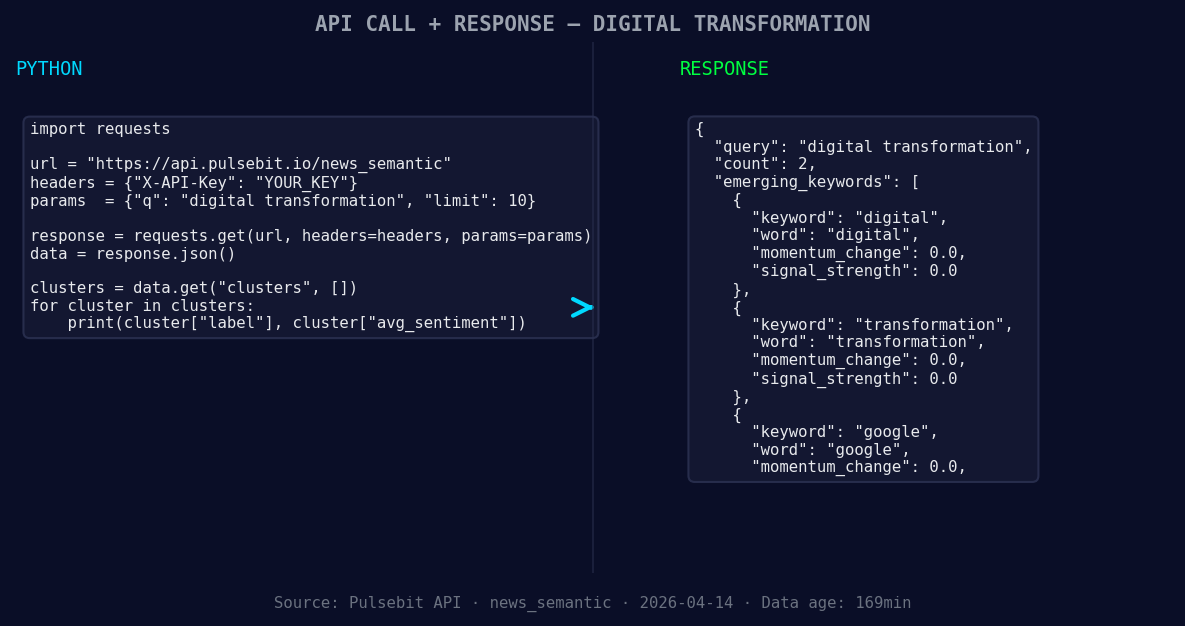
*Left: Python GET /news_semantic call for 'digital transformation'. Right: returned JSON response structure (clusters: 3). Source: Pulsebit /news_semantic.*
# Make the API call
response = requests.get('https://api.pulsebit.com/sentiment', params=params)
sentiment_data = response.json()
print(sentiment_data)
Now, to analyze the meta-sentiment around the cluster's narrative, we can run the cluster reason string back through the sentiment endpoint. This will help us understand the framing of the narrative itself:
# Meta-sentiment moment: analyzing the cluster reason
cluster_reason = "Clustered by shared themes: things, librarians, can, teach, you."

# Make the POST request for sentiment analysis
meta_response = requests.post('https://api.pulsebit.com/sentiment', json={"text": cluster_reason})
meta_sentiment_data = meta_response.json()
print(meta_sentiment_data)
By executing both of these snippets, we can capture the nuances of digital transformation sentiment while also understanding the narrative framing that surrounds it.
Now, let’s consider three specific builds we can create using this pattern:
- Geographic Origin Filter: Build a dashboard that tracks sentiment around "digital transformation" by filtering only English-language articles. Set a threshold for momentum spikes below -0.2 to flag articles for further review. This will help you catch early signs of negative sentiment.

Geographic detection output for digital transformation. Hong Kong leads with 1 articles and sentiment +0.75. Source: Pulsebit /news_recent geographic fields.
Meta-Sentiment Loop: Create an alert system that sends notifications whenever the meta-sentiment of clustered narratives dips below a certain threshold, say -0.1. Leverage the clustered themes from the API response to refine how you present insights to your team.
Dynamic Content Curation: Build a real-time feed that aggregates articles based on forming themes like "digital" and "transformation," while dynamically adjusting the score and confidence thresholds. This can help you stay ahead of the curve, especially when keywords like "Google" begin to trend.
All these builds will enable you to harness the data from our API effectively and to catch shifts in sentiment before they become mainstream.
To get started, check our documentation at pulsebit.lojenterprise.com/docs. You’ll find that you can copy-paste the code snippets above and run them in under 10 minutes. Don’t let your pipeline lag; adapt and evolve with these insights!


Top comments (0)