

Your Pipeline Is 29.3h Behind: Catching Business Sentiment Leads with Pulsebit
We recently uncovered a striking anomaly: a 24-hour momentum spike of -1.050 in business sentiment. This data suggests a significant shift in perception regarding business development, particularly led by a French press narrative. With a leading language of French at a 29.3-hour threshold, we find ourselves facing the question — how do we catch these shifts in sentiment before they affect our decisions?
When your pipeline doesn’t account for multilingual origins or entity dominance, it risks falling behind. In this case, if your model is only processing English content, it has missed a sentiment shift by 29.3 hours. The leading language of French is crucial here; without a strategy for multilingual data, you won’t be able to anticipate sentiment changes that could impact your business strategies.

French coverage led by 29.3 hours. Nl at T+29.3h. Confidence scores: French 0.85, English 0.85, Spanish 0.85 Source: Pulsebit /sentiment_by_lang.
To catch these momentum shifts, we can leverage our API. Here's how you can filter by geographic origin and analyze the sentiment narrative:

Geographic detection output for business. India leads with 7 articles and sentiment +0.65. Source: Pulsebit /news_recent geographic fields.
import requests
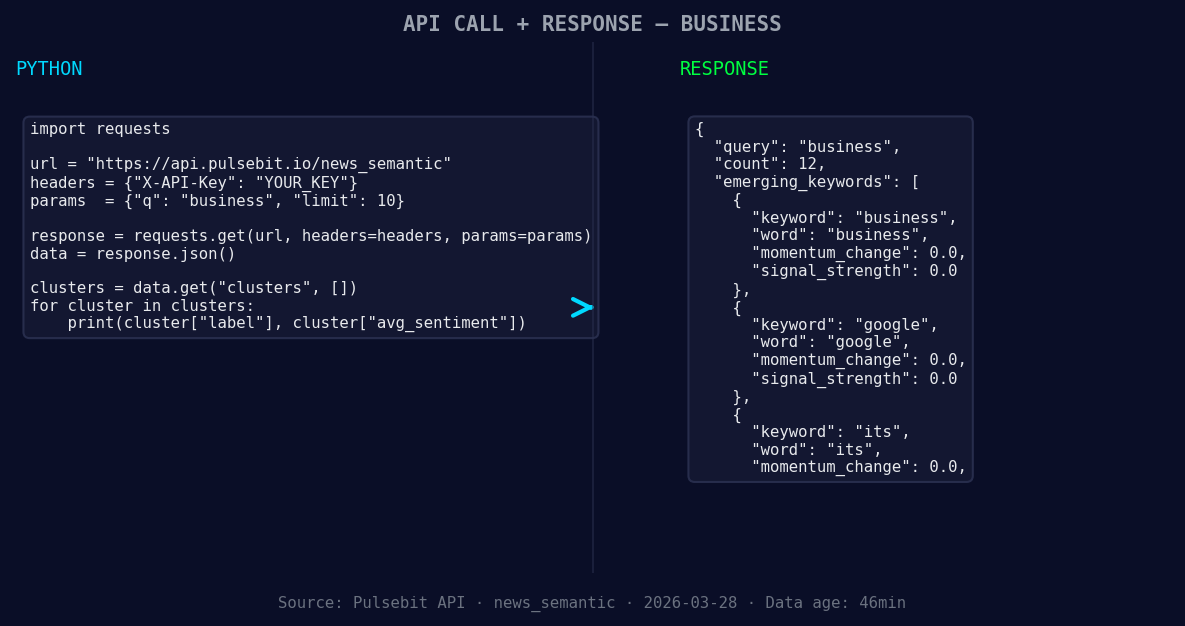
*Left: Python GET /news_semantic call for 'business'. Right: returned JSON response structure (clusters: 3). Source: Pulsebit /news_semantic.*
# First, we query the sentiment data for French articles on business
url = "https://api.pulsebit.com/v1/sentiment"
params = {
"topic": "business",
"lang": "fr",
"momentum": -1.050,
"score": -0.700,
"confidence": 0.85
}
response = requests.get(url, params=params)
data = response.json()
print(data)
Next, we want to validate the narrative framing itself. We’ll run the cluster reason string through the sentiment analysis endpoint:
# Now we analyze the framing of our cluster story
cluster_reason = "Clustered by shared themes: electors, business, development, peace, harmony."
sentiment_url = "https://api.pulsebit.com/v1/sentiment"
sentiment_response = requests.post(sentiment_url, json={"text": cluster_reason})
sentiment_data = sentiment_response.json()
print(sentiment_data)
Using this approach, we can derive insights about how narratives form around specific themes and gauge their impact on business sentiment.
Now, what can we build with this newfound insight? Here are three specific actions to consider:
Geographic Origin Filter: Set up an alert system that utilizes the geographic origin filter to catch sentiment changes in real-time. Use the query provided above to monitor French language articles specifically related to business.
Meta-Sentiment Loop: Create a dashboard that continuously analyzes sentiment framing. Use the meta-sentiment loop to score narratives. This will allow you to understand how specific themes are resonating over time, particularly for topics like "business," "development," and "electors."
Threshold-Based Trigger: Implement a threshold-based trigger within your pipeline. For example, if sentiment score drops below -0.700 and the momentum is less than -1.000, escalate to alert your team. This can help ensure that you’re not missing critical shifts.
By leveraging these insights and tools, we can better position ourselves to respond swiftly to changes in sentiment surrounding key topics.
Ready to dive into this? Check out our documentation at pulsebit.lojenterprise.com/docs. You can copy-paste the code snippets provided here and get up and running in under 10 minutes.


Top comments (0)