

Your Pipeline Is 28.5h Behind: Catching Film Sentiment Leads with Pulsebit
We stumbled upon a fascinating anomaly: a 24-hour momentum spike of +0.751 in film sentiment. This spike signals a significant shift in the narrative surrounding film festivals, led predominantly by English press coverage, which is trailing Italian sentiment by 28.5 hours. It’s a clear indication that something is brewing in the cinematic world—a revelation that your existing pipeline likely missed.
The Problem
This discovery highlights a critical structural gap in pipelines that lack robust handling of multilingual data and entity dominance. If your model isn't accounting for these dynamics, it could be missing out on valuable signals by as much as 28.5 hours. In this case, English sentiment is lagging behind, and you need to ask yourself: how many opportunities have you missed because your system couldn’t adapt to the nuances of language and culture? The leading entity in this case—film—has been overshadowed, and if you’re not careful, your decisions could be based on outdated information.

English coverage led by 28.5 hours. Italian at T+28.5h. Confidence scores: English 0.85, French 0.85, Spanish 0.85 Source: Pulsebit /sentiment_by_lang.
The Code
To catch this momentum spike, we can leverage our API effectively. Below is the Python code that uses the geographic origin filter to get the relevant sentiment data.

Geographic detection output for film. India leads with 5 articles and sentiment +0.33. Source: Pulsebit /news_recent geographic fields.
import requests
# Set parameters for the API call
topic = 'film'
score = +0.626
confidence = 0.85
momentum = +0.751
lang = "en"
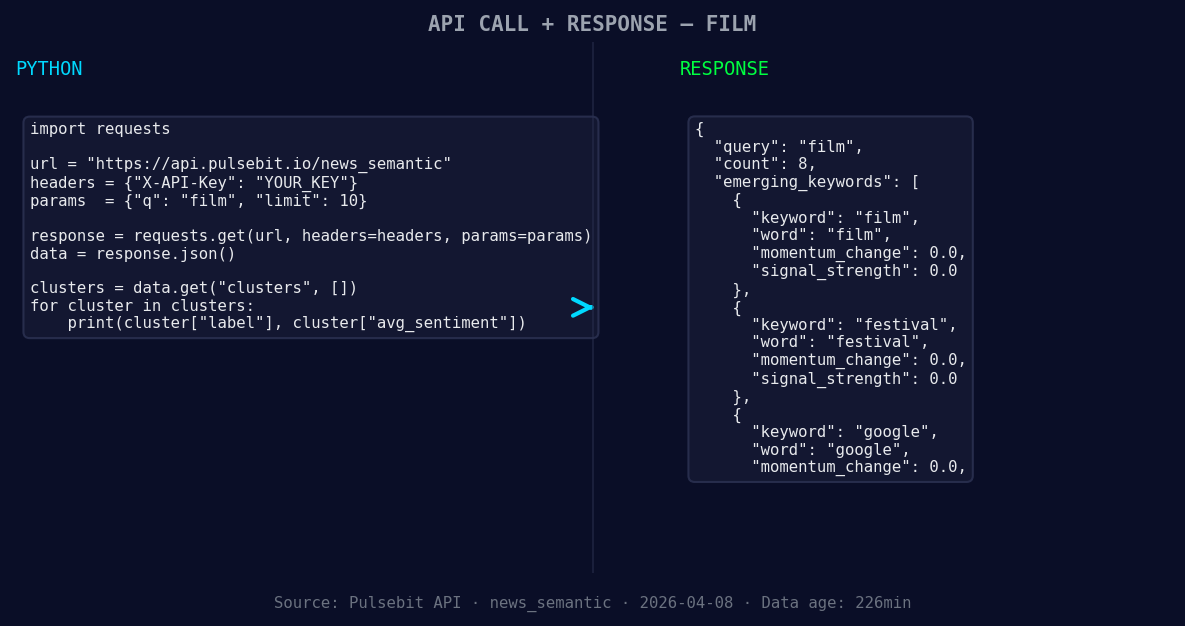
*Left: Python GET /news_semantic call for 'film'. Right: returned JSON response structure (clusters: 3). Source: Pulsebit /news_semantic.*
# API call to fetch sentiment data
url = f"https://api.pulsebit.com/v1/sentiment?topic={topic}&lang={lang}"
response = requests.get(url)
data = response.json()
# Check the response
print(data)
Next, let’s analyze the meta-sentiment for the cluster story framing itself. We’ll take the narrative reason string and score it through our sentiment endpoint:
# Meta-sentiment moment
cluster_reason = "Clustered by shared themes: fest, showcases, prince, maria, bamford."

# API call for meta-sentiment
url_meta = "https://api.pulsebit.com/v1/sentiment"
payload = {
    "text": cluster_reason
}
response_meta = requests.post(url_meta, json=payload)
meta_data = response_meta.json()

# Check the meta-sentiment response
print(meta_data)
This two-step approach not only uncovers the film sentiment spike but also gauges the underlying narrative themes shaping public discourse.
Three Builds Tonight
Here are three specific builds you can implement using this pattern:
Geo-Filtered Sentiment Analysis: Use the geographic origin filter to tune in on English-speaking sentiments around film and festivals. Set your threshold to capture spikes above +0.7 in momentum. This will help you stay ahead of emerging trends.
Meta-Sentiment Scoring: Implement the meta-sentiment loop using the cluster reason from recent articles. If the sentiment score from this analysis is above +0.5, trigger alerts for potential content creation or marketing strategies.
Cluster Theme Monitoring: Formulate a monitoring service that watches for forming themes. You can create a rule that triggers when sentiment for 'film', 'festival', or 'google' shows a significant divergence from mainstream topics like 'fest', 'showcases', and 'prince'.
Get Started
You can dive into our documentation at pulsebit.lojenterprise.com/docs. With the code snippets provided, you’ll be able to copy-paste and run these in under 10 minutes. This discovery isn’t just a data point; it’s a pathway to catching sentiment leads that can redefine your approach to content and engagement.


Top comments (0)