

Your Pipeline Is 25.6h Behind: Catching Blockchain Sentiment Leads with Pulsebit
We recently uncovered a fascinating anomaly: a 24-hour momentum spike of +0.439 related to the topic of blockchain. This spike is not just a number; it represents a key moment where sentiment shifted significantly, particularly with news like "Visa launches validator node on Tempo blockchain network." With the leading language being English and a 25.6-hour lag, it's clear that if you aren't picking up these signals quickly, you're falling behind.
If your pipeline isn't tuned to handle multilingual origins or dominant entities, it’s missing critical insights. Your model missed this by a staggering 25.6 hours! In a world where blockchain news can shift sentiment in seconds, this kind of lag can cost you opportunities. The leading entity here is Visa, a strong signal in the blockchain space, and if you're not catching it in real-time, you're effectively blind to the changing tides.

English coverage led by 25.6 hours. Id at T+25.6h. Confidence scores: English 0.95, French 0.95, Spanish 0.95 Source: Pulsebit /sentiment_by_lang.
Here's how we can catch these signals using our API. First, we need to filter by geographic origin, focusing on English-language news articles. This allows us to drill down into the most relevant content. The following Python code snippet demonstrates how we can query our API for this specific topic and parameters:

Geographic detection output for blockchain. India leads with 1 articles and sentiment +0.85. Source: Pulsebit /news_recent geographic fields.
import requests
# Define parameters
topic = 'blockchain'
momentum = +0.439
score = +0.539
confidence = 0.95
# API call to filter by language
api_url = 'https://api.pulsebit.io/sentiment'
params = {
"topic": topic,
"lang": "en",
"momentum": momentum,
"score": score,
"confidence": confidence
}
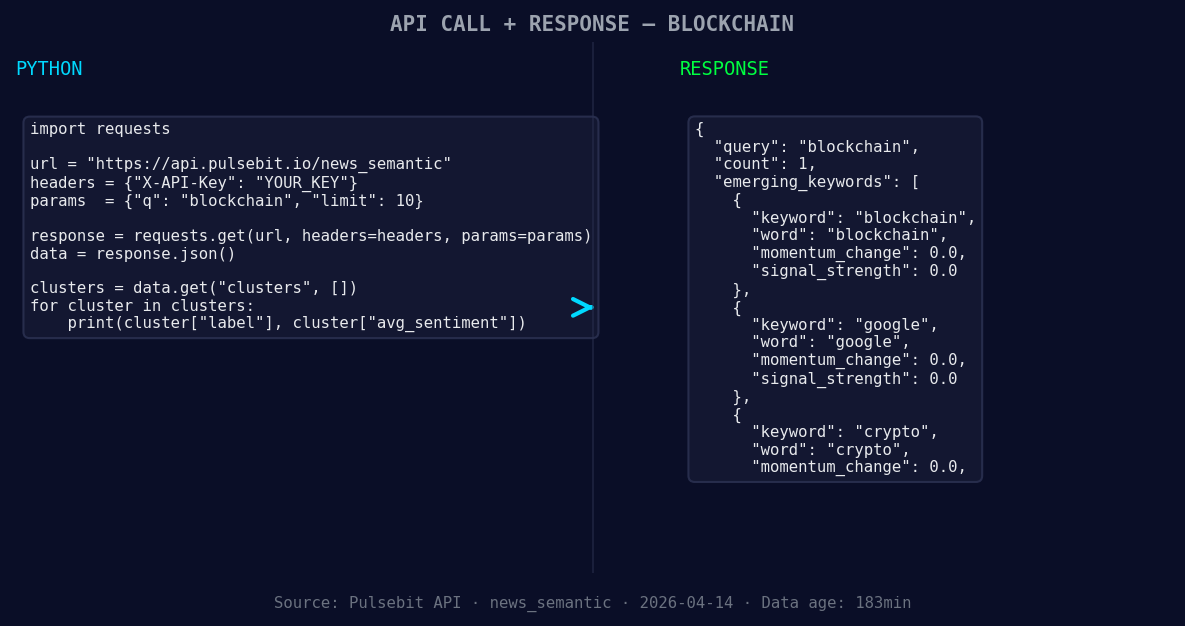
*Left: Python GET /news_semantic call for 'blockchain'. Right: returned JSON response structure (clusters: 3). Source: Pulsebit /news_semantic.*
response = requests.get(api_url, params=params)
data = response.json()
print(data)
Next, to score the narrative framing itself, we can run the cluster reason string through the sentiment scoring endpoint. This helps us understand how the news is being framed in the context of broader themes. Here’s how we would do that:
# Meta-sentiment moment
cluster_reason = "Clustered by shared themes: uses, blockchain, steal, everything, omnistealer."
meta_sentiment_response = requests.post(api_url + '/sentiment', json={"text": cluster_reason})
meta_sentiment_data = meta_sentiment_response.json()

print(meta_sentiment_data)
Using these two pieces of code, we can not only identify spikes but also understand their implications by analyzing the sentiment around the narratives.
Now, let’s discuss three specific builds you can implement with this newfound pattern. First, set a signal threshold for momentum spikes greater than +0.400, indicating a significant shift in sentiment. Next, establish a geo filter to focus specifically on English-language articles, ensuring you’re capturing the most relevant news. Lastly, leverage the meta-sentiment loop to assess how narratives are framed in relation to forming themes like blockchain, Google, and crypto, particularly against mainstream topics such as uses and theft.
By tracking these patterns, you can proactively adjust your strategies based on sentiment shifts in real-time.
If you want to dive into this, head over to our documentation at pulsebit.lojenterprise.com/docs. We’ve made it straightforward; you can copy-paste this code and run it in under 10 minutes to start catching these sentiment leads. Don't let 25.6 hours of lag hold you back from seizing the blockchain opportunity!


Top comments (0)