

Your model might be 26.0 hours behind when it comes to detecting cultural sentiment shifts. This time lag is particularly evident with a recent anomaly revealing a 24-hour momentum spike of +0.292 related to the topic of culture. What’s driving this sudden surge? The leading narrative is centered around "Amazon's AI Understanding of Culture," which ties directly to emerging themes in global technology and education. As developers, we need to recognize and act on these trends before they become mainstream.
The structural gap here is glaring. If your pipeline doesn't account for multilingual sources or the dominance of certain entities, you risk missing critical insights that can shape your models. You missed this by 26.0 hours, and while you were caught up in other signals, Amazon's narrative was quietly evolving. Ignoring these cultural shifts can result in delayed reactions to market conditions, which is a disadvantage we can’t afford.

English coverage led by 26.0 hours. No at T+26.0h. Confidence scores: English 0.85, Spanish 0.85, French 0.85 Source: Pulsebit /sentiment_by_lang.
To catch these momentum spikes, we can leverage our API effectively. Here’s how you can implement a solution in Python:
import requests
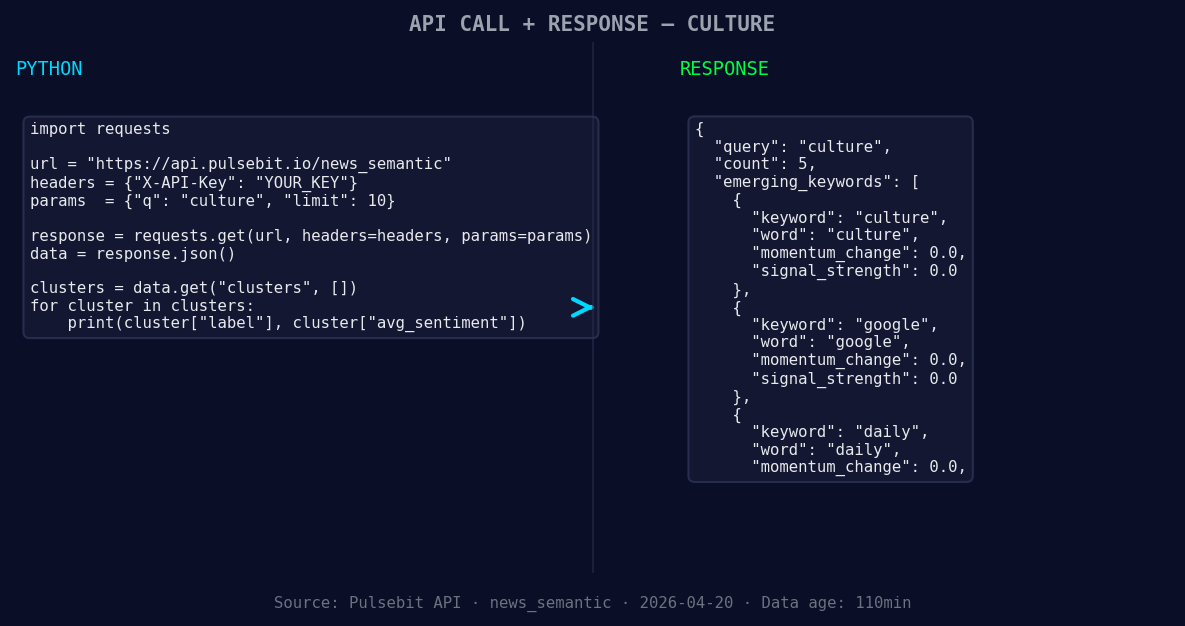
*Left: Python GET /news_semantic call for 'culture'. Right: returned JSON response structure (clusters: 3). Source: Pulsebit /news_semantic.*
# Define the parameters
topic = 'culture'
score = +0.700
confidence = 0.85
momentum = +0.292
# Make the geographic origin filter call
response = requests.get(
f"https://api.pulsebit.com/articles?topic={topic}&lang=en"
)
articles = response.json()
# Print the articles for debugging
print(articles)
# Prepare the meta-sentiment moment string
meta_sentiment_input = "Clustered by shared themes: amazon, global, alexa+:, how, teaching."
# Call the sentiment endpoint
sentiment_response = requests.post(
"https://api.pulsebit.com/sentiment",
json={"text": meta_sentiment_input}
)
sentiment_score = sentiment_response.json()
# Print sentiment score
print(sentiment_score)
In this code, we start by querying articles about "culture" with the language filter set to English. This ensures we’re only analyzing relevant content that aligns with our interests. Then, we take the reason string from our cluster analysis and run it through the sentiment endpoint to gauge the narrative framing itself. This dual approach not only identifies emerging trends but also contextualizes them in terms of sentiment, giving us a richer understanding of the landscape.
Now that we've established a method for capturing these insights, you might be wondering how to put this into practice. Here are three specific builds you can implement with this pattern:
- Cultural Sentiment Alert: Set a threshold for a momentum spike (e.g., +0.250) and automate alerts to notify you when articles exceed this threshold. Use the geographic filter to ensure relevance to your target audience.

Geographic detection output for culture. India leads with 3 articles and sentiment +0.27. Source: Pulsebit /news_recent geographic fields.
Meta-Sentiment Analysis Dashboard: Create a dashboard that visualizes the sentiment analysis of your clusters. Use the meta-sentiment loop to regularly feed new narratives into the system, allowing you to track how sentiment evolves over time. This is critical for understanding themes like culture (+0.00), as well as the formation of narratives around entities like Google (+0.00) and daily trends.
Trend Mapping Tool: Develop a tool that maps cultural trends against mainstream narratives. By pulling in data from various clusters, you can visualize how new themes evolve alongside established ones, ensuring you’re always ahead of the curve.
To dive deeper into these implementations, check out our documentation at pulsebit.lojenterprise.com/docs. You can copy-paste the code above and run it in under 10 minutes to start capturing these insights for your projects. Let’s not stay behind; let’s lead the conversation on culture and technology together.


Top comments (0)