

Your pipeline just missed a significant anomaly: a 24-hour momentum spike of +0.789 in the entertainment sector. This spike, coupled with the leading language being English with a lag of 8.0 hours, reveals a critical gap in how your model processes sentiment data. Specifically, if your pipeline doesn’t handle multilingual origins or recognize entity dominance, it could leave you blind to crucial shifts in sentiment, particularly around topics like "Taiwan’s Taroko Sports Expands to San Antonio." Your model missed this by a staggering 8 hours, and that’s a problem.

English coverage led by 8.0 hours. Nl at T+8.0h. Confidence scores: English 0.85, French 0.85, Spanish 0.85 Source: Pulsebit /sentiment_by_lang.
With this level of lag, you risk missing out on emerging narratives that can have a material impact on your strategy. The leading language indicates a strong English press influence, while the cluster story highlights the need to monitor how local developments can shift sentiment across different regions. Ignoring these factors means your sentiment analysis could be outdated, and that’s not a place you want to be in a fast-paced environment.
To catch this anomaly, we can use our API to retrieve the necessary data. Here’s how we can get started with Python:
import requests
# Define parameters for the API call
params = {
'topic': 'entertainment',
'lang': 'en',
'momentum': 0.789,
'score': 0.0,
'confidence': 0.85
}
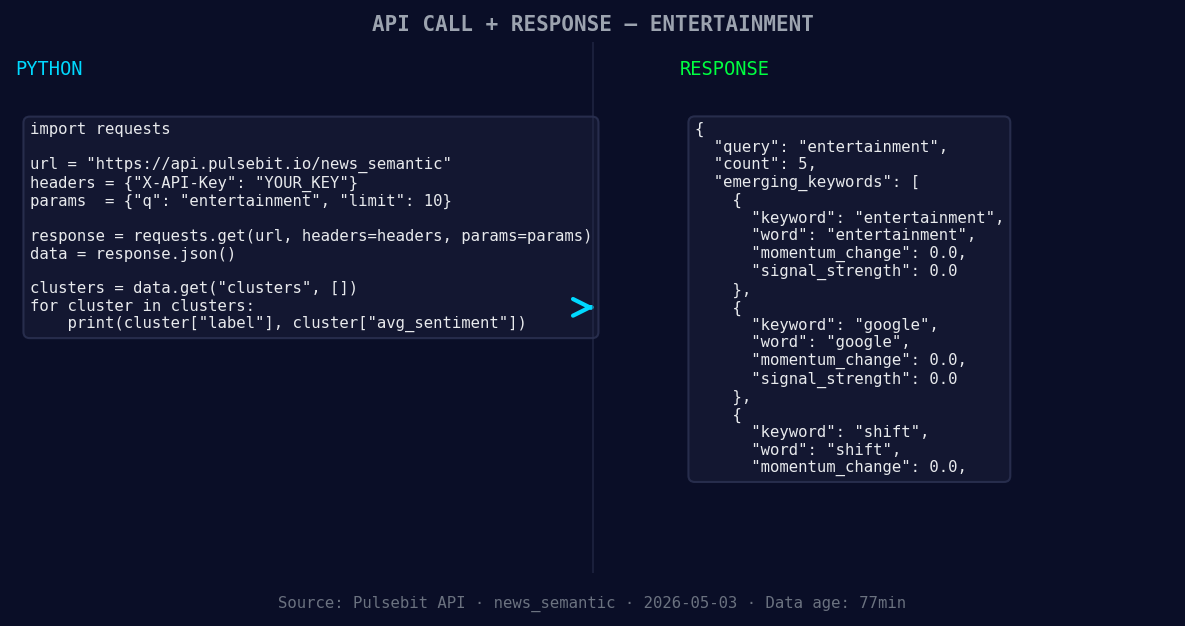
*Left: Python GET /news_semantic call for 'entertainment'. Right: returned JSON response structure (clusters: 3). Source: Pulsebit /news_semantic.*
# API call to fetch data
response = requests.get('https://pulsebit.lojenterprise.com/api/v1/sentiment', params=params)
data = response.json()
print(data)
This simple request fetches the latest sentiment data for the entertainment topic in English, allowing you to stay ahead. But we can go a step further by running the cluster reason string through our sentiment analysis to understand the narrative framing itself:
# Meta-sentiment analysis on the cluster reason
meta_sentiment_input = "Clustered by shared themes: san, antonio, taroko, sports, bringing."
meta_response = requests.post('https://pulsebit.lojenterprise.com/api/v1/sentiment', json={"text": meta_sentiment_input})
meta_data = meta_response.json()
print(meta_data)
This POST request allows us to dive deeper into the narrative around this anomaly. By examining the themes associated with “San Antonio” and “Taroko,” we can gain insights that inform our decision-making and strategy.
Now, let’s talk about three specific things you can build with this pattern.
- Geographic Origin Filter: Set a threshold to trigger alerts when sentiment in entertainment topics spikes by 0.5 or more, specifically for regions like San Antonio. Integrate the geo filter in your alerts system to ensure you never miss a local sentiment shift.

Geographic detection output for entertainment. Hong Kong leads with 4 articles and sentiment +0.24. Source: Pulsebit /news_recent geographic fields.
Meta-Sentiment Loop: Create a dashboard that showcases the sentiment scores of clustered narratives every hour. Use the results from the meta-sentiment analysis to visualize how themes evolve. For instance, track how sentiments around “entertainment” shift in contrast to mainstream topics like “San Antonio” and “Taroko.”
Forming Gap Insights: Establish a monitoring system to continuously analyze forming gaps in sentiment, focusing on keywords like “entertainment” and “shift." Use the data to inform content strategies, ensuring your outputs align with emerging trends.
Getting started with this approach is straightforward. You can check our documentation at pulsebit.lojenterprise.com/docs. You'll be able to copy, paste, and run these snippets in under 10 minutes, empowering you to catch sentiment shifts before your competitors do.


Top comments (0)