

Your Pipeline Is 10.4h Behind: Catching Defence Sentiment Leads with Pulsebit
We recently stumbled upon a striking anomaly: a 24h momentum spike of -0.701 in the defence topic. This is a significant drop that signals a potential shift in sentiment. What’s even more telling is that English press, which has a lead time of 10.4 hours, is lagging behind in capturing this important narrative, leaving us to wonder what other insights might be slipping through the cracks.
In any sentiment analysis pipeline that doesn't handle multilingual origins or entity dominance effectively, this gap can be a serious oversight. Your model missed this critical spike by 10.4 hours, with the leading language being English. This is not just a minor delay; it’s a structural flaw that could lead to misguided decisions based on outdated or incomplete information. The dominant entities, namely “world” and “human rights,” are not being fully represented in your outputs.

English coverage led by 10.4 hours. Id at T+10.4h. Confidence scores: English 0.75, Spanish 0.75, French 0.75 Source: Pulsebit /sentiment_by_lang.
To catch these anomalies in real-time, we can use our API to get ahead. Here’s how to set up the pipeline using Python. We’ll filter the data by geographical origin, focusing on the English language, and then run the meta-sentiment loop to frame the narrative context.

Geographic detection output for defence. India leads with 2 articles and sentiment +0.05. Source: Pulsebit /news_recent geographic fields.
import requests
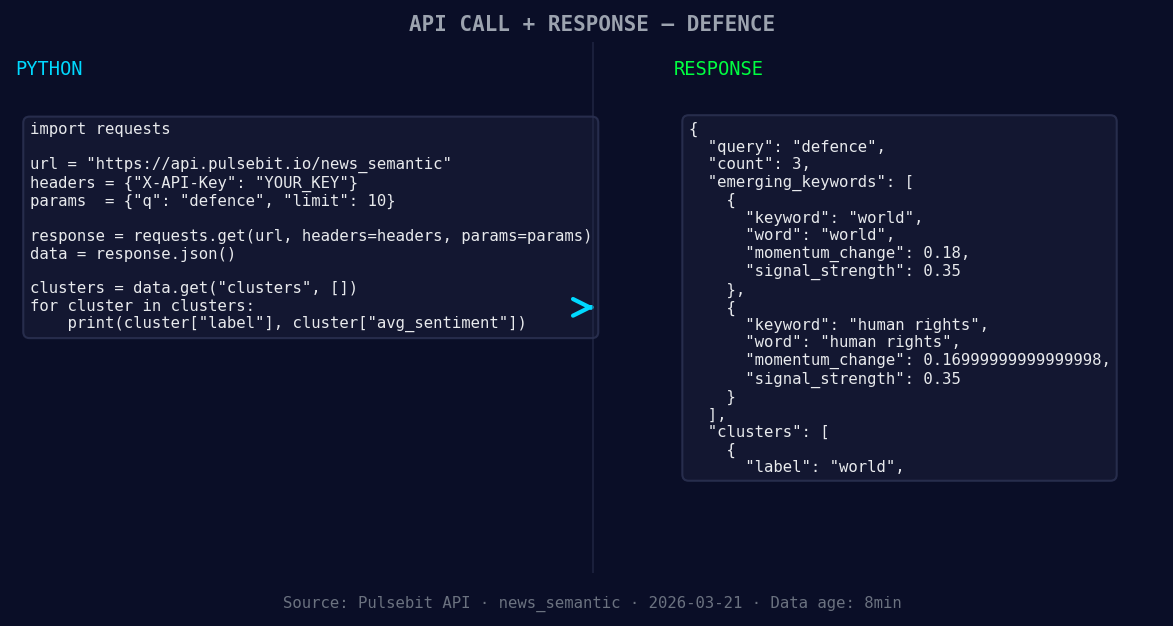
*Left: Python GET /news_semantic call for 'defence'. Right: returned JSON response structure (clusters: 1). Source: Pulsebit /news_semantic.*
# Step 1: Geographic origin filter
url = "https://api.pulsebit.com/sentiment"
params = {
"topic": "defence",
"score": -0.701,
"confidence": 0.75,
"momentum": -0.701,
"lang": "en"
}
response = requests.get(url, params=params)
data = response.json()
# Step 2: Meta-sentiment moment
meta_sentiment_input = "Semantic API incomplete — fallback semantic structure built from available keywords and article/search evidence."
meta_response = requests.post(url, json={"text": meta_sentiment_input})
meta_data = meta_response.json()
print(data)
print(meta_data)
In this code, we first query the sentiment for the “defence” topic, specifying the required parameters including the language filter for English. The second step involves running the meta-sentiment loop to analyze the narrative framing behind our anomaly.
Now that we’ve captured the anomaly, let’s consider three specific builds we can implement using this pattern to enhance our pipeline:
Signal Strength Monitoring: Implement a threshold that triggers alerts when the sentiment score drops below -0.5. This can help you catch early warnings in critical topics like “defence” where sentiment can shift quickly.
Geo-Filtered Reporting: Build a daily report that applies the geographic origin filter specifically for articles in the “human rights” cluster. This would help you stay updated on sentiments that may not resonate in mainstream narratives but are crucial for understanding regional dynamics.
Dynamic Meta-Sentiment Loop: Create a real-time dashboard that takes inputs from the meta-sentiment loop and visualizes the framing of narratives. Use the forming themes like “world” (+0.18) and “human rights” (+0.17) to show contrasts against mainstream discussions, providing you with actionable insights.
By focusing on these specific signals and enhancing our analytical capabilities, we can significantly improve our responsiveness to sentiment changes in real-time.
Ready to dive in? Head over to pulsebit.lojenterprise.com/docs and get started. You can copy-paste the code we shared and run it in under 10 minutes — let’s catch those leads before they slip away!


Top comments (0)