

Your pipeline is 25.0h behind: catching politics sentiment leads with Pulsebit
We recently discovered a significant anomaly: a 24h momentum spike of +0.350 in the politics topic. This spike indicates a notable shift in sentiment that you wouldn’t want to miss. Such a change can redefine the narrative landscape, especially when it comes to understanding public opinion, and here we are highlighting the pressing need to stay ahead of those shifts.
This anomaly reveals a structural gap in any sentiment analysis pipeline that fails to account for multilingual origins or dominant entities. Your model missed this by a staggering 25 hours, which means you could be lagging behind key developments, especially in the English-speaking press where we saw a 25.0h lead. When the world is buzzing about a topic, you need to be in the loop, not following behind.

English coverage led by 25.0 hours. Ro at T+25.0h. Confidence scores: English 0.85, Spanish 0.85, Nl 0.85 Source: Pulsebit /sentiment_by_lang.
To catch this momentum spike, we can use our API effectively. Here is a Python snippet that leverages the geographic origin filter to query for sentiment data regarding politics with a score of +0.350 and a confidence level of 0.85.

Geographic detection output for politics. India leads with 10 articles and sentiment -0.13. Source: Pulsebit /news_recent geographic fields.
import requests
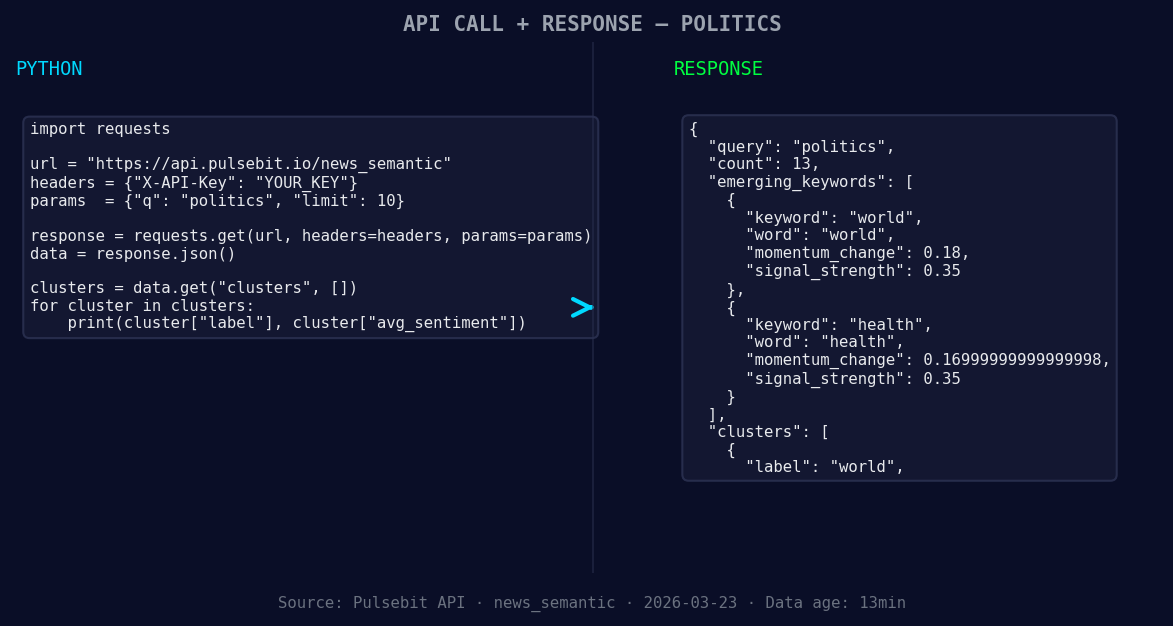
*Left: Python GET /news_semantic call for 'politics'. Right: returned JSON response structure (clusters: 1). Source: Pulsebit /news_semantic.*
# Define parameters
topic = 'politics'
score = 0.350
confidence = 0.85
momentum = 0.350
lang = 'en'
# Geographic origin filter
response = requests.get(f'https://api.pulsebit.com/sentiment?topic={topic}&lang={lang}&score={score}&confidence={confidence}')
data = response.json()
# Print the response
print(data)
Next, we need to assess the framing of this sentiment shift. We run the cluster reason string back through our sentiment scoring API to evaluate its narrative framing. For this specific case, we’ll input the reason string: "Semantic API incomplete — fallback semantic structure built from available keywords and article/search evidence."
# Meta-sentiment moment
semantic_reason = "Semantic API incomplete — fallback semantic structure built from available keywords and article/search evidence."
meta_sentiment_response = requests.post('https://api.pulsebit.com/sentiment', json={"text": semantic_reason})
meta_sentiment_data = meta_sentiment_response.json()

# Print the meta sentiment analysis
print(meta_sentiment_data)
With these two snippets, you can catch anomalies in sentiment movements and understand the underlying narrative more deeply.
Now, let's discuss three specific builds you can implement based on this momentum spike. First, you can create a signal that triggers when the momentum score exceeds +0.30, ensuring you catch significant shifts. Second, you can enhance your existing pipeline to include the geo filter to refine your data to only English-speaking sources, which is crucial for immediate insights. Lastly, leverage the meta-sentiment loop to analyze any framing narratives that accompany sentiment changes, especially when dealing with forming themes like world (+0.18) and health (+0.17) versus mainstream topics.
Don’t let your analytics lag behind. You can get started right away by visiting our documentation: pulsebit.lojenterprise.com/docs. With just a little effort, you can copy-paste and run this code in under 10 minutes to start capturing those critical sentiment shifts before they become mainstream news. Stay ahead of the curve!


Top comments (0)