

Your Pipeline Is 9.9h Behind: Catching Robotics Sentiment Leads with Pulsebit
We recently uncovered a fascinating anomaly: a 24h momentum spike of +0.635 in the robotics sector. This spike caught our attention, driven primarily by the English press, which was ahead by 9.9 hours, and it brings to light a critical gap in how sentiment data can be leveraged in our pipelines. One article stood out, highlighting "RoboSense Achieves First-Ever Quarterly Profit," emphasizing the potential that can be missed if we don’t adapt to the dynamics of multilingual sources.

English coverage led by 9.9 hours. No at T+9.9h. Confidence scores: English 0.85, Spanish 0.85, French 0.85 Source: Pulsebit /sentiment_by_lang.
Your model missed this by 9.9 hours. Imagine the insights you could have gained by catching this momentum earlier, especially when the leading language was English, and the dominant entity was RoboSense. If your pipeline doesn't account for this multilingual origin or the dominance of certain entities, you're essentially flying blind. This gap could lead to missed opportunities, especially in fast-moving sectors like robotics.
Here’s how we can catch this sentiment spike using a straightforward Python implementation. First, we need to filter the data by the dominant language, which is English in this case. Here’s the code to retrieve the relevant sentiment data:
import requests
# Set parameters for the API call
topic = 'robotics'
lang = 'en'
api_url = 'https://api.pulsebit.com/v1/sentiment'
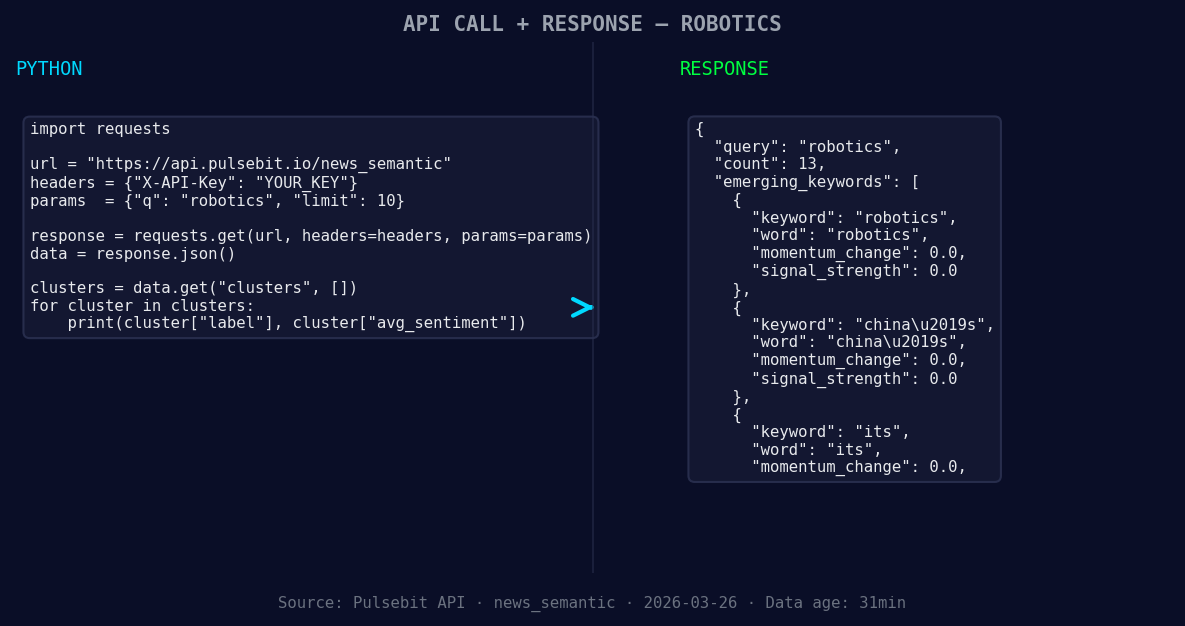
*Left: Python GET /news_semantic call for 'robotics'. Right: returned JSON response structure (clusters: 3). Source: Pulsebit /news_semantic.*
# Fetch the momentum spike data
response = requests.get(api_url, params={
'topic': topic,
'lang': lang
})
# Check if the response is successful
if response.status_code == 200:
data = response.json()
print(data)
else:
print(f"Error: {response.status_code}")
Next, we’ll run the cluster reason string through our meta-sentiment endpoint. This will help us score the narrative framing itself:
# Run the cluster reason string through the sentiment endpoint
cluster_reason = "Clustered by shared themes: its, robosense, expectations, first-ever, quarterly."
sentiment_response = requests.post(api_url, json={'text': cluster_reason})

if sentiment_response.status_code == 200:
    sentiment_data = sentiment_response.json()
    sentiment_score = sentiment_data['sentiment_score']
    print(f"Sentiment Score for Cluster Reason: {sentiment_score}")
else:
    print(f"Error: {sentiment_response.status_code}")
Now that we have the data, let's think about how we can build on this insight. We can create three specific builds leveraging this momentum spike:
Geo-Filtered Alert System: Set up a webhook that triggers alerts when sentiment scores exceed a threshold (e.g., +0.5) in regions where English is the dominant language. This allows us to catch spikes early, focusing on topics like robotics.
Meta-Sentiment Analysis Dashboard: Build a dashboard endpoint that visualizes the sentiment scores of narrative frames. Use the score from the cluster reason string to display how framing impacts sentiment, helping us understand the context better.
Clustering Patterns Tracker: Develop a routine to monitor and log emerging clusters over time, particularly those that include themes like "robotics" or "China’s." This will help us identify which topics are gaining traction and provide us with actionable insights.
These builds will not only close the gap we identified but also ensure we’re proactively engaging with evolving sentiment trends.
Ready to get started? Check out our API documentation at pulsebit.lojenterprise.com/docs. You'll be able to copy-paste and run this in under 10 minutes. Don't let your pipeline fall behind; seize the opportunity to catch these insights in real-time!

Geographic detection output for robotics. Hong Kong leads with 8 articles and sentiment +0.50. Source: Pulsebit /news_recent geographic fields.


Top comments (0)