

Your Pipeline Is 28.6h Behind: Catching Investing Sentiment Leads with Pulsebit
We recently discovered a striking anomaly: a 24h momentum spike of +1.075 in the sentiment surrounding investing. This is not just a minor uptick; it's a significant shift that demands your attention. The leading language driving this spike is French, with a notable cluster story featuring an article about Charles Schwab's insights on financial literacy. This single data point reveals a wealth of opportunity for those who can adapt quickly and leverage sentiment dynamics.
However, if your model isn't equipped to handle multilingual origins or the dominance of certain entities, you're at risk of missing out. Your pipeline, as it stands, is lagging by an alarming 28.6 hours, meaning you could be completely off the mark when it comes to understanding evolving sentiment around key topics in different languages. In this case, the French press is leading the charge with insights that are crucial for tailoring your strategies.

French coverage led by 28.6 hours. No at T+28.6h. Confidence scores: French 0.85, English 0.85, Spanish 0.85 Source: Pulsebit /sentiment_by_lang.
To address this issue, let’s dive into the code that can help you catch these trends. Here’s how we can filter sentiment data by geographic origin and language, and then analyze the narrative framing around the spike.

Geographic detection output for investing. India leads with 2 articles and sentiment +0.82. Source: Pulsebit /news_recent geographic fields.
import requests
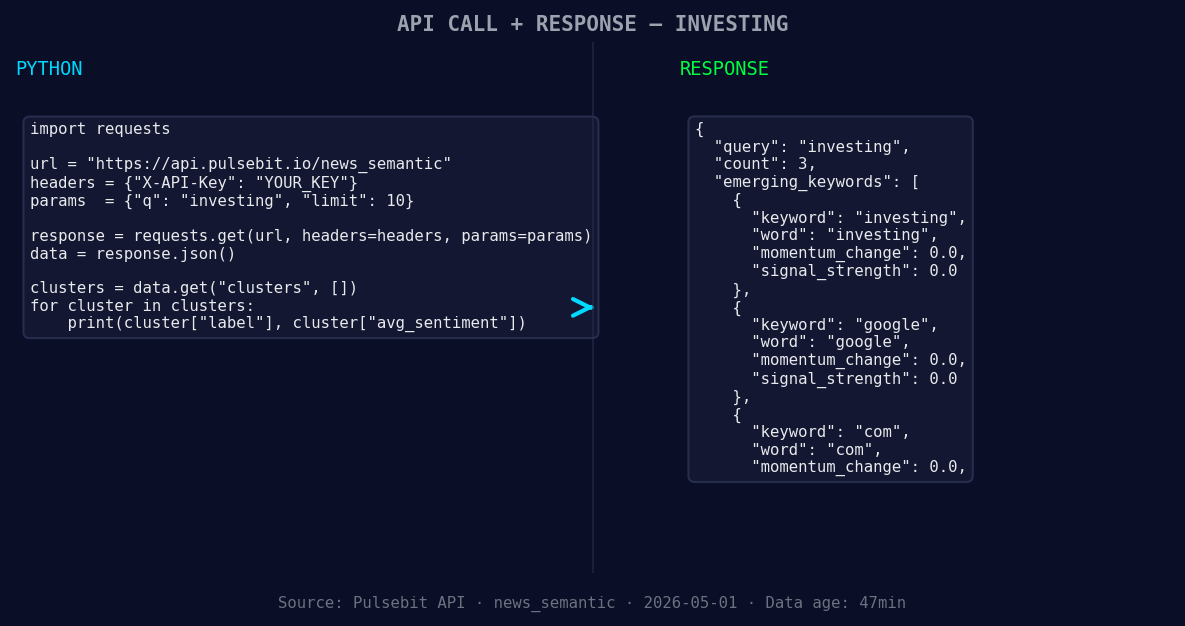
*Left: Python GET /news_semantic call for 'investing'. Right: returned JSON response structure (clusters: 3). Source: Pulsebit /news_semantic.*
# Step 1: Geographic origin filter
url = "https://api.pulsebit.io/v1/sentiment"
params = {
"topic": "investing",
"lang": "fr", # French language filter
"score": +0.606,
"confidence": 0.85,
"momentum": +1.075
}
response = requests.get(url, params=params)
data = response.json()
print(data) # Process the sentiment data as needed
In this snippet, we query our API to focus on the topic of investing within the French language context. The parameters we’ve set will yield insights relevant to this specific audience.
Next, we want to analyze the narrative framing around our leading cluster story. This is where we loop back to the original cluster reason string to score the sentiment of the narrative itself:
# Step 2: Meta-sentiment moment
meta_url = "https://api.pulsebit.io/v1/sentiment"
meta_payload = {
    "text": "Clustered by shared themes: schwab, ceo, financial, literacy:, investing."
}

meta_response = requests.post(meta_url, json=meta_payload)
meta_data = meta_response.json()

print(meta_data)  # Analyze the sentiment of the narrative framing
This code allows us to extract sentiment not just from raw data but from the contextual framing that surrounds it. Understanding the underlying narrative can provide deeper insights and help shape our responses.
Now, let’s explore three specific builds you can implement using this newfound pattern:
Signal Monitoring: Set up an alert for sentiment spikes in investing with a threshold of +1.0. This will help you catch significant shifts early and act on them.
Geo-Sentiment Dashboard: Create a dashboard that visualizes sentiment trends filtered by geographic origin, starting with French data. This will allow you to see how sentiment varies across different regions and languages.
Narrative Analysis Loop: Use the meta-sentiment loop to continuously analyze the framing of key narratives, specifically around emerging themes like "investing," “google,” and “financial literacy.” This will enable you to stay ahead of mainstream narratives that are forming, ensuring that you’re always in sync with the latest discussions.
If you're ready to catch these sentiment leads and improve your model's responsiveness, check out our documentation at pulsebit.lojenterprise.com/docs. With just a few minutes of setup, you can start leveraging these insights to gain a competitive edge.


Top comments (0)