

Your Pipeline Is 19.1h Behind: Catching Business Sentiment Leads with Pulsebit
We recently encountered an intriguing anomaly in our sentiment analysis: a 24h momentum spike of +0.625. This spike, driven primarily by English press coverage, indicates a surge in sentiment around business topics, particularly as the Australian Stock Exchange (ASX) is expected to drop following losses on Wall Street. With only one article contributing to this spike, it became clear that there's a significant shift in sentiment that warrants immediate attention.
But here’s the kicker: your model missed this by 19.1 hours. Yes, that’s right—19.1 hours behind the leading English narratives compared to Italian sources. If your pipeline isn't equipped to handle multilingual origins or entity dominance, you're effectively leaving valuable insights on the table.

English coverage led by 19.1 hours. Italian at T+19.1h. Confidence scores: English 0.85, French 0.85, Spanish 0.85 Source: Pulsebit /sentiment_by_lang.
To catch this momentum spike, we can leverage our API effectively. Below is how to implement the necessary steps in Python.
import requests
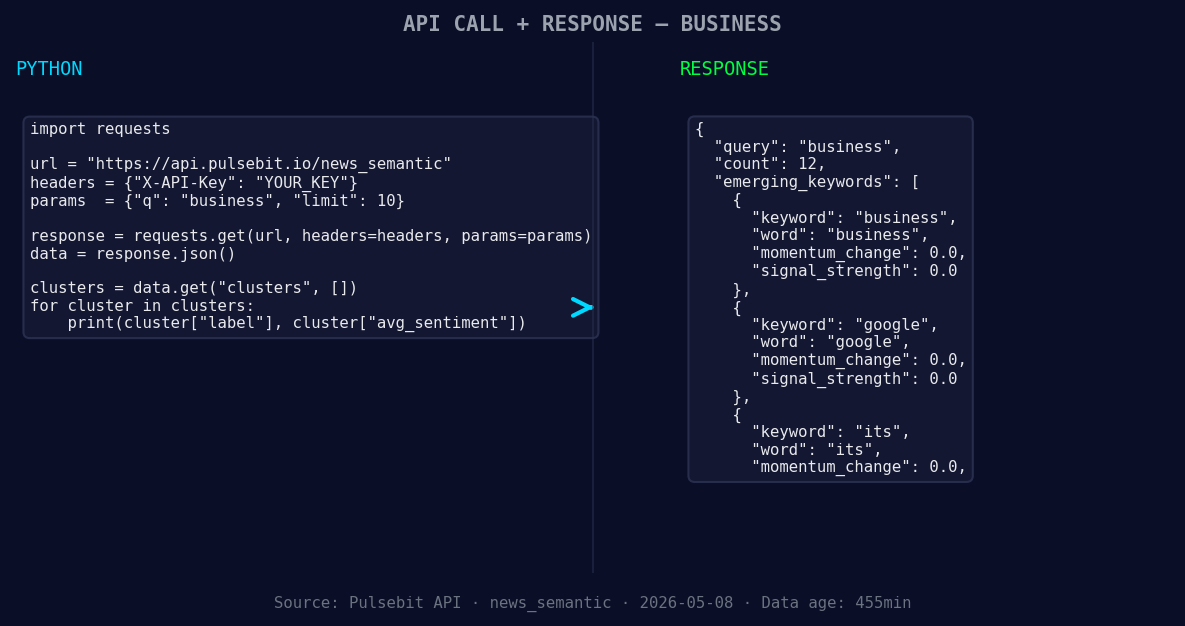
*Left: Python GET /news_semantic call for 'business'. Right: returned JSON response structure (clusters: 3). Source: Pulsebit /news_semantic.*
# Step 1: Geographic origin filter
query_params = {
"topic": "business",
"lang": "en",
"score": -0.600,
"confidence": 0.85,
"momentum": +0.625
}
response = requests.get("https://api.pulsebit.com/sentiment", params=query_params)
data = response.json()
# Step 2: Meta-sentiment moment
cluster_reason = "Clustered by shared themes: live:, asx, drop, following, losses."
meta_sentiment_response = requests.post("https://api.pulsebit.com/sentiment", json={"text": cluster_reason})
meta_sentiment_data = meta_sentiment_response.json()
print(meta_sentiment_data)
In the code snippet above, we first filter for business-related articles in English, capturing the recent spike in sentiment. Next, we analyze the cluster reason string to score the narrative framing itself, which can provide us with deeper insights into the underlying themes driving the sentiment changes.
Now that we've demonstrated how to capture this anomaly, let's explore three specific builds that can enhance your sentiment analysis pipeline.
- Signal with Geo Filter: Create a real-time alert system for business sentiment spikes. Set a threshold of +0.500 for momentum and use the geographic filter to focus on English content. This will allow you to catch emerging narratives before they gain traction across other languages.

Geographic detection output for business. India leads with 7 articles and sentiment +0.26. Source: Pulsebit /news_recent geographic fields.
Meta-Sentiment Loop: Implement a scoring mechanism for cluster narratives with a confidence threshold of 0.85. This will help you assess the reliability of the sentiment shifts based on clustered themes. For instance, if you get a negative sentiment score from the cluster reason like "live:, asx, drop," you can trigger a review process for potential investment decisions.
Theme Monitoring Dashboard: Construct a dashboard that visualizes forming themes. Use metrics like forming: business(+0.00), google(+0.00), its(+0.00) against mainstream signals like live:, asx, drop. This will help you visualize the sentiment landscape and make timely decisions based on emerging trends.
These builds will not only enhance your ability to catch sentiment shifts but also ensure that you're leveraging multilingual insights effectively.
If you're ready to get started, check out our documentation at pulsebit.lojenterprise.com/docs. You can copy-paste the code above and run it in under 10 minutes, bringing your sentiment analysis pipeline up to speed with real-time insights.


Top comments (0)