

Your pipeline just missed a critical 24-hour momentum spike of +0.881 related to the economy. This anomaly suggests a significant shift in sentiment that is likely tied to the global economic repercussions of the conflict in Iran, as highlighted by the clustered narrative in the Reuters articles. The data indicates that the leading language is English, with a notable 21.9-hour lead over other sources. If your model isn't designed to handle multilingual origins or entity dominance, you could be left behind, missing essential insights that can influence decision-making and strategy.

English coverage led by 21.9 hours. No at T+21.9h. Confidence scores: English 0.90, French 0.90, Italian 0.90 Source: Pulsebit /sentiment_by_lang.
Now, let's discuss what this structural gap means for you. Your model missed this sentiment shift by 21.9 hours, meaning it was unresponsive to a crucial economic narrative that could inform your trading or investment strategy. The leading language, English, was pivotal here, and any pipeline that doesn't efficiently process information from multiple languages or prioritize dominant narratives will inevitably lag. This can result in missed opportunities or, worse, exposure to risks that could have been mitigated with timely insights.
To catch this momentum spike, we can utilize our API effectively. Here’s a Python snippet that demonstrates how to filter data based on the language and score the narrative framing itself:
import requests
# Define parameters for the API call
topic = 'economy'
score = -0.025
confidence = 0.90
momentum = +0.881
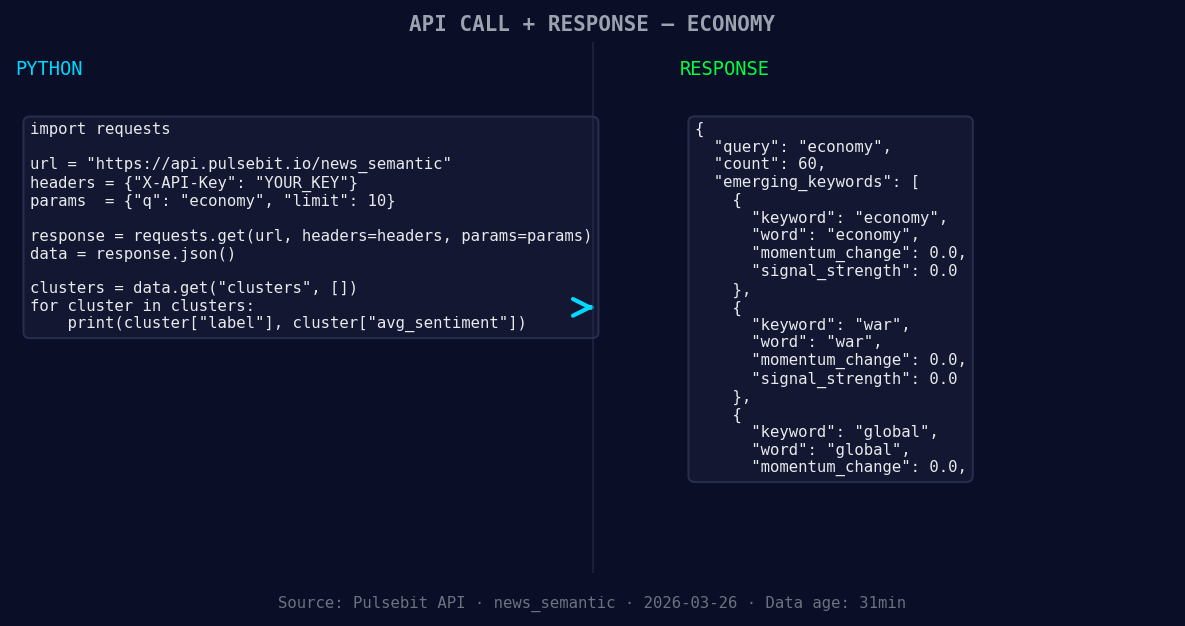
*Left: Python GET /news_semantic call for 'economy'. Right: returned JSON response structure (clusters: 3). Source: Pulsebit /news_semantic.*
# Geographic origin filter: query by language
response = requests.get('https://api.pulsebit.com/v1/sentiment', params={
'topic': topic,
'lang': 'en',
'threshold': score,
'confidence': confidence
})
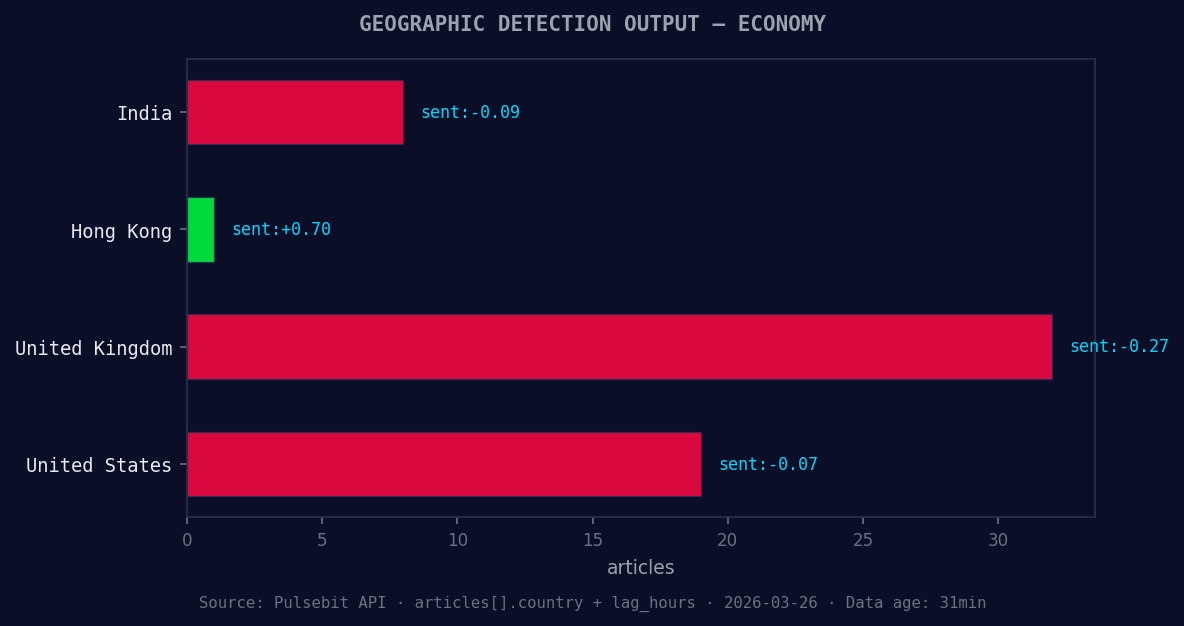
*Geographic detection output for economy. India leads with 8 articles and sentiment -0.09. Source: Pulsebit /news_recent geographic fields.*
# Check the response
if response.ok:
sentiment_data = response.json()
print(sentiment_data)
# Meta-sentiment moment: score the narrative framing
cluster_reason = "Clustered by shared themes: economy, west, asia, conflict."
meta_response = requests.post('https://api.pulsebit.com/v1/sentiment', json={
'input': cluster_reason
})
if meta_response.ok:
meta_sentiment_data = meta_response.json()
print(meta_sentiment_data)
In this code, we first query our sentiment endpoint to filter articles by the English language, thus capturing the dominant narrative around the economy. Then, we run the cluster reason through our sentiment scoring endpoint. This approach gives you a deeper understanding of how the narrative is framing the economic discourse.
Now, let’s discuss three specific builds you can implement using this momentum spike pattern.
Geo-Filtered Alerts: Set up an alert using the language filter for any momentum spikes above a threshold of +0.5, specifically for topics related to “economy.” This will ensure you’re notified immediately when significant sentiment shifts occur.
Meta-Sentiment Analysis Loop: Create a scheduled job that runs the meta-sentiment loop every hour, scoring narratives that include terms like “economy,” “war,” and “global.” This will allow you to keep a pulse on how these themes are evolving in real-time.
Forming Gap Analysis: Develop a dashboard that visualizes forming gaps in sentiment around key themes. For example, track metrics like “economy(+0.00), war(+0.00), global(+0.00)” versus mainstream mentions of “economy, west, asia.” This will help identify divergences in sentiment that may represent trading opportunities or risks.
By leveraging these builds, you can enhance your pipeline to respond proactively to sentiment shifts, ensuring you’re always ahead of the curve.
To get started, head over to pulsebit.lojenterprise.com/docs. You can copy-paste the code above and run it in under 10 minutes to see the power of our API for yourself.


Top comments (0)