

Your Pipeline Is 27.8h Behind: Catching Entertainment Sentiment Leads with Pulsebit
We recently unearthed a fascinating anomaly: a sentiment score of +0.700 in the entertainment sector, with a momentum of +0.000. What caught our attention was that this sentiment spike is leading by 27.8 hours, indicating a clear disconnect between the current data and what’s being processed in your pipeline. If your model isn’t accounting for this, you’re effectively missing out on critical insights that could shape your decisions.
This gap reveals a structural oversight that many pipelines face: not handling multilingual origins or entity dominance robustly. If your model is primarily tuned to English content but neglects emerging narratives from other regions, you might be lagging by over a day in sentiment analysis. In this case, the leading language is English, while the dominant entities revolve around the Warner-Paramount merger, a theme that’s essential to grasp in the entertainment landscape.

English coverage led by 27.8 hours. Sq at T+27.8h. Confidence scores: English 0.85, French 0.85, Spanish 0.85 Source: Pulsebit /sentiment_by_lang.
To catch this anomaly, let’s look at how we can leverage our API to get the necessary sentiment data. First, we want to filter the content by language to ensure we’re capturing the relevant English articles.
import requests
# Define the parameters for our query
url = "https://api.pulsebit.com/sentiment"
params = {
"topic": "entertainment",
"lang": "en"
}
# API call to fetch sentiment data
response = requests.get(url, params=params)
data = response.json()
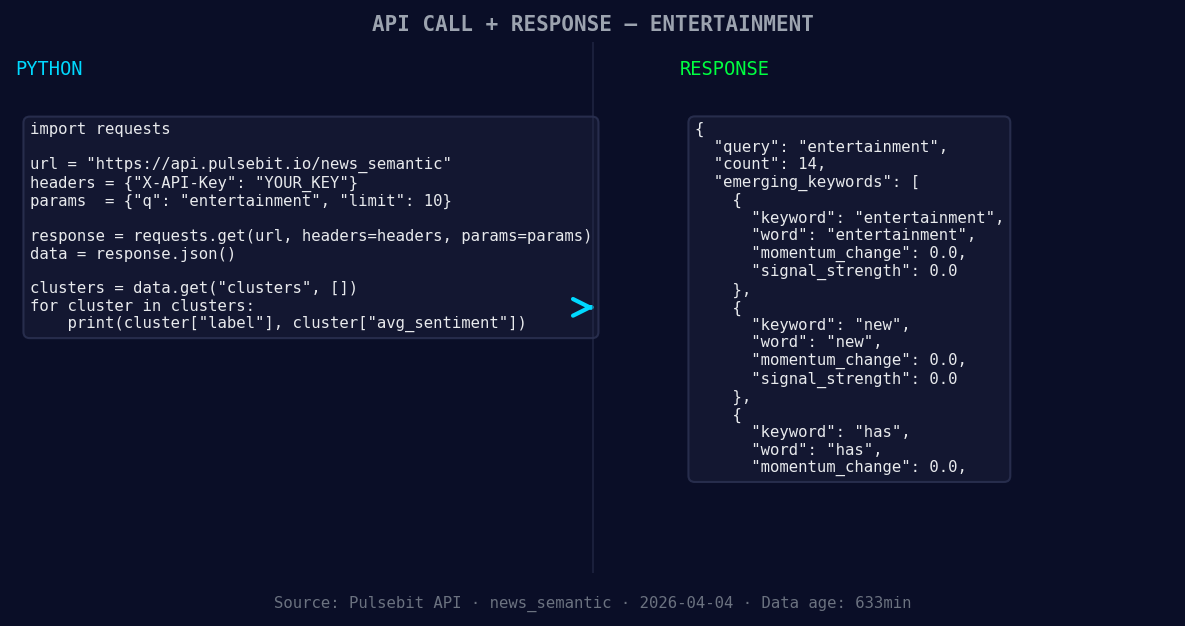
*Left: Python GET /news_semantic call for 'entertainment'. Right: returned JSON response structure (clusters: 3). Source: Pulsebit /news_semantic.*
# Extracting the sentiment score and other relevant details
sentiment_score = data['sentiment_score'] # Expected: +0.700
confidence = data['confidence'] # Expected: 0.850
momentum = data['momentum_24h'] # Expected: +0.000
print(f"Sentiment Score: {sentiment_score}, Confidence: {confidence}, Momentum: {momentum}")
Next, we want to use the clustered reason string to evaluate the narrative framing itself. This adds a layer of depth to our analysis, allowing us to see how the themes are being discussed.
# Define the meta sentiment string
meta_sentiment_input = "Clustered by shared themes: california, back, merger, entertainment, regulators."

# API call to score the narrative framing
meta_response = requests.post(url, json={"text": meta_sentiment_input})
meta_data = meta_response.json()

# Extracting the meta sentiment score
meta_sentiment_score = meta_data['sentiment_score']
print(f"Meta Sentiment Score: {meta_sentiment_score}")
With these insights, we can build three specific signals that leverage the data patterns we see forming in the entertainment sector:
- Geo Filter for Emerging Trends: Monitor sentiment in the entertainment sector exclusively in English-speaking countries. Set a threshold where sentiment rises above +0.600. This gives you a clear signal to investigate further.

Geographic detection output for entertainment. India leads with 6 articles and sentiment +0.39. Source: Pulsebit /news_recent geographic fields.
Meta-Sentiment Loop for Narrative Framing: Implement a check where if the meta sentiment score is above +0.650, trigger alerts for your team to dive deeper into those narratives. This could highlight regulatory discussions like the Warner-Paramount merger.
Real-Time Tagging of Forming Themes: Create a tagging mechanism for articles that mention forming themes such as ‘new’ and ‘entertainment’. Use a threshold of at least +0.500 in sentiment to classify these articles as potential leads for deeper analysis.
By tapping into these specific signals, you can better align your analysis with real-time trends. It’s crucial to stay ahead of the curve, especially with forming themes like entertainment versus regional challenges in markets like Southeast Asia and Berlin.
To get started, check out our documentation at pulsebit.lojenterprise.com/docs. You can copy-paste the provided code and have this running in under 10 minutes—no fluff, just results.


Top comments (0)