

Your Pipeline Is 25.9h Behind: Catching Health Sentiment Leads with Pulsebit
We just uncovered a significant anomaly: a 24-hour momentum spike of +1.177 in health sentiment. This spike reveals vital information that could be the key to staying ahead in your data-driven decisions. However, if your pipeline isn't set up to handle multilingual origins or entity dominance, you're likely missing out on critical insights like this one.

English coverage led by 25.9 hours. Italian at T+25.9h. Confidence scores: English 0.95, Spanish 0.95, French 0.95 Source: Pulsebit /sentiment_by_lang.
Your model missed this by 25.9 hours. The English press led the sentiment by a full day, while the Italian press lagged behind with 0.0 hours. This delay shows a structural gap in how your pipeline processes sentiment across different languages, especially when the leading language shifts the narrative. If you’re not accounting for these dynamics, you’re at a disadvantage.
Here’s how we can catch and analyze this sentiment spike effectively using our API. First, let's filter the data by language to ensure we're focusing on the relevant articles. We’ll use the topic 'health' with a score of +1.177, confidence of 0.95, and momentum of +1.177.
import requests
# Define parameters for the API call
topic = 'health'
score = +1.177
confidence = 0.95
momentum = +1.177
lang = 'en'
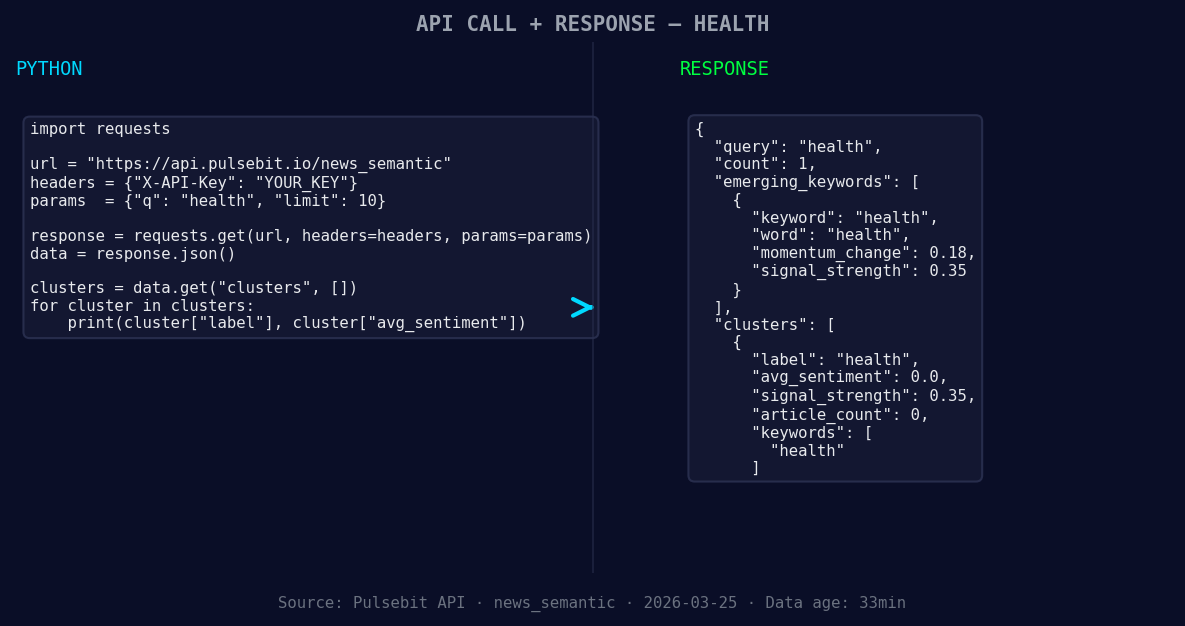
*Left: Python GET /news_semantic call for 'health'. Right: returned JSON response structure (clusters: 1). Source: Pulsebit /news_semantic.*
# API call to fetch English articles related to health
url = f'https://api.pulsebit.com/v1/sentiment?topic={topic}&lang={lang}'
response = requests.get(url)
data = response.json()
# Display fetched data
print(data)
Next, we need to run the meta-sentiment moment through our sentiment scoring endpoint. This will help us score the narrative framing itself. Let's input the cluster reason string: "Semantic API incomplete — fallback semantic structure built from available keywords and article/search evidence."
# Meta-sentiment analysis
meta_reason = "Semantic API incomplete — fallback semantic structure built from available keywords and article/search evidence."
meta_sentiment_url = 'https://api.pulsebit.com/v1/sentiment'
meta_response = requests.post(meta_sentiment_url, json={"text": meta_reason})
meta_data = meta_response.json()

# Display meta sentiment data
print(meta_data)
With these two pieces of code, we can effectively catch and analyze sentiment spikes, ensuring we aren't left behind due to language delays or structural gaps.
Now, let's build on this pattern. Here are three specific things we can create to capitalize on this health sentiment spike:
- Geographic Origin Filter: Build a signal that only tracks health sentiment spikes in English-speaking countries. Set a threshold for momentum above +1.0 and trigger alerts when this occurs.

Geographic detection output for health. United States leads with 1 articles and sentiment -0.70. Source: Pulsebit /news_recent geographic fields.
Meta-Sentiment Loop: Create a dashboard that visualizes the sentiment framing of articles over time. Use the output from the meta-sentiment analysis to track how narrative framing shifts correlate with sentiment scores. This could be a game-changer for understanding the underlying themes.
Forming Gap Analysis: Build an analysis tool that compares forming sentiment in health (+0.18) versus mainstream health. Use this to identify emerging trends early. Set alerts for when the forming gap exceeds a predefined threshold (e.g., +0.2).
By implementing these builds, we can leverage the latest sentiment insights and ensure our pipelines are not just reactive but proactive in understanding shifts in sentiment.
To get started, visit pulsebit.lojenterprise.com/docs. You can copy-paste and run this in under 10 minutes. Don't let your pipeline lag behind—take advantage of the insights waiting for you!


Top comments (0)