

Your pipeline just missed a 24h momentum spike of -0.244 in the fashion domain, which is significant. This anomaly indicates a notable shift in sentiment, yet it seems like your model was lagging by 26.2 hours. The leading language here is English, with a cluster story revolving around the San Antonio fashion scene, specifically capturing the essence of a local event. If you're not capturing these shifts, you're missing out on vital insights that could inform your strategies.
This gap reveals a crucial flaw in your pipeline if it doesn't account for multilingual origins or the dominance of certain entities in your data. In this case, the dominant narrative revolves around the San Antonio fashion show, and if your model missed it by 26.2 hours, it could mean you're not adequately harnessing the power of local sentiment. The implications of this oversight can affect everything from targeted marketing to inventory decisions.

English coverage led by 26.2 hours. Id at T+26.2h. Confidence scores: English 0.90, French 0.90, Spanish 0.90 Source: Pulsebit /sentiment_by_lang.
To catch these types of anomalies, we can leverage our API effectively. Here’s a Python snippet that captures this momentum shift:
import requests
# Define parameters for the API call
params = {
'topic': 'fashion',
'lang': 'en', # Geographic origin filter
'momentum': -0.244,
'score': -0.700,
'confidence': 0.90
}
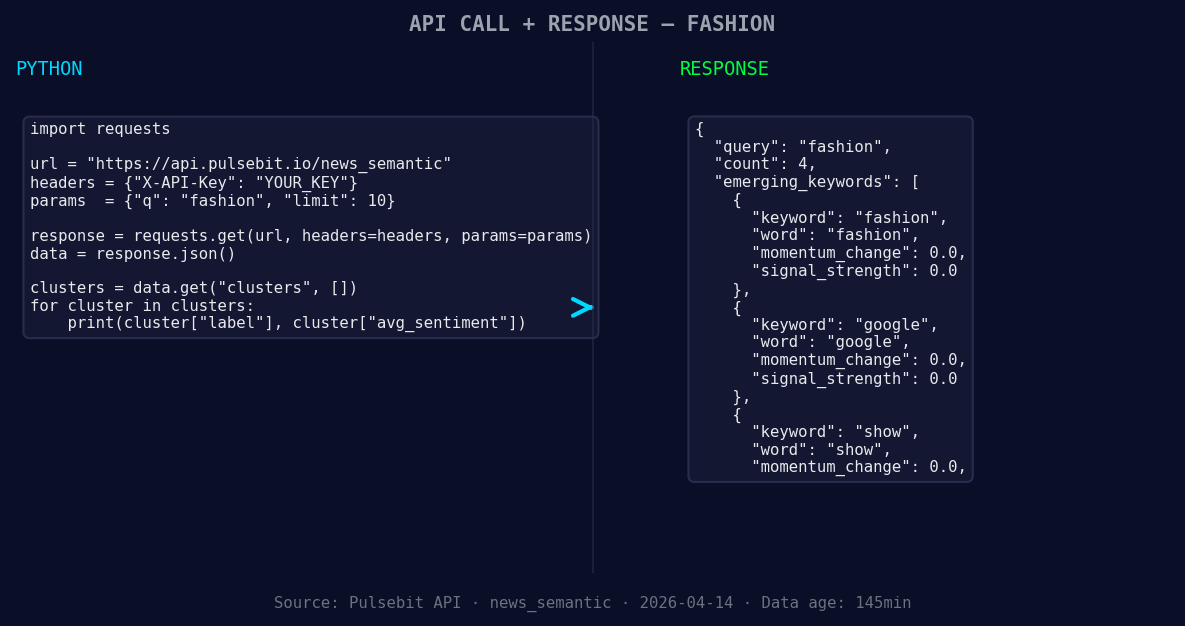
*Left: Python GET /news_semantic call for 'fashion'. Right: returned JSON response structure (clusters: 3). Source: Pulsebit /news_semantic.*
# Make the API call to fetch relevant articles
response = requests.get('https://api.pulsebit.com/v1/articles', params=params)
articles = response.json()
# Process the cluster reason for sentiment analysis
cluster_reason = "Clustered by shared themes: photos:, san, antonio, designers, showcase."
sentiment_response = requests.post('https://api.pulsebit.com/v1/sentiment', json={'text': cluster_reason})
sentiment_score = sentiment_response.json()
print(f"Articles: {articles}")
print(f"Sentiment Analysis: {sentiment_score}")
In this code, we first filter the articles based on the topic 'fashion' and specify the language as English. The results are processed to include the sentiment score of the narrative framing itself. This dual approach allows us to not only catch the spike but also understand the underlying sentiment of the clustered narratives.
Here are three builds inspired by this discovery:
Geo-Filtered Trend Analysis: Create a routine that monitors English-language articles for fashion-related sentiment spikes, setting a threshold of -0.244 or lower. This way, you can catch significant drops in sentiment before they affect your decisions.
Meta-Sentiment Loop: Develop a function that runs the cluster reason string through our sentiment API, capturing the sentiment of the entire narrative. This can be set to trigger alerts when sentiment dips below -0.700, enabling your team to react promptly.
Cluster Story Relevance: Design a dashboard that visualizes forming themes with markers for sentiment shifts. For instance, track ‘fashion’, ‘google’, and ‘show’ as forming positive trends against mainstream narratives like ‘photos’, ‘san’, and ‘antonio’. This could provide valuable insights for content creation and marketing strategies.
To dive deeper, check out our documentation at pulsebit.lojenterprise.com/docs. With just a few lines of code, you can start leveraging this powerful data in under 10 minutes. Don’t let your pipeline lag behind; catch those trends before they shape your narratives!


Top comments (0)