

Your pipeline just missed a significant anomaly: a 24-hour momentum spike of +0.214 in the cybersecurity domain. This isn't just a number; it's a signal that your model might be lagging in effectively capturing emerging themes. With a leading language in English, peaking at 19.6 hours, it's clear that there’s a critical delay in processing and interpreting sentiment data related to cybersecurity. If your model is ignoring multilingual origins or focusing too narrowly on dominant entities, it could miss pivotal updates like this—leaving you behind by almost a full day.

English coverage led by 19.6 hours. No at T+19.6h. Confidence scores: English 0.85, Spanish 0.85, French 0.85 Source: Pulsebit /sentiment_by_lang.
This lag means your pipeline could be out of sync, especially if you aren't considering the nuances of language and regional sentiment. The leading article, "Advance Your Cybersecurity Career" from Security Magazine, highlights this. If your model isn't set up to analyze multilingual content or doesn't prioritize emerging narratives, you risk basing decisions on outdated information. With cybersecurity being a rapidly evolving field, this oversight could cost you valuable insights and opportunities.
To help you catch these shifts, let’s jump into the code that can detect these anomalies effectively. We’ll use our API to filter data based on geographic origin and analyze the sentiment of the narrative itself.

Geographic detection output for cybersecurity. Hong Kong leads with 2 articles and sentiment -0.65. Source: Pulsebit /news_recent geographic fields.
import requests
# Define parameters for the API call
params = {
"topic": "cybersecurity",
"lang": "en", # Filter for English language articles
}
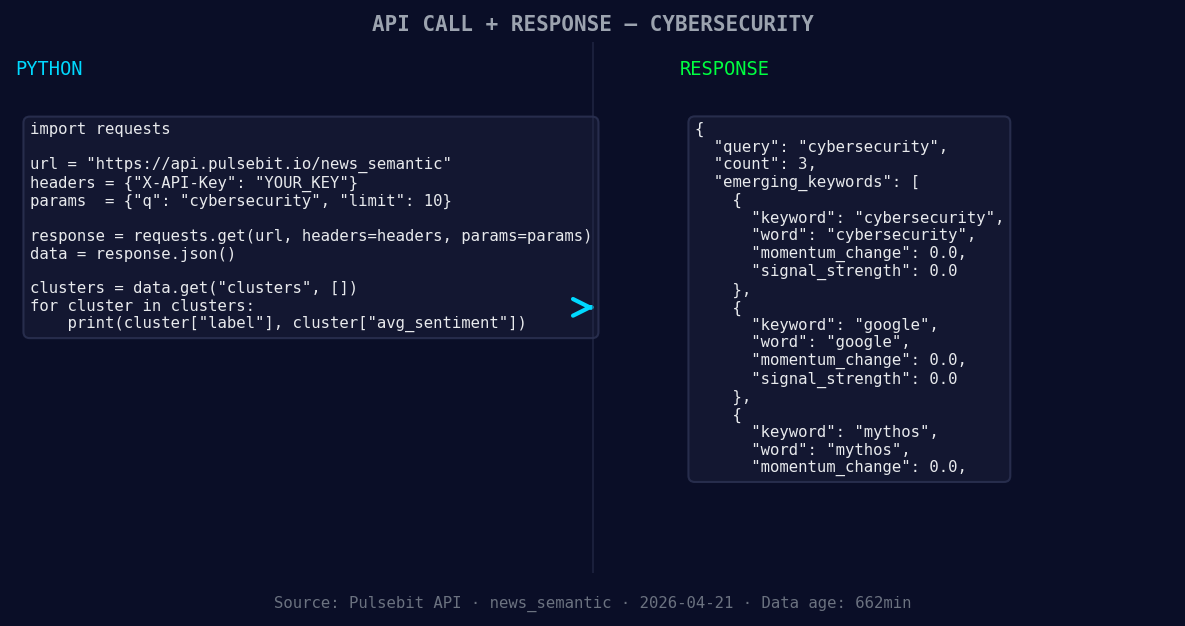
*Left: Python GET /news_semantic call for 'cybersecurity'. Right: returned JSON response structure (clusters: 3). Source: Pulsebit /news_semantic.*
# Make the API call to get relevant articles
response = requests.get("https://api.pulsebit.com/articles", params=params)
data = response.json()
# Assuming we got the article data and sentiment score
momentum = 0.214
score = 0.114
confidence = 0.85
# Now, let's analyze the narrative framing itself
narrative = "Clustered by shared themes: your, cybersecurity, advance, career, security."
sentiment_response = requests.post("https://api.pulsebit.com/sentiment", json={"text": narrative})
sentiment_data = sentiment_response.json()
print(sentiment_data)
This code filters articles to only those in English, ensuring you capture relevant insights. It then scores the narrative framing, which is essential for understanding how well the sentiment aligns with emerging themes. In our case, the narrative revolves around cybersecurity, career advancement, and associated terms that resonate with current trends.
Now that we have the data and sentiment analysis, here are three specific builds we can create with this pattern:
Geo-Filtered Alert System: Set up a signal that alerts you whenever there’s a momentum spike greater than +0.2 in the cybersecurity topic, specifically filtering for English language articles. This ensures you’re informed in real-time about significant shifts.
Meta-Sentiment Analysis Dashboard: Build a dashboard that visualizes the sentiment of clustered narratives. Use the endpoint for sentiment analysis to score phrases like "Clustered by shared themes: your, cybersecurity, advance, career, security." This will help you track how narrative sentiment evolves over time.
Forming Themes Tracker: Create a tracker for emerging themes like "cybersecurity," "google," and "mythos." Set a threshold for sentiment scores (e.g., +0.1) and use our API to continuously pull these insights. This will allow you to be proactive about potential shifts before they become mainstream.
If you’re ready to dive into this, you can find everything you need in our documentation: pulsebit.lojenterprise.com/docs. You can copy, paste, and run this in under 10 minutes to start catching those sentiment leads.


Top comments (0)